Is It an ADHD Thing That You Stay Completely Calm in a Real Crisis but Fall Apart Trying to Find Your Keys?

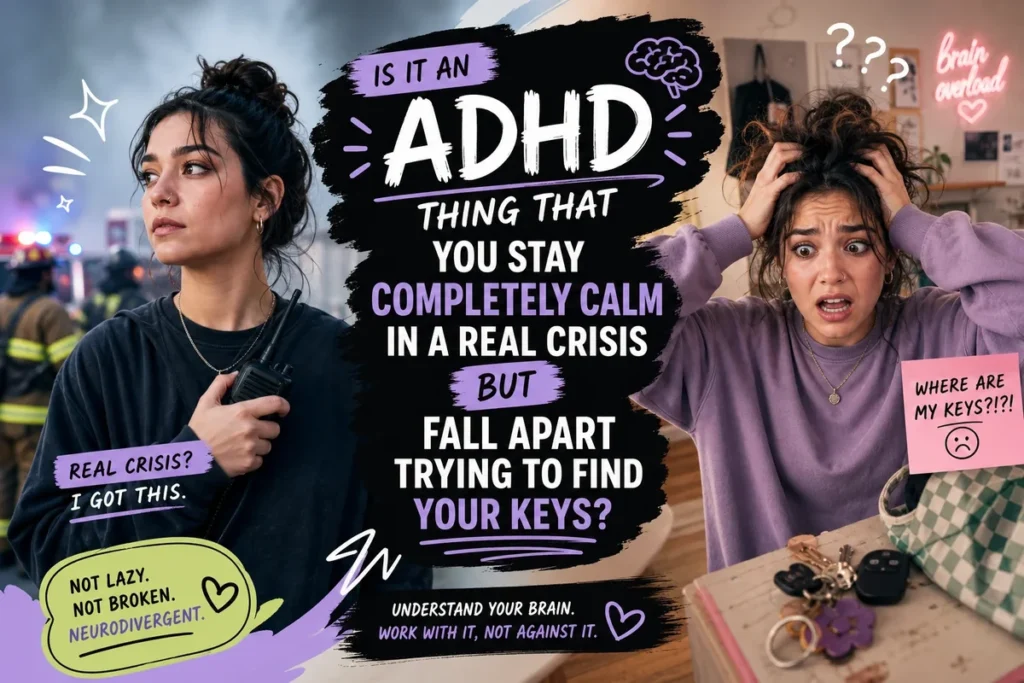
A fire starts in the kitchen, and you move with startling clarity. You grab the extinguisher, aim at the base of the flames, sweep back and forth, and the fire is out before you've even registered fear. Your hands are steady. Your voice is calm. You know exactly what to do and you do it. Then, forty-five minutes later, you spend twenty minutes tearing apart your apartment looking for your keys, which are in your hand. The terror you feel about being late to a dentist appointment exceeds anything you felt while staring at actual flames. You cannot explain this to anyone. You cannot explain it to yourself.
Yes, this is absolutely an ADHD thing. It has a name: the interest-based nervous system. Your brain does not activate based on importance, logic, or consequences. It activates based on urgency, novelty, interest, and challenge. A genuine emergency provides all four in abundance. A dental appointment provides none. This is not a character flaw, a trauma response, or evidence that you secretly enjoy chaos. This is the fundamental architecture of how your dopamine system decides what gets fuel and what gets left stranded.
The ADHD Emergency Calm Response Is Not a Paradox
To everyone else, your behaviour looks backwards. They see someone who panics about forgetting to email a colleague but remains eerily composed when a car runs a red light in front of them. They assume you are exaggerating your daily struggles or downplaying your crisis responses. Neither is true.
The neurotypical brain uses importance-based motivation. If something matters, it gets attention and energy. If something matters a lot, it gets priority. The system is logical, proportional, predictable. The ADHD brain does not work this way. Research into executive function and ADHD shows that the prefrontal cortex, responsible for prioritizing and initiating tasks, requires adequate dopamine to function. In ADHD, baseline dopamine is often insufficient for routine activation. The brain sits in a kind of waiting mode, unable to engage even when you desperately want to.
But emergencies change the equation entirely. Genuine threat triggers a massive neurochemical response. Adrenaline and norepinephrine flood the system. Dopamine surges. Suddenly, the ADHD brain has everything it needs to operate at full capacity. The very same brain that could not locate its keys five minutes ago can now assess a crisis, make split-second decisions, and execute a complex sequence of actions with precision.
Why Life Feels Simpler When Your Only Job Is to Survive
There is a specific relief that comes with crisis. Everything narrows. The endless menu of things you should be doing, could be doing, might have forgotten to do collapses into one clear imperative: handle this. Now. The cognitive load of daily life, with its thousand small decisions and competing priorities, simply vanishes.
As if life became simpler, once my only job was to survive.
This is not romanticism. This is neurology. The ADHD brain struggles profoundly with what researchers call task selection: choosing which of many possible actions to initiate. When everything feels equally urgent (or equally not urgent), the brain often chooses nothing, producing the paralysis you know intimately. An emergency eliminates task selection entirely. There is only one task. There is only now. The very thing that makes ADHD daily life so exhausting, the constant decision-making about what to do next, disappears.
People with ADHD often report that they functioned best during objectively difficult periods: deployment, disaster relief, medical emergencies, even chaotic work environments. The external structure and urgency did what their internal systems could not. This is not because they are thrill-seekers or incapable of peace. It is because their nervous system finally had the input it needed to perform.
ADHD Adrenaline Focus Is Real, But It Has Limits
The crisis-clarity experience is so powerful that some people with ADHD unconsciously structure their lives to recreate it. They procrastinate until deadlines become emergencies. They thrive in high-pressure jobs where urgency is constant. They find themselves volunteering for roles that would stress out most people, because stress is the only reliable activator they have found.
This works, up to a point. The ADHD emergency calm response is genuine and can be harnessed strategically. But it comes with costs. Chronic adrenaline exposure takes a physical toll. You cannot maintain crisis-mode indefinitely without burning out. The strategy of manufacturing emergencies also tends to alienate people who do not understand why you left everything to the last minute again.
The hidden cost: When you rely on crisis to function, ordinary life feels increasingly intolerable. The gap between how capable you feel in emergencies and how incapable you feel doing dishes grows wider. This is not laziness. This is a nervous system calibrated for threat that receives no signal from normalcy.
Understanding that ADHD adrenaline focus is a feature of your neurology, not evidence that you could focus all the time if you just cared more, is essential. You are not pretending to struggle with daily tasks. You are not exaggerating your difficulties. The same brain that saved a life or handled a disaster genuinely cannot initiate the action of putting laundry away, because the laundry provides no urgency signal at all.
Why Standard Advice Makes This Worse
The usual productivity advice assumes an importance-based motivational system. "Break tasks into smaller steps." "Remember your why." "Think about the consequences of not doing it." None of this helps when your brain does not respond to importance, purpose, or consequences. You already know the laundry matters. You already know the consequences of not paying the bill. Knowing has never been the problem.
Advice designed for neurotypical brains can actually increase ADHD suffering by adding a layer of shame. If the solution is supposed to be "just think about how important it is," and thinking about importance does not help, the implied conclusion is that you do not care enough. This is false, and it is painful.
People who experience the ADHD emergency calm response often carry a particular kind of self-doubt. If I can handle actual disasters, they think, why can't I handle returning a library book? The answer is that these are not different amounts of the same resource. They are completely different neurological scenarios. The disaster gives you something. The library book gives you nothing.
Working With Your Interest-Based System
Once you understand that your brain activates based on urgency, novelty, interest, and challenge rather than importance, you can start to work with your system instead of against it.
Urgency can be created artificially. Body doubling, where you work alongside someone else who expects you to be working, creates mild social urgency. Timers create time pressure. Public commitments create accountability urgency. None of these are as powerful as a genuine emergency, but they can provide enough signal to initiate action.
Novelty keeps your brain engaged. Doing the same task in a different location, at a different time, or with a different method can provide the novelty hit that allows you to actually start. This is why you can clean the entire kitchen if a friend is coming over but not if it is just Tuesday.
Interest cannot be manufactured, but it can be added. Listening to a podcast while doing chores, gamifying tasks with apps, or pairing boring activities with something you actually enjoy can smuggle interest into tasks that inherently have none.
Challenge is underrated. Sometimes making a task harder makes it easier to do, because challenge engages the brain in a way that simple tasks do not. Racing yourself, setting arbitrary rules, or attempting to do something in a suboptimal way can paradoxically make completion more likely.
ADHD Daily Anxiety Overwhelm Is the Flip Side
The same neurology that produces ADHD emergency calm response produces ADHD daily anxiety overwhelm. When there is no external urgency, your brain often generates internal urgency in the form of anxiety. This is not helpful urgency. It is diffuse, non-specific dread that makes everything feel equally pressing and therefore equally impossible to start.
Many people with ADHD discover that their anxiety and their ADHD are intertwined in ways they did not expect. The anxiety is often not a separate condition but a downstream consequence of living in a brain that refuses to cooperate with normal life. You are anxious because you know your own unpredictability. You are anxious because you have failed at "easy" things so many times. You are anxious because the gap between what you can do in a crisis and what you can do on a Tuesday is incomprehensible, even to you.
Late discovery insight: Adults who receive their ADHD diagnosis later in life often report that the emergency-calm, daily-chaos pattern is one of the most validating things they learn. Finally, someone can explain why they were the calmest person in the room during a genuine crisis but fell apart trying to schedule a doctor's appointment. The pattern is not random. It is not weakness. It is predictable neurology.
The ADHD Nervous System Emergency Mode Is Not Broken
There is a temptation to view the ADHD emergency calm response as evidence that you are capable of focus and therefore to blame when you cannot summon it for mundane tasks. This is a misunderstanding. The emergency response is not "what you could do all the time if you tried." It is a specific state triggered by specific neurological conditions that simply do not exist during normal life.
Some environments naturally provide more activation. Combat veterans with ADHD often report that deployment was the period of their lives when they functioned best, not because war is good, but because the constant high stakes provided constant activation. First responders, emergency room staff, and people in high-pressure fields frequently have higher rates of ADHD, possibly because the job itself provides what their brains need.
This does not mean you should seek out dangerous situations to feel functional. It means understanding that your nervous system has real requirements, and that meeting those requirements is not cheating but necessary accommodation.
What Actually Helps
Medication, when effective, raises baseline dopamine levels enough that the gap between emergency-you and daily-you narrows. You may still function better in high-urgency situations, but the floor rises. Tasks that were previously impossible become merely difficult. This is not a small thing.
External structure substitutes for internal structure. Systems, routines, body doubling, accountability partners, visible reminders, and environmental design all provide scaffolding that your brain does not naturally build. This is not laziness accommodation. This is disability accommodation.
Self-knowledge is surprisingly powerful. Simply understanding that the ADHD emergency calm response is a neurological pattern, not a moral failing, can reduce the shame spiral that makes everything harder. You are not choosing to be capable in disasters and incapable at dishes. Your brain is responding to entirely different stimuli in entirely different ways.
The goal is not to eliminate the gap between crisis capability and daily capability. That gap may always exist to some degree. The goal is to understand the gap, plan for it, work with it, and stop using it as evidence that you are fundamentally broken. You are not broken. You are differently activated. And the same neurology that makes daily life difficult makes you someone who can handle genuine emergencies with remarkable calm. Both of these are true. Both of these are you.
Rate this article
Was this a useful hit?