Is It an ADHD Thing That Your Brain Completely Shuts Down and Goes Empty on Your Days Off?

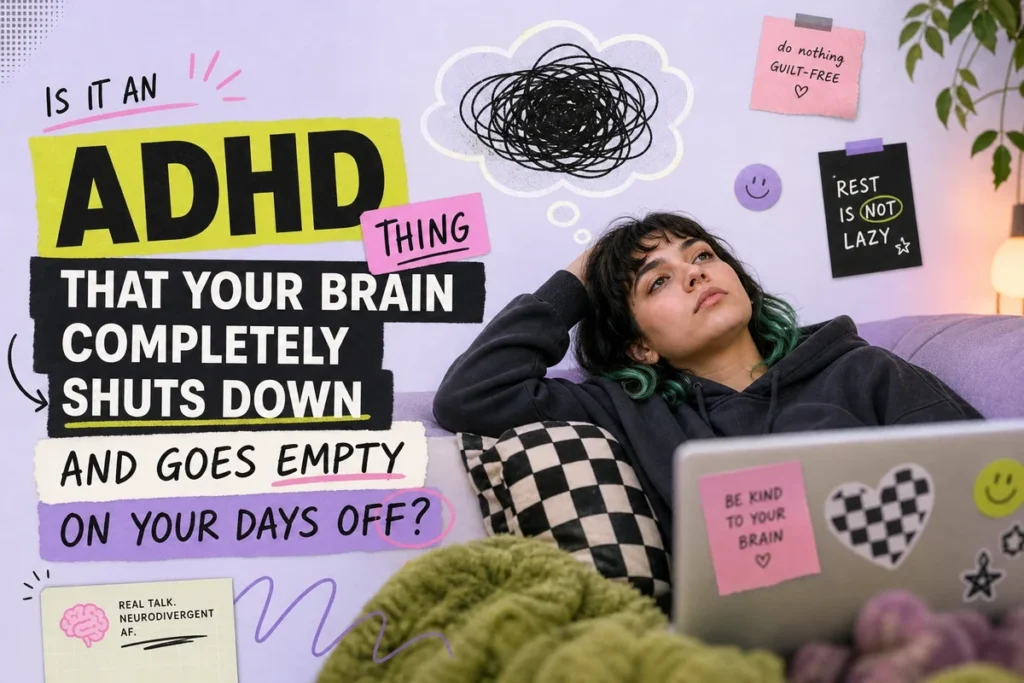
The weekend starts, and you have a plan. Clean the room, do the laundry, finally start that project, maybe see someone. Then it is noon and you are still in bed, phone in hand, scrolling without taking anything in. The clothes are on the floor where they were on Friday. You want to move. You know exactly what needs doing. You just cannot make the first step happen, and the hours slide by with a dull, heavy emptiness that is not quite rest and not quite anything else.
Yes, this is an ADHD thing. It is structure-dependent activation: your brain's starting system runs on outside demands, and when the demands disappear, so does the fuel. That is what ADHD free time brain shutdown looks like from the inside.
Why You Function Monday to Friday and Collapse on Saturday
The cruel part of this pattern is the contrast. All week you get up, get dressed, show up, and produce. Then the moment nothing is required of you, you cannot do even the small things you actually want to do. It makes you suspect you are faking competence at work, or faking exhaustion at home.
You are not faking either one. Your brain is doing exactly what an ADHD brain does: it performs well when something external is pushing it, and stalls when nothing is. A work schedule supplies a lot of pushing. There is a start time, other people waiting, consequences for being late, and a clear sequence of what happens next. You borrow all of that structure from the outside world.
On a day off, the borrowed structure vanishes. What is left is you, an open stretch of hours, and a brain that has never been good at generating its own starting signal.
What Is Happening in the Brain When Structure Disappears
ADHD affects the brain systems responsible for executive function: planning, organising, starting tasks, and managing attention and emotion.1 Those systems depend heavily on dopamine and norepinephrine signalling, which is the chemistry that tells your brain a task is worth the effort of beginning.
In a typical brain, internal goals can generate enough of that signal on their own. "The room is messy, I should clean it" turns into action fairly smoothly. In an ADHD brain, an internal goal with no urgency attached often produces nothing. The thought arrives, and the motor follow-through does not.
External pressure fixes this by raising the stakes artificially. A deadline, a person waiting, a clock running out: these spike the signal enough to cross the starting line. Take them away, and the activation system has nothing to push against. That is the core of ADHD structure removal brain: not laziness, not a lack of desire, but a starting mechanism that was never self-powered in the first place.
ADHD free time brain shutdown is not a failure to rest or a failure to try. It is what happens when a brain that runs on external demand is handed a day with none.
ADHD Weekend Paralysis Is Not the Same as Resting
Here is where it gets confusing. From the outside, and often from the inside, paralysis looks like relaxing. You are horizontal. You are not working. You are doing nothing. So it should count as rest.
But rest and paralysis feel different if you pay attention. Real rest leaves you a little restored. You chose it, you enjoyed some of it, and when it ends you feel readier for what comes next. Paralysis leaves you tense underneath. You are lying there while a running commentary says you should be up, and the guilt builds with every hour. You end the day more depleted than you started it, with nothing done and nothing recovered.
A useful test is to ask whether you chose this, or whether it happened to you. If you wanted to lie down and watch something and you are enjoying it, that is rest. If you are scrolling because you cannot do anything else and you are quietly miserable, that is ADHD weekend paralysis dressed up as rest.
There is a second thing hiding in here too. After a week of masking, holding focus, and running on borrowed structure, many ADHDers genuinely are depleted. Recovery after effort is a real and underdiscussed part of ADHD. Often both are true at once: you need rest, and you are also stuck. Part of the work is telling them apart.
Why ADHDers Often Do Better With More Obligations, Not Fewer
This is the part that sounds backwards. Many people with ADHD get more done, and feel better, when they have a fuller schedule. A packed week is easier than an empty one. A day with three appointments feels more manageable than a day with nothing.
It makes sense once you see the mechanism. Each obligation is a small piece of external structure. It tells your brain when to start, what comes next, and when it is over. Fewer obligations means fewer of those anchors, and the empty space between them is where the brain drifts and stalls.
The same logic explains why some ADHDers feel unusually calm and capable in real emergencies. When the demand is urgent and obvious, the starting problem disappears. There is nothing to decide and nothing to generate internally. The situation does the pushing.
This is not an argument for overloading yourself. It is a clue about what your brain needs. If structure is the fuel, the goal is not to have no free time. The goal is to put enough scaffolding inside your free time that you can actually use it, or actually enjoy it.
Why the Standard Advice Fails ADHD Days Off Executive Dysfunction
The usual advice is to make a to-do list, plan your day, and just start with the easy stuff. If you have ADHD, you have probably tried all of it, and watched it fail.
The problem is that these tools assume the hard part is deciding what to do. It is not. You already know the room needs cleaning. The hard part is the bridge between knowing and starting, and a list does not build that bridge. It just gives you a longer inventory of things you are failing to begin.
Self-discipline advice fails for the same reason. Willpower is a way of forcing the starting signal through sheer effort, and ADHD days off executive dysfunction is exactly the situation where that signal is unavailable. Pushing harder on a system that has no fuel produces shame, not movement.
The reframe: Recognising ADHD free time brain shutdown while it is happening can loosen its grip. Naming it, "this is paralysis, not laziness", takes away the shame layer, which is often what keeps you pinned down longest.
How to Build Enough Structure to Be Free
The fix is not to schedule every minute. It is to borrow back just enough outside pressure to get the engine started, then let momentum do the rest.
Start with the smallest possible physical action. Not "clean the room." Stand up, stretch your arms overhead, and shake out the tension. Put one thing back in a drawer. Small movements work because they break the freeze without asking your brain to commit to a whole project. Once you are moving, the next step is far easier than the first.
Next, bring in another person. Telling a friend you are stuck can be enough to break it, and a friend who answers with a firm, caring "get up" is borrowing you their external push. Body doubling works the same way: someone else being present, even on a video call, supplies the structure your day lacks.
Then use time anchors. A fixed appointment on a Saturday morning, a class, a walk with someone, a standing call, gives the day a spine. Some people find that doing creative or important work early, before the day has a chance to go shapeless, is the anchor that works. Quiet early hours with no competing demands suit some brains well. It will not suit everyone, so treat it as an experiment.
Finally, build in a deliberate rest block. If part of the day is explicitly for resting, you stop the guilt from contaminating it. "I am resting from 2 to 4" feels completely different from "I am failing to do anything." Structure applied to rest is what lets rest be rest.
What to Do When Nothing Breaks the Freeze
Sometimes none of it works. You try the stretch, the text, the timer, and you are still stuck. That happens, and it does not mean you did it wrong.
On those days, the most useful thing is to stop adding pressure. Accept where you are for a while, with the knowledge that these states pass. Fighting paralysis with self-criticism tends to extend it. Dropping the fight, while keeping one tiny action available for when the energy shifts, is usually faster than forcing it.
Over time, patterns emerge. You may notice that paralysis is worst after a particularly draining week, or when a day has no fixed point at all. That information lets you plan around it, rather than being ambushed every weekend.
The Takeaway
If your brain shuts down on your days off, that is an ADHD free time brain shutdown, not a character flaw. Your starting system runs on outside demand, and a day with none leaves it idle. Stop trying to out-discipline it. Instead, put one anchor into each day off: a person, a time, or a first physical action small enough to do while still in your pyjamas. Structure is not the opposite of freedom for your brain. It is what makes the freedom usable.
Rate this article
Was this a useful hit?