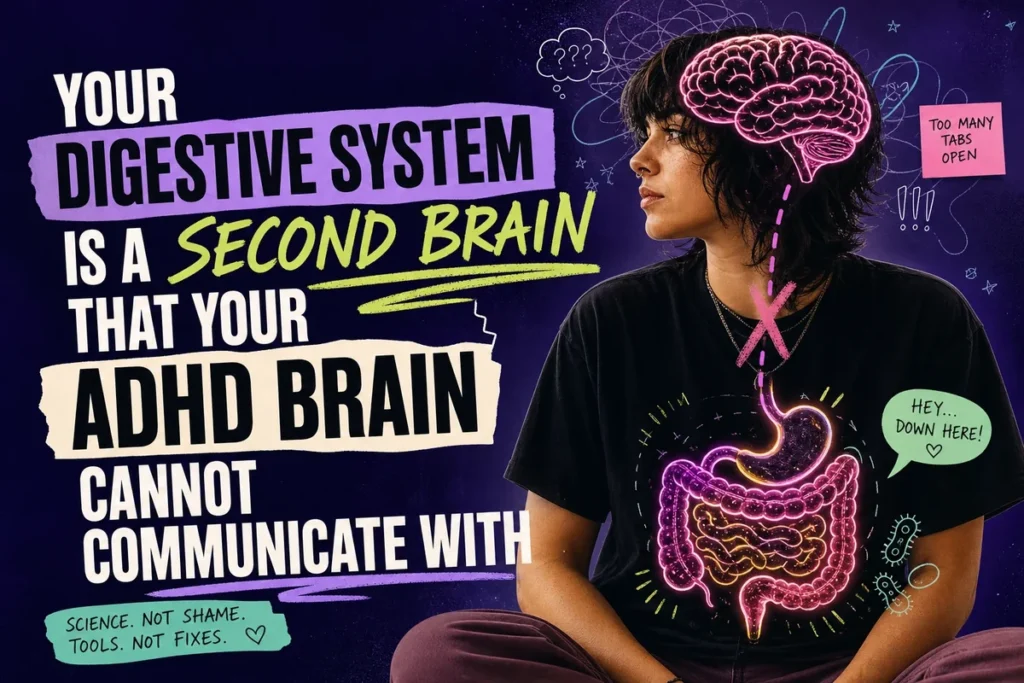
Your Digestive System Is a Second Brain That Your ADHD Brain Cannot Communicate With

It's 4 p.m. and you realize you haven't eaten since yesterday. Not because you were dieting or because you forgot in a cute, quirky way. Your body just never sent the memo. Now your hands are shaky, your head is pounding, you're weirdly irritable, and you only figured out why when you stood up and nearly blacked out. Or it's the opposite: your stomach has been hurting for hours, and you only noticed when the pain became impossible to ignore. This is the ADHD gut health problem nobody explains to you, and it isn't a willpower issue.
Your gut and your brain are in constant conversation. For a lot of ADHD brains, that conversation is happening on a bad connection. Messages arrive late, garbled, or not at all. Here's what's actually going on, and what you can do about it.
The Signal Never Arrives, Then Everything Arrives at Once
Most people get a gradual build. Hunger starts as a mild nudge, becomes a growl, becomes an obvious "go eat something." Fullness works the same way in reverse. Stomach discomfort gives early warnings that something you ate isn't sitting right.
With ADHD, that gradient often collapses. You feel nothing, nothing, nothing, and then you are in crisis. Starving and nauseous. Stuffed past comfortable without ever noticing the halfway point. Cramping hard when there was no earlier hint. It can feel like your body is ambushing you, when really the early signals just never reached the part of your brain that does the noticing.
That's why so many of us describe our relationship with food as chaotic. We aren't being dramatic or undisciplined. We're making decisions without the data most people get for free.
What Interoception Actually Is
Interoception is your brain's ability to sense what's happening inside your body: heartbeat, hunger, thirst, the need to pee, temperature, gut sensations, fatigue. It's the internal sense most people never think about, because for them it just works.
Research increasingly suggests that interoception differences are common in ADHD. Studies have found that people with ADHD often report lower awareness of internal bodily signals, and that these differences are linked to emotional dysregulation and attention difficulties.1 This is still an active research area, so nobody can give you a tidy universal rule. But the pattern matches what thousands of ADHDers describe: "I don't know I'm hungry until I'm angry," "I didn't realize I needed the bathroom until it was urgent," "I can't tell if I'm full."
When it comes to interoception and digestion, the issue isn't that your gut is silent. Your gut may be sending plenty. The issue is that your brain isn't reliably tuning in, especially when something more stimulating is competing for attention. Hyperfocus on a project, a game, or a deadline can drown out the signal entirely.
Your gut might be talking the whole time. ADHD gut health often comes down to a brain that isn't picking up the call.
The Gut-Brain Axis and Why ADHD Lives There Too
Your gut has its own nervous system, the enteric nervous system, with hundreds of millions of neurons. That's where the "second brain" nickname comes from. It communicates with your brain constantly through the vagus nerve, hormones, and immune signaling. Researchers call this two-way connection the gut-brain axis.
Your gut also produces a lot of the body's serotonin, and gut microbes influence compounds involved in mood and stress response. Dopamine, the neurotransmitter most associated with ADHD, interacts with this system too. The science on the gut-brain axis in ADHD is genuinely early. Some studies have found differences in gut microbiome composition in people with ADHD compared to those without, but results are inconsistent and it's not clear which direction the relationship runs.2 Anyone telling you they've found the one gut fix for ADHD is selling something.
What we can say honestly: the gut and brain are tightly linked, ADHD affects brain signaling, and it makes sense that this shows up in digestion, appetite, and body awareness. You don't need a finished theory to take your experience seriously.
The IBS and ADHD Overlap Is Real
If your stomach has been a mess for years, you might have wondered whether it's connected to your brain. It might be. Research has found higher rates of gastrointestinal problems, including irritable bowel syndrome, constipation, and abdominal pain, in people with ADHD.3 The IBS and ADHD comorbidity shows up often enough that clinicians are starting to pay attention to it.
There are a few plausible reasons, and they probably stack. Chronic stress and a dysregulated nervous system can disrupt digestion. Irregular eating patterns, like skipping meals and then eating a huge one at midnight, are hard on your gut. Stimulant medication can suppress appetite and change how your digestive system behaves. And if you can't sense early discomfort, you may not connect a certain food or habit to the pain that comes later.
That last one matters. Normally, feedback loops teach you: "dairy makes me feel gross, so I'll skip it." If the feedback is delayed, muffled, or buried under other stimulation, you don't learn the lesson. You just keep feeling bad and have no idea why.
Worth knowing: Chronic stomach pain, constant constipation, or digestive symptoms that disrupt your life deserve a real medical conversation, not just ADHD hacks. Tell your doctor about both your ADHD and your gut symptoms. They can be connected, and they can also have separate causes that need separate treatment.
How This Wrecks Your Day Without Looking Like a Problem
Missed body signals don't announce themselves as "an interoception issue." They show up disguised as other things.
You think you're lazy, but your blood sugar crashed three hours ago. You think you're anxious, but you're dehydrated and running on caffeine. You think you have no emotional control, but you haven't eaten since breakfast and your brain is running on fumes. You think you can't focus, but your stomach is cramping in the background and eating a chunk of your attention without your noticing.
For ADHD brains already working with limited executive function, this is brutal. Task initiation is hard enough when you're fed and comfortable. Add a body you can't read, and you're trying to run a complicated machine with half the dashboard lights out.
It also feeds the shame spiral. You eat nothing all day, then overeat at night, then feel gross and out of control, and decide you're bad with food. But the pattern makes sense once you see it. Your body didn't ask for dinner at 6 p.m. like it was supposed to. It screamed for it at 11 p.m., after hours of ignored signals.
Working With a Body You Can't Read in Real Time
You can't just "listen to your body" when the line is down. That advice assumes a working connection. So the strategy is to stop depending on the feeling and build outside systems that stand in for it.
Eat on a schedule, not on hunger. Treat meals like appointments. Set alarms if you need to. Yes, it feels robotic. It's also what actually works for many ADHDers, because the schedule doesn't need you to feel anything first.
Make food friction-free. If eating requires three decisions and a cooking project, it won't happen. Keep things around that need almost no effort: yogurt, fruit, cheese, wraps, nuts, microwave rice, protein shakes. Safe, boring, easy foods are not a failure. They're infrastructure.
Put cues where you can't miss them. A water bottle on your desk. A snack next to your laptop. A sticky note on the bathroom mirror. Your environment can do the reminding your body can't.
Use external data when internal data is unreliable. Notice the late signals, like a headache, irritability, shakiness, brain fog, or sudden bad mood. Over time, you can learn to treat those as "check on food, water, and bathroom" prompts instead of mysterious personal failings.
Train the Signal, Slowly
Interoception isn't completely fixed. Some research on mindfulness, body scanning, and similar practices suggests that interoceptive awareness can improve with practice, although the evidence in ADHD specifically is still limited.1 So this isn't a promise. It's a low-risk experiment.
Start small. A few times a day, pause and ask: what's my stomach doing? Is it empty, tight, full, fluttery, achy, nothing? You will probably get "nothing" a lot. That's fine. You're not looking for a perfect answer, you're building the habit of checking in.
Pair it with something you already do. Check in when you sit down at your desk, when you pick up your phone after a scroll session, or when you walk into the kitchen. Habits stick better when they're attached to existing cues.
Keep a simple log of what you ate and how your gut felt a couple of hours later. This is a workaround for delayed feedback. You're creating the connection your brain doesn't make automatically. Patterns often show up faster on paper than in your head.
What You Can Take From This
If you've spent years thinking you're just bad at eating, bad at noticing pain, or bad at taking care of yourself, consider another explanation. ADHD gut health is tangled up with interoception, stress, medication, and a gut-brain connection that doesn't always carry clear messages. That's not a character flaw. It's a communication problem between two systems.
You can work with it. Schedule the meals, simplify the food, set up your space, track the patterns, and get medical help when your gut symptoms are serious or persistent. Your body is still talking. You're just building a better way to hear it.
References: 1. Research on interoceptive awareness and ADHD, including studies linking reduced interoceptive sensitivity to attention and emotion regulation differences. 2. Emerging research on gut microbiome composition in ADHD, which remains preliminary and inconsistent. 3. Studies reporting elevated rates of gastrointestinal symptoms, including IBS and constipation, in ADHD populations.
Rate this article
Was this a useful hit?