Your Brain Learned to Track Everyone Else's Mood Before You Learned to Track Your Own

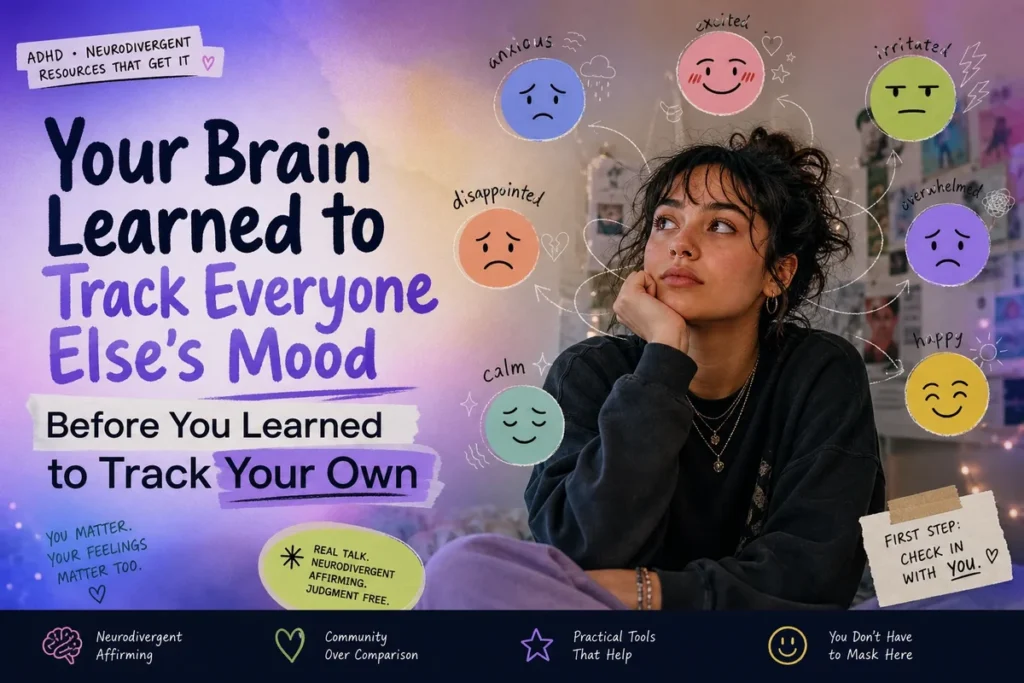
Your roommate closes the cabinet a little harder than usual and you already know. Something happened at work. She's not mad at you, but she might be, so you start running the math. Should you say something? Should you leave her alone? Meanwhile, your own stomach has been growling for four hours and you've been vaguely irritable since noon, but you couldn't tell anyone why. You can read a room in half a second. You cannot read yourself.
That gap is not a personality quirk. For a lot of people with ADHD, ADHD hypervigilance pointed outward long before anyone taught you to look inward. Your brain got really good at one kind of tracking and never got the training for the other.
What ADHD Hypervigilance Actually Looks Like
Hypervigilance usually gets talked about in the context of trauma, and that overlap is real. But for ADHDers it often shows up in quieter, everyday ways. You notice when a friend's text has fewer exclamation points than usual. You clock the shift in a teacher's voice before they finish the sentence. You can tell when a room is about to go sideways.
People call this being "so empathetic" or "so intuitive," and sometimes it is. But a lot of the time it is not a gift. It is a scan that never turns off. Your brain is running a background program asking one question over and over: is everyone okay with me right now?
If you are what the internet calls a people-reader, you probably know the cost. By the end of a social day you are wiped, and you can't explain why, because nothing "happened." What happened is that you worked the entire time.
Why Your Brain Built This Skill First
Think about what childhood was like for a kid with undiagnosed ADHD. You got corrected a lot. You lost things, talked too much, forgot instructions, cried at what seemed like nothing. Research on ADHD and criticism backs this up: children with ADHD receive significantly more negative feedback from adults and peers than their classmates do.1
Now picture a kid absorbing that day after day. The lesson is not "I should work on my attention." The lesson is "I need to know when someone is about to be upset with me." So the radar develops. You learn to catch the sigh, the pause, the change in posture. Spotting disapproval early becomes a survival move, because it lets you adjust before the correction lands.
That is not weakness. It is a smart adaptation by a brain that was in an environment it could not control. The problem is that adaptations built for survival tend to run on autopilot long after you needed them.
ADHD hypervigilance is not you being dramatic or "too sensitive." It is a skill your brain built to stay safe, and it has been running at full power ever since.
The Other Half: You Can't Hear Your Own Signal
Here is where it gets strange. While your outward radar was getting sharper, your inward one was getting ignored. Nobody asked what you felt. Or they asked, and the honest answer ("I don't know") got treated like a dodge.
There is a term for difficulty identifying and describing your own emotions: alexithymia. It is not an official diagnosis, but it is a well-studied trait, and the overlap with ADHD is significant. Studies have found elevated alexithymia in adults with ADHD compared to the general population, and a meaningful share of ADHDers score in the clinical range.2
In real life, alexithymia with ADHD feels like this. Someone asks how you're feeling and your mind goes blank, or you say "fine" because it's faster. You notice you're upset only after you've snapped at someone. You cry and have no idea what set it off. Your body gives you signals (tight chest, buzzing skin, a headache that shows up out of nowhere) but the translation layer between body and feeling is missing or slow.
This is the heart of emotional awareness in ADHD: it isn't that you don't have feelings. It's that they arrive without labels, and by the time you figure out what they were, they have already driven the car.
Why These Two Things Feed Each Other
The outward scan and the inward blind spot are not separate problems. They reinforce each other.
When your attention is busy monitoring everyone else, there is no bandwidth left for your own signals. You can't notice that your shoulders are up around your ears because you are busy noticing that your manager seems off today. And the less practice you get reading yourself, the more you rely on external cues to figure out how you should feel. If everyone around you is calm, maybe you are calm. If someone is upset, you absorb it fast, sometimes without being able to tell whose feeling it is.
That is why so many ADHDers describe feeling like a sponge, or like they have no stable sense of their own mood. Your emotional baseline gets set by the room instead of by you.
The loop: Scanning others uses up the attention you would need to scan yourself. Not scanning yourself makes you rely on others to tell you how to feel. That makes scanning others feel even more necessary.
How This Shows Up in Your Relationships
This pattern gets expensive in close relationships. You become the person who always knows what your partner needs, and who can't say what you need. You smooth things over before anyone asks. You apologize first to end the tension, even when you're not sure what you did.
Friends might describe you as easy to be around, and the truth is that you've been doing constant behind-the-scenes labor to make that true. Then one day resentment shows up out of nowhere, because you've been ignoring your own needs for months and never noticed.
It also makes conflict confusing. When someone asks "what's wrong?" the honest answer might be "I don't know yet." But in the moment, that sounds like stonewalling. So you either go quiet or say something that is not quite true, just to fill the space.
If this sounds familiar, it can also overlap with rejection sensitivity, where a perceived slight lands like a physical hit. Hypervigilance is often the reason the slight gets perceived in the first place: your radar picks up a shift and your brain fills in the worst-case reason.
Turning the Radar Inward: What Actually Helps
You are not trying to switch off ADHD hypervigilance. The ability to read people is useful, and it is part of how you connect. The goal is to give yourself the same level of attention you give everyone else, even if only for a few seconds at a time.
Start with the body, not the feeling. If naming emotions is hard, skip it at first. Ask what is physically happening: jaw tight, stomach hollow, hands restless, eyes heavy. Body sensations are data, and you do not have to interpret them yet. Over time, patterns show up. Tight jaw and shallow breathing might usually mean anxious. Heavy limbs and flat mood might mean you need rest, not a pep talk.
Use a small, boring word list. Alexithymia makes open-ended questions feel impossible. "What are you feeling?" is a huge prompt. "Is it closer to mad, sad, scared, glad, tired, or hungry?" is something you can answer. Accuracy matters less than the habit of checking in.
Check in on a schedule instead of waiting for a feeling to announce itself. Your internal signals are quiet, so do not rely on them to interrupt you. Set a reminder a few times a day and ask the same short question. You are building a skill, and skills come from repetition, not inspiration.
Notice when you are scanning. The moment you catch yourself decoding someone's tone, treat it as a cue to ask what you are feeling right now. The radar going off is a useful trigger for a self-check.
When You Need More Than Self-Help
If you grew up in an environment where reading people was truly necessary for safety, this may go deeper than ADHD alone. Trauma, anxiety, and ADHD overlap a lot, and untangling them on your own is hard. A therapist who understands neurodivergent brains can help, especially one familiar with alexithymia and emotional regulation. If you are in the middle of a Late Discovery process and still figuring out what is ADHD and what is learned coping, that is a good thing to bring to someone.
And if building a daily check-in feels like one more thing you will forget, that is normal. Tools like Steady are designed for exactly this: quick prompts that help you name what is happening before it turns into a spiral.
You Were Paying Attention the Whole Time
Here is the reframe that matters. You were never bad at emotional awareness. You were trained, early and thoroughly, to point it in one direction. The skill is already there. It just has not been aimed at you.
ADHD hypervigilance made you fast, perceptive, and good at keeping the peace. It also left you without a map of your own interior. Both things are true. The work now is not to become a different person. It is to spend a little of that attention on the one person in the room you have been skipping.
Start small. One body check, one word from the list, one pause before you decode someone else's face. That is how you learn to track your own mood the way you have always tracked everyone else's.
1 Research on negative feedback in children with ADHD, including work summarized by Russell Barkley and colleagues, describes disproportionate criticism and corrective input compared to peers.
2 Studies of adults with ADHD, including work published in the Journal of Attention Disorders, report higher rates of alexithymia than in non-ADHD comparison groups.
Rate this article
Was this a useful hit?