Your Body Keeps the Score, But Your ADHD Brain Cannot Read It Until It Screams

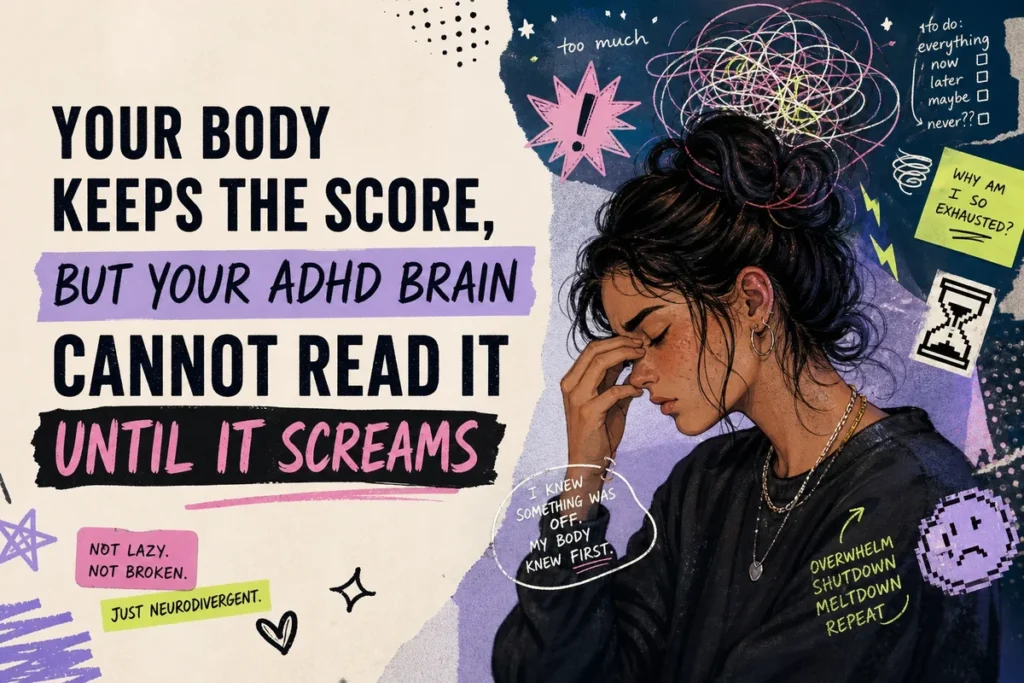
It's 4 p.m. You've been at your desk since morning. You stand up and the room tilts. Your head is pounding, your hands are a little shaky, and you realise you haven't eaten since yesterday. Or you've been holding your bladder for three hours and only just noticed, now that it's urgent. Or you've been sitting on a sore, tense back for a week and only clock it when you can't turn your head.
Nobody warned you. Your body didn't send a polite notification. Or it did, and it landed somewhere your brain never checked. This is ADHD interoception: the gap between what your body is signalling and what your brain actually registers. And if you've ever been called careless, lazy, or bad at taking care of yourself, this is probably part of the reason it never worked.
What ADHD Interoception Actually Is
Interoception is your sense of your internal state. Hunger, thirst, heartbeat, temperature, pain, the need to pee, tiredness, nausea, the flutter in your stomach before something stressful. It's the sense that tells you what's happening inside you, the way vision tells you what's happening outside.
Most people treat this as background noise that just works. Their stomach gets empty, they feel hungry, they eat. For a lot of ADHD brains, that chain breaks somewhere in the middle. The signal might be too faint, too late, or too tangled up with other signals to read.
Research is starting to back up what ADHDers have said for years. Studies on interoceptive processing in ADHD have found differences in how people with ADHD perceive and interpret internal bodily signals, and that these differences are tied to attention and emotional regulation.1 This isn't a character flaw. It's a processing difference.
ADHD interoception isn't about not caring what your body needs. It's about the message arriving late, garbled, or not at all.
Why Your Body's Signals Show Up Late
Part of this comes down to attention. ADHD attention isn't a shortage, it's a regulation problem. When you're locked into something interesting, urgent, or even just loud in your head, your brain allocates almost everything to it. Internal signals are low-priority traffic. They get dropped.
That's why hyperfocus is so good at hiding hunger. You're not ignoring your body on purpose. Your brain has turned the volume on everything else down to zero, and your body's messages are on that list.
The other piece is that interoceptive signals are subtle. A growling stomach is a late-stage hunger cue. The early version is a slight dip in focus, a bit of irritability, a vague sense that something is off. If you don't recognise that early version as "I need food," you only find out when you're shaky and snappy and ready to cry over a spilled drink.
So it looks like you wait until the last second. In reality, you never got the early warning in a form you could read.
The Crisis Pattern: When Your Body Has to Scream
If you've lived with delayed body signals your whole life, you probably have a familiar rhythm. Fine, fine, fine, then suddenly very not fine. You go from "I'm okay" to "I might pass out" with no middle stage.
It shows up in a few ways:
You realise you're starving only after you've gone past hungry into nauseous. You drink water only when your mouth is dry and your head hurts. You notice you're exhausted when you crash, not when you started fading. You find a bruise and have no idea where it came from. You've been in pain for days before it registers as something worth acting on.
Then there's the bathroom thing. A lot of ADHDers describe it as going from zero to emergency with no warning. That's not a quirk, it's the same pattern. The signal exists, but it doesn't reach you until the volume is maxed out.
This is what the title means. Your body is keeping the score the whole time. It just can't get you to read it until the numbers are impossible to ignore.
Why It Looks Like Neglect (and Isn't)
From the outside, this pattern looks a lot like not taking care of yourself. Skipping meals. Running on no sleep. Ignoring pain. People who don't experience the gap assume you just don't prioritise your health, and plenty of ADHDers absorb that story and believe it.
But neglect implies you knew and chose not to act. Most of the time, you didn't know. You can't respond to a signal you didn't receive.
That distinction matters, because shame is a terrible strategy for fixing a perception problem. Telling yourself to try harder at noticing hunger is like telling yourself to try harder at hearing a frequency you can't hear. What works is building external systems that do the noticing for you, and slowly training the internal channel.
Reframe: If you've been called careless about your body, ask whether anyone ever taught you how to read these signals, or just told you to. ADHD interoception is a skill gap created by a processing difference, not a moral failure.
The Alexithymia Overlap
Interoception doesn't only cover physical sensations. It's also the foundation of emotional awareness. Your brain builds emotions partly from body signals: a tight chest, a hot face, a hollow stomach. If you can't read those signals clearly, naming the emotion gets much harder.
That's where alexithymia ADHD overlap comes in. Alexithymia is difficulty identifying and describing your own feelings. Research suggests it's significantly more common in people with ADHD than in the general population, and that it's linked to emotional dysregulation.2
In real life, it sounds like: "I don't know what I'm feeling, I just feel bad." You might be angry and think you're hungry. You might be anxious and think you're tired. You might be overwhelmed and read it as annoyance at the person closest to you.
It also explains why the same physical state can get mislabelled. A racing heart could be excitement, caffeine, anxiety, or a missed meal. If the signal is blurry, you guess, and often guess wrong.
If this sounds like you, it's worth mentioning to a clinician. It doesn't change who you are, but it does change what kind of support helps.
Why Burnout Hits So Hard When You Can't Read Your Body
Burnout is rarely a single event. It's a long slide of accumulated strain that you didn't register along the way. Poor body awareness ADHD turns that slide into a cliff.
Most people get early warnings: a growing sense of tiredness, tension, dread on Sunday nights. They adjust, rest, say no. If your internal gauge doesn't show you the drop, you keep pushing at full speed until your body forces a hard stop. Illness. Panic attacks. Sudden inability to function.
That's not weakness, and it's not being dramatic. It's what happens when the early signals never made it through. By the time you notice, the tank is not low, it's empty, and recovery takes weeks instead of an evening.
This is also why "just listen to your body" is such useless advice for you. It assumes the channel is open. For many ADHDers it isn't, or it's open but noisy.
You can't listen to a body that's speaking in a language you were never taught. You can learn the language, but first you need subtitles.
Building Subtitles: What Actually Helps
The goal isn't to become someone with perfect interoception overnight. It's to build backup systems and slowly sharpen the signal. Here's what tends to work.
Use time, not feelings, as your trigger. If you can't trust hunger to tell you when to eat, let a clock do it. Meals and water at set times, whether or not you feel like it. It feels artificial at first. It works anyway.
Make the need visible. A water bottle on your desk, snacks in your bag, a visible reminder on your phone lock screen. If your body can't prompt you, your environment can.
Learn your personal early warnings. Next time you hit a crisis, trace back. What was the first sign something was off? Maybe your focus slid, your mood tipped, your shoulders crept up. Those are your early signals, and they're specific to you. Write them down. Over time you start to catch them sooner.
Do short body scans. Not a meditation retreat. Sixty seconds. Start at your jaw and work down to your feet. You're not trying to feel anything profound, just to practise checking in. The more you do it, the more the channel opens. Some research on interoceptive training suggests awareness can improve with practice, which is encouraging even if the evidence in ADHD specifically is still developing.3
Name sensations before emotions. Instead of "I feel bad," try "my chest is tight and my stomach is empty." Physical description is easier to get right than emotional labelling, and it builds the bridge between the two.
Reality check: Medication can change how much of this you notice. Some people on stimulants report that hunger and thirst cues get even quieter, while others find their body awareness improves as their attention steadies. If appetite or signals shift after starting medication, tell your prescriber. It's useful information, not a side issue.
When to Take It Seriously
Most of the time, delayed body signals are an inconvenience you can manage with systems. But some situations need real attention.
If you regularly go a full day without eating, if you've ignored pain that turned out to be serious, if you're dehydrated often enough to get ill, or if you've had a medical scare because you didn't notice something sooner, bring it up with a doctor. Tell them the specific pattern, not just "I forget to eat." Describing it as reduced awareness of internal signals gives them something concrete to work with.
And if you're newly through a Late Discovery, this might be a piece of your history that suddenly makes sense. The fainting spells, the "mysterious" headaches, the stomach issues, the times you were told you were fine until you really weren't. Looking back through this lens can be uncomfortable, but it can also be a relief. You weren't failing at basic self-care. You were doing it without the instructions your body never delivered.
What to Take From This
Your body has been talking the whole time. ADHD interoception means the message gets lost on the way to you, not that you ignored it. That shifts the question from "why can't I take care of myself" to "what systems do I need so my body's needs get met even when I can't feel them?"
Start small. One alarm. One glass of water. One sixty second scan. Build outward from there, and be patient with a signal that's been faint for years. It can get clearer. In the meantime, you're allowed to rely on clocks, cues, and reminders, because they do the job your internal alarm system can't yet. Understanding your ADHD interoception is the first step to meeting your body before it has to scream.
1 Research on interoceptive processing differences in ADHD, including work published in peer-reviewed psychiatry and neuroscience journals, links atypical internal signal perception to attention and emotional regulation.
2 Studies examining alexithymia in ADHD populations report elevated rates compared with the general population and associations with emotion dysregulation.
3 Interoceptive awareness training has shown promise in broader clinical research; evidence specific to ADHD is still emerging.
Rate this article
Was this a useful hit?