You Overshare in the First Conversation and Then Disappear for Six Months

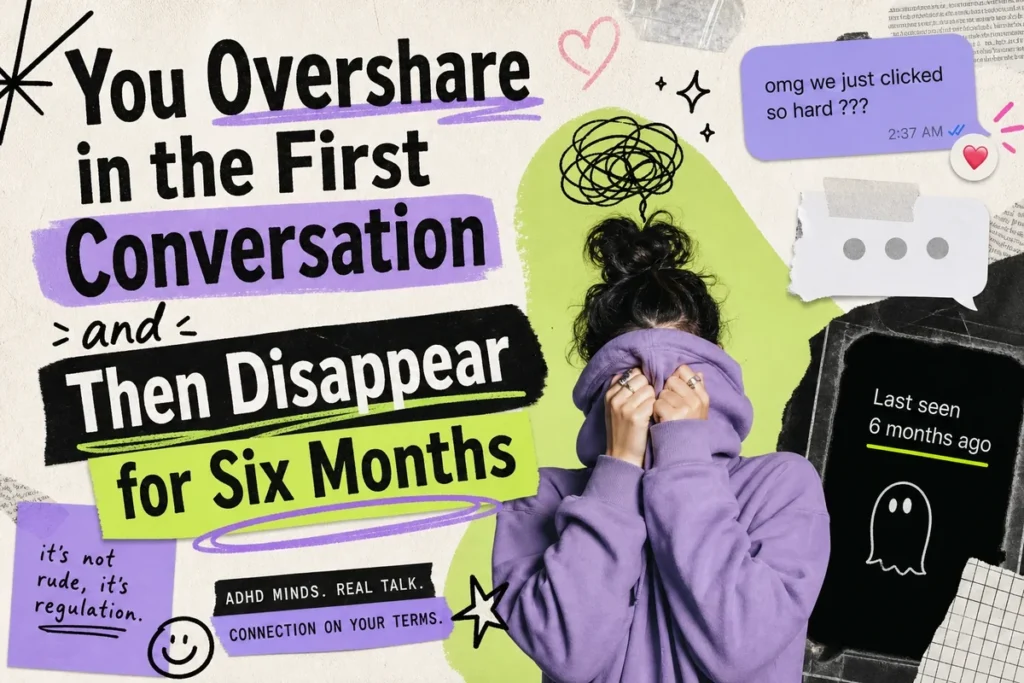
You met someone at a party, a work thing, or a group chat that got weirdly personal. Two hours later you had told them about your family, your last relationship, the thing that happened in ninth grade, and the niche rabbit hole you have been down for three weeks. You walked home feeling electric. They got you. You got them. This was the start of something.
Then the texts came in. A meme. A "we should hang out!" You meant to answer. You really did. Then it was a week, then a month, and now it has been long enough that replying feels like writing an apology letter. So you do nothing. Six months later you see their name pop up and your stomach drops. ADHD oversharing followed by silence is one of the most confusing patterns in your social life, and it is not because you are fake.
The Pattern Nobody Warns You About
Here is the cycle. You meet someone and your brain lights up. Novelty, attention, and being understood all hit at once. You go all in. Within one or two conversations you have given them a level of access most people reserve for friends of five years.
Then the energy shifts. The newness fades, the conversation becomes maintenance, and maintenance is where your brain starts to struggle. You do not stop caring. You just stop being able to see the person. They slip out of sight, and out of sight is genuinely out of mind for a lot of ADHD brains.
From the outside it looks like you flip a switch. From the inside it feels like nothing happened at all. That gap between how it looks and how it feels is where most of the shame lives.
Why ADHD Oversharing Happens So Fast
Start with the first half of the loop. Plenty of ADHDers describe a social filter that works differently, not because they do not know the social rules, but because the pause between thought and sentence is thinner. ADHD is tied to difficulties with inhibition, the brain skill that lets you hold something back and decide whether to say it.1 When you are excited, interested, or finally feeling understood, that brake gets even weaker.
Add the dopamine piece. New people are novel, and novelty is one of the most reliable ways to get your reward system firing. Telling someone your whole story and watching them react feels amazing. It is a hit of connection with almost no friction.
And there is a third factor that does not get discussed enough: a lot of you have spent years masking. You have been editing yourself so hard for so long that when someone finally feels safe, everything comes out at once. It is less "TMI" and more "pressure valve."
ADHD oversharing is rarely about having no boundaries. It is often about having held everything in for so long that the first safe person gets all of it.
The Disappearing Half: Out of Sight, Out of Mind Is Real
Now the second half. Why do you vanish?
Working memory is a big part of it. Relationships live in tiny repeated actions: replying, remembering, following up, checking in. Every one of those depends on holding something in mind and acting on it later. If your working memory is shaky, a person you adore can fall off your mental map the moment they leave your screen.
Then there is object permanence, the informal ADHD community term for how things you cannot see stop feeling present. It is not a clinical diagnosis, but ask a room of ADHDers and they will tell you immediately what it means. Your friends become a notification you did not open, and unopened things stop existing.
Finally, task initiation. A reply feels small, but replying to a message that has been sitting for two weeks requires you to start, to think of something to say, and to push through guilt. That is three barriers stacked on one text. If you have ever stared at a message for twenty minutes and then closed the app, that is task paralysis wearing a social costume.
ADHD Ghosting Friends Without Meaning To
Let us name the thing: you did ghost them. Not out of malice, but the effect is real. The person on the other end does not see your working memory or your guilt spiral. They see a message that went unanswered.
This is the part where most advice gets it wrong. Either it tells you that you are a terrible friend, or it tells you that your intentions are all that matter. Neither is true. Your intentions are good, and your impact still lands on a real person. Both things are allowed to be true at once.
ADHD ghosting friends is also rarely about one person. It is a system problem. Every relationship you have competes for the same limited pool of executive function, and the ones without a built-in structure, like a shared class, a job, or a roommate, lose first.
Reality check: Going quiet on someone does not mean you do not care. It means the friendship has no system holding it up, and your brain does not run on willpower alone. Fix the system, not your character.
The Shame Spiral That Keeps You Stuck
The longer the silence, the heavier the reply. A two-day gap is easy to bridge. A six-month gap feels like it requires a full explanation, a confession, and probably a gift basket. So you wait for the perfect moment and the perfect words, and neither ever shows up.
This is where rejection sensitivity can pile on. If you are prone to feeling criticism or rejection intensely, you may be convinced they are angry, or that they have already written you off. Often they have not. Many people, especially other ADHDers, assume their friend got busy and think nothing of it. Your imagined version of their reaction is almost always harsher than the real one.
The shame also feeds the next round. You feel so awkward about the last disappearance that the next friendship starts with extra intensity, as if you could prove you are a good person by giving more, faster. That brings you right back to oversharing.
Why Maintenance Feels Like Running a Second Identity
Here is a way to see it. When you meet someone, you are in performance mode in the best sense: curious, present, full of material. Keeping a friendship going asks for something else. You have to carry a running file on that person, their job, their sister, the thing they were stressed about, and you have to produce a version of yourself that is consistent across weeks.
For a brain that lives in the present moment, that can feel like maintaining a second identity. You are not just being yourself, you are being yourself on a schedule, with continuity, for an audience. That is a lot of overhead for something that is supposed to be fun.
No wonder it feels easier to start fresh with someone new. New people do not need a backlog. They get the highlight reel of your current obsession, and you get to be fully present. That is not a character flaw. It is a brain that is great at ignition and tired by upkeep.
How to Stop the Whiplash Without Becoming Someone Else
You do not need to become a person who sends perfectly timed birthday texts. You need a few low-effort systems that do the remembering for you.
First, shrink the size of a reply. A voice note, a reaction, or a single photo counts. The goal is contact, not a masterpiece. Lowering the bar is one of the best ways to beat paralysis around messaging.
Second, externalize the memory. Put people in your calendar or a simple tracker. Tag a few close friends and give each one a rough check-in rhythm. It sounds cold, but it is the opposite: you are building a structure so warmth can actually happen.
Third, slow the opening. You do not have to stop being open. Just stagger it. Share one real thing in the first conversation, then let the second and third conversations carry the rest. Pacing disclosure is a skill, and you can practice it without losing your personality.
Fourth, tell people how you work. A short, honest line like "I am bad at texting back but I love you, please nudge me" can change everything. The right people will take it well. The ones who do not may not have been the right fit for how your brain runs.
And if you have already gone silent? Send the awkward text anyway. Keep it short, skip the essay, and do not grovel. "Hey, I vanished and that is on me. I miss you. Want to catch up?" is enough. Research on social reconnection suggests people consistently underestimate how much others appreciate being reached out to.2
What Keeping the Good Ones Actually Looks Like
The goal is not to fix ADHD oversharing so thoroughly that you become guarded and polished. Your openness is one of the best things about you. People feel safe around someone who is real.
The goal is to give that openness somewhere to land. A few friendships supported by simple systems will serve you better than a long list of intense, short-lived connections. You get to be the person who dives in, and the person who stays.
If you have spent years thinking you are flaky or fake, consider another explanation: you have a brain that connects fast and forgets to maintain, in a world that only rewards the second part. That is a gap you can build a bridge over. Start with one name, one text, and one tiny system, and let the pattern change from there.
Rate this article
Was this a useful hit?