You Cannot Tell If You Are Hungry, Tired, or Having a Feeling

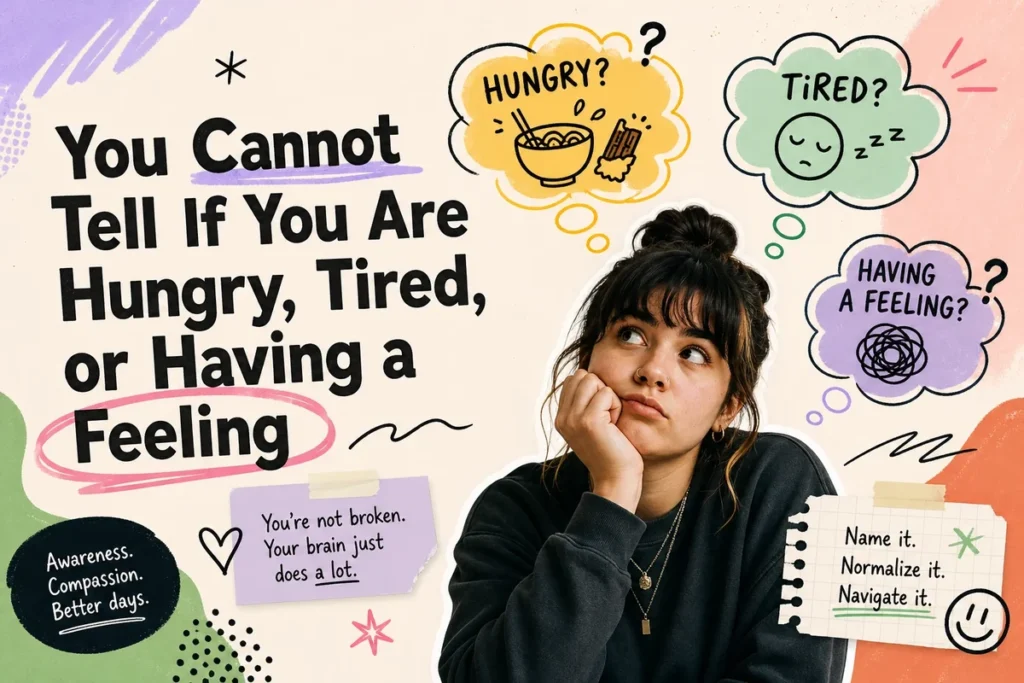
It is 4 p.m. and something is wrong. Your chest is tight, your head is fuzzy, and you are irritable in a way that has no obvious target. You scroll for a while. You open the fridge, close it, open it again. You wonder if you are sad, or anxious, or just tired. Then you realize you have not eaten since a granola bar at 10, and you have had nothing to drink but coffee. Or maybe you have eaten, and it is something else entirely. You genuinely cannot tell.
If that sounds familiar, you are not being dramatic and you are not bad at being a person. This is a well-documented overlap between alexithymia and ADHD, and it explains why your internal signals tend to arrive as one big undifferentiated "bad."
What alexithymia actually is
Alexithymia is not a diagnosis you can get on its own in the usual sense, and it is not the same as having no feelings. It is a trait where you have difficulty identifying, differentiating, and describing your own emotional states. You feel something. You just can't tell what it is, or where one feeling ends and another begins.
Researchers usually describe a few parts of it: trouble identifying feelings, trouble describing feelings to other people, and a tendency to focus on external events rather than inner experience. Someone with alexithymia might say "I feel off" or "I feel bad" and honestly not have a finer-grained word available.
The link to ADHD is not small. Studies have found that alexithymia is considerably more common in adults with ADHD than in the general population, with some research suggesting roughly a third or more of ADHD adults show clinically elevated alexithymia traits.1 It also shows up in autistic people at high rates, which matters if you are AuDHD.
Interoception deficit: the signal problem underneath
Interoception is your brain's ability to sense what is happening inside your body. Heartbeat, hunger, thirst, temperature, the need to pee, muscle tension, fatigue. It is the data feed your brain uses to figure out what you need.
When that feed is faint, delayed, or noisy, you get what people online call an interoception deficit. Your body is sending information, but it reaches you late, muddled, or not at all. You notice you are starving only when you are shaky and snappy. You realize you needed the bathroom an hour ago. You find out you are exhausted when you are already crying over a spilled drink.
There is growing research on interoceptive differences in ADHD, though it is still developing, and not every study agrees.2 What the research does support is that differences in sensing and interpreting internal states are real and measurable for many people with ADHD. What you have been calling "being bad at taking care of myself" may be partly a data problem, not a character problem.
Alexithymia ADHD is not about feeling nothing. It is about feeling a lot of something and having no label for it, because the body signals underneath never got sorted in the first place.
Why it all collapses into "bad"
Here is where the two things stack. Emotions are not just thoughts. They are built partly out of body signals: a racing heart, a tight stomach, heat in your face. Your brain reads those sensations and, with context, builds a label like "anxious" or "angry" or "excited."
Now imagine the body signals are already blurry because of interoception differences. Then imagine the labeling step is also shaky because of alexithymia. What you get is a single low-resolution category. Hungry feels like irritable. Tired feels like sad. Anxious feels like nauseous. Overstimulated feels like angry. All of it files under the same heading: something is wrong and I need it to stop.
That is why the reaction is often disproportionate or misdirected. You snap at a friend when you needed lunch. You cancel plans because you feel "off" when you were actually just under-slept. You doomscroll for two hours because something hurts and scrolling is the only thing that dulls it. You are responding to the alarm, not to the cause, because the cause never came through clearly.
How it shows up in everyday Gen Z life
This is rarely dramatic. It is mostly small, repeated confusion. You eat a huge meal and then realize you were never hungry, you were restless. You go to bed at 3 a.m. and cannot tell whether you are tired or just done with the day. You get a text and your stomach drops, but you can't say whether it is dread, excitement, or just caffeine.
In relationships it gets harder. Someone asks "what's wrong?" and the honest answer is "I don't know," which they hear as avoidance. You say "I'm fine" because it is faster than failing to explain. Then you get accused of shutting down, when really the process of translating your inner state into words broke somewhere upstream.
At work or school, it looks like crashing at 2 p.m. and calling it laziness. Or pushing through a headache, thirst, and a full bladder because none of it registered as urgent until you were close to tears. Plenty of people with bodily cues ADHD patterns are told they are "so dramatic" or "so bad at self-care," when the underlying issue is that the cues are not reaching them in usable form.
Worth knowing: Not being able to name a feeling does not mean you are broken or emotionally stunted. It means the translation layer between body and label is under-trained or noisy. That is a skill gap you can work on, not a fixed flaw.
The Late Discovery angle
A lot of people hit this after a Late Discovery of ADHD, and it recontextualizes years of confusing moments. The kid who was told "you can't be hungry, you just ate." The teen who "overreacted" to everything. The adult who always seemed fine and then fell apart for what looked like no reason.
If nobody ever taught you to read your internal signals, and your signals were already hard to read, you built workarounds. Maybe you learned to eat on a schedule. Maybe you learned to treat every strong feeling as an emergency. Maybe you learned to detach from the whole system because it was noisy and unreliable.
None of that was a failure. It was your brain adapting with the information it had. The point of understanding it now is not to rewrite your past. It is to give yourself better tools going forward.
Sorting the signal: a practical method
You cannot fix this by sitting still and "tuning in" harder. For many people with interoception differences, being told to "just notice your body" is useless or even distressing. A better approach is to treat it like detective work using external data.
Start with the basics, in order. When did I last eat? When did I last drink water? How much did I sleep? Have I moved around today? Have I been around loud, bright, or crowded stuff for a long time? These questions use information you can look up, like a clock or your phone, instead of relying on a signal that may not show up.
Next, describe the sensation physically before you try to name an emotion. Tight, hollow, buzzy, heavy, hot, shaky. Where is it? Chest, throat, stomach, jaw? This builds the bridge between raw body data and emotional labels, and it takes pressure off getting the "right" word.
Then run a small experiment. Eat something, drink water, step outside, or lie down for ten minutes, and check whether the feeling changes. If it shifts, you learned something. If it does not, you have ruled out one cause and can move toward others: stress, loneliness, anxiety, unfinished tasks, a conversation that is still bothering you.
Building a bigger emotional vocabulary
"Bad" is a fine starting point, but it is too big to be useful. A wider vocabulary gives your brain more categories to sort into. Instead of bad, try on options: drained, wired, lonely, embarrassed, overstimulated, restless, disappointed, dreading something, bored in a painful way.
Many people find emotion wheels or word lists helpful, not because the words will feel right immediately, but because recognizing a word when you see it is easier than producing it from scratch. Think of it as multiple choice instead of fill in the blank.
Some people also find it helpful to track patterns over a week or two. Not to produce perfect data, just to notice that the "bad feeling" shows up reliably around 3 p.m., or after certain conversations, or when you skipped breakfast. Patterns are easier to spot on paper than in the moment.
You do not need to feel your feelings perfectly. You need enough information to make a decent guess and try something. That is what working with alexithymia ADHD looks like in real life.
When to get extra support
If this is affecting your relationships, your work, or your mental health, it is worth bringing up with a clinician who understands ADHD and, ideally, neurodivergent emotional processing. Therapy approaches that build emotional granularity and body awareness, such as DBT-informed skills or certain somatic approaches, can help some people. Fit matters, and not every therapist is familiar with this overlap, so it is fair to ask directly.
It is also worth noting that alexithymia can be tied to trauma, depression, or autism, and sometimes to several at once. Sorting that out with a professional can save you a lot of guessing.
If you are overwhelmed right now: You do not need to figure out the emotion first. Meet the basics (food, water, rest, quiet), then come back to the question. A regulated body makes everything else easier to read.
What this means for you
If you have spent years wondering why you can't tell hungry from sad from tired, there is a real explanation, and it is not that you are careless or emotionally behind. Alexithymia ADHD overlap, plus interoception differences, means your internal signals often arrive blurry, late, or bundled together as one vague "bad."
You can work with that. Use external data, describe sensations physically, run small experiments, and grow your emotional vocabulary one word at a time. It will not be instant, and some days it will still feel like static. But the signal gets easier to read when you stop expecting it to be clear and start treating it like something you can learn to decode.
1 Edel, M.A., et al. (2010). "Alexithymia and ADHD in adults." Research on the prevalence of alexithymic traits in adults with ADHD. 2 Research on interoception in ADHD is ongoing, and findings vary across studies and methods.
Rate this article
Was this a useful hit?