You Apologize Before Anyone Is Upset Because Your Brain Already Decided You Did Something Wrong

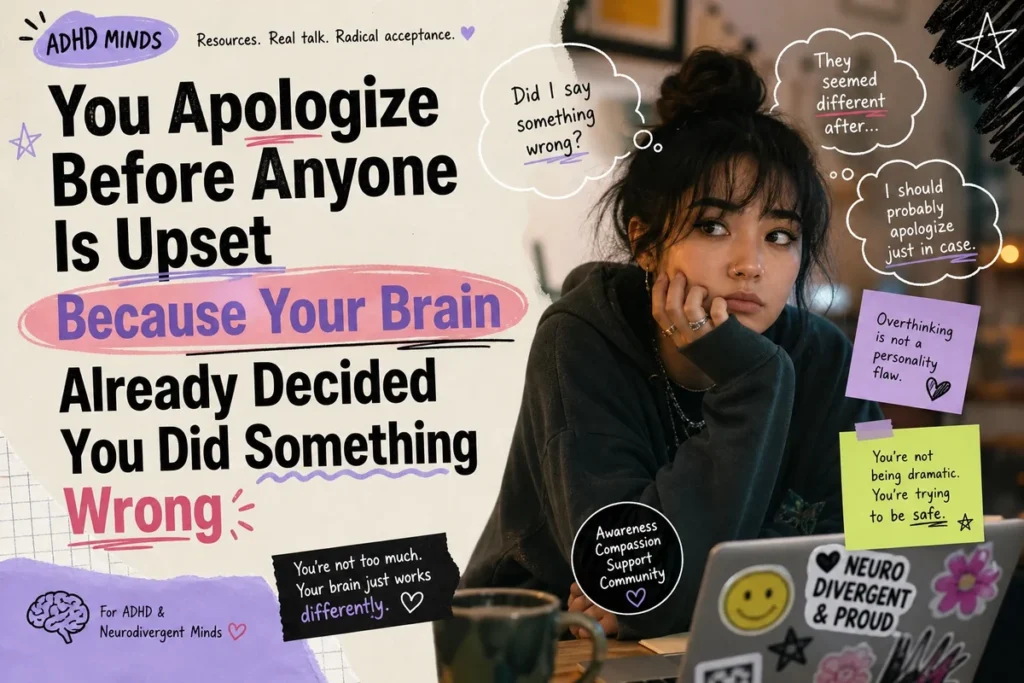
You sent the message at 2:14 p.m. By 2:16 you had already typed "sorry if that was annoying" and hit send on a second message. Nobody replied to the first one yet. Nobody said it was annoying. Your friend might be in a meeting, or in the shower, or just living their life. But your brain had already run the trial, reached a verdict, and sentenced you to an apology. This is the ADHD preemptive apology, and if it's your default setting, you are far from the only one.
It looks like politeness from the outside. From the inside it feels like survival. You are not apologizing because you did something wrong. You are apologizing because your nervous system detected a possible threat and grabbed the nearest tool to make it go away.
What the ADHD preemptive apology actually looks like
It's rarely a dramatic "I am so sorry for what I did." It's smaller and sneakier than that. It's "sorry, random question." It's "sorry for the long text." It's "sorry I'm being a lot right now." It's "sorry to bother you" before you ask a coworker something that is literally their job to answer.
Sometimes it's an apology for taking up space at all. You apologize when someone bumps into you. You apologize to the barista for your order being complicated. You apologize for replying late to a message that was sent four hours ago, to a person who also replies in four hours.
The giveaway is the timing. A normal apology follows an event: you did something, someone was affected, you acknowledge it. A preemptive apology skips the middle step. It fires before anyone has reacted, sometimes before anything has happened. You are apologizing to a reaction that exists only in your head.
Why your brain says sorry first: the RSD connection
Rejection sensitive dysphoria, usually shortened to RSD, describes an intense emotional pain in response to perceived rejection, criticism, or disapproval. The word that matters there is perceived. The rejection doesn't have to be real. It just has to feel possible.
RSD isn't an official diagnosis, but it's a widely used clinical and community term, and the experience it describes is common. Dr. William Dodson, one of the clinicians who has written most about it, has estimated that a large majority of adults with ADHD experience emotional responses to rejection that are far more intense than what people around them expect.1 Emotional dysregulation more broadly is also increasingly recognized as a core part of how ADHD shows up, not a side effect of it.2
So here's what's happening when RSD apologizing kicks in. Your brain scans a social situation and flags a gap: no reply yet, a short answer, a flat tone, a face that didn't light up. It fills that gap with the worst available explanation. Then it looks for the fastest way to reduce the pain before it arrives. An apology is fast. It's cheap. It feels like control.
The ADHD preemptive apology isn't about the other person's feelings. It's an attempt to get ahead of your own.
You've had practice at being wrong
Here's the part that doesn't get said enough. Your brain didn't invent this pattern from nothing. It learned it.
If you grew up with undiagnosed ADHD, you probably heard a lot of corrections. You forgot things. You lost things. You talked too much, or zoned out, or missed what was said two seconds ago. Research on children with ADHD suggests they receive significantly more negative feedback from adults than their peers do, and that kind of repetition shapes how you expect the world to respond to you.3
After enough of that, your brain stops waiting to find out whether you did something wrong. It assumes you did and works backward. For a lot of people dealing with Late Discovery, this is the moment things click: the over-apologizing wasn't a personality flaw. It was a learned reflex from years of being told, in a hundred small ways, that you were a problem to manage.
That reflex made sense when you were a kid. It kept you out of trouble. It's still running now, in a group chat, long after the situation that built it is gone.
ADHD social anxiety and the guessing game
ADHD social anxiety isn't just nerves. It's often a data problem. Social interaction runs on tiny signals: tone, timing, eye contact, pacing. ADHD brains can miss some of those signals, misread others, and then carry a lot of leftover uncertainty about what just happened.
Add in the working memory piece. You replay the conversation afterward because you can't hold all of it in real time. You remember the moment you interrupted. You remember the joke that didn't land. You don't remember the six moments that went fine, because those never set off an alarm.
So you come out of a normal interaction with a highlight reel of your own mistakes. And the preemptive apology becomes a way to patch the uncertainty. If you apologize first, you don't have to find out what they really thought.
What ADHD over-apologizing costs your relationships
This is the part that stings, because the apology is supposed to protect the relationship. Over time, it often does the opposite.
First, it dilutes the real thing. If you say sorry forty times a day, the one time you genuinely owe someone an apology, it lands like background noise. People stop hearing it.
Second, it makes other people do emotional work they didn't sign up for. When you say "sorry I'm so annoying," the polite response is "you're not annoying!" Now your friend is reassuring you about something they never thought. Once or twice, that's fine. Every day, it gets heavy. It can start to feel like they're managing your anxiety instead of just talking to you.
Third, it plants ideas that weren't there. Sometimes the apology creates the problem. "Sorry if that was rude" can make someone go back and reread a message looking for the rude part. You wanted to prevent a reaction and ended up inviting one.
The hidden cost: An ADHD preemptive apology tells the other person you expect to be a burden. Most people don't believe that about you until you keep telling them. Constant apologizing can teach people to see you the way your RSD already does.
Last, it keeps your own nervous system stuck. Every time you apologize and nothing bad happens, your brain doesn't learn "that was safe." It learns "the apology worked." So the loop gets reinforced, and you never collect proof that you would have been fine without it.
How to interrupt the ADHD preemptive apology
You can't white-knuckle your way out of this. If you try to just stop apologizing through willpower, the anxiety has nowhere to go, and it usually comes out sideways. The goal is to work with your brain, not to fight it. Here's what tends to actually help.
Name the trigger before you act on it. The urge to apologize has a signature: a tight chest, a sudden heat, a rush to type. When you feel it, try labeling it in your head: "This is RSD, not a fact." That one sentence creates a tiny gap between the feeling and the action. A gap is all you need.
Sort the apology. Ask yourself whether someone told you there's a problem, or whether you're responding to a feeling. If someone said "hey, that hurt," a real apology is on the table. If you're apologizing to silence, a tone, or a hunch, you're apologizing to your own fear.
Swap sorry for the actual thing you mean. A lot of preemptive apologies are disguised gratitude or disguised requests. "Sorry I'm late again" can become "thanks for waiting." "Sorry to bother you" can become "thanks for taking a look at this." You still acknowledge the other person. You just stop confessing to a crime.
Make the wait survivable. The real work is tolerating the uncertainty after you send a message and before anyone responds. Put the phone in another room. Do something with your hands. Remind yourself of one other explanation that fits the same facts: they're busy, they're tired, they haven't looked yet. You don't have to be convinced. You just have to leave the door open.
When someone is actually upset
None of this means you should never apologize. Real apologies matter, and ADHD does create real friction: missed plans, forgotten replies, interrupted conversations. Owning those things is part of being in relationships.
The difference is proportion and specificity. A real apology is about something that happened, is aimed at the person it affected, and usually comes with a next step. "I'm sorry I forgot your birthday. I should have set a reminder, and I'm going to fix that" does more than "sorry sorry sorry I'm the worst" ever will.
If you tend to spiral into shame when you do get something wrong, that's worth paying attention to too. Shame makes apologies bigger and less useful, because they stop being about the other person and become a request for forgiveness so you can stop feeling terrible. Aim for a clean, short, honest version and then let it be done.
You can be someone who makes mistakes and still not owe an apology for existing. Both things are true at once.
Telling the people close to you
If you have people who matter to you, it can help to tell them what's going on. Not as a big confession, just as information. Something like: "I over-apologize when I'm anxious. If I do it, it's not that I think you're mad. It's just my brain doing its thing."
That one sentence can change how they respond. Instead of reassuring you every time, they might say "no need to apologize, we're good," which is short, kind, and doesn't turn into a whole thing. You can even ask them to be your reality check: "If I'm wrong about this, will you tell me?"
It also helps to notice who makes the apology urge worse. Some people really do react harshly to normal mistakes, and your reflex might be a reasonable read of that environment. If you only over-apologize around certain people, that's useful information about the relationship, not just about your brain.
What to take from all this
The ADHD preemptive apology is not a character flaw, and it's not politeness gone wrong. It's a protective reflex built by a brain that learned early to expect disapproval and now scans for it constantly. Understanding that doesn't make the urge vanish, but it changes what you do with it.
Start small. Catch one apology a day and ask whether it was real or whether it was fear. Replace one "sorry" with a plain sentence. Let one silence stay silent without filling it. Each time nothing bad happens, your brain gets a little more evidence that you're allowed to take up space without paying for it first.
Worth remembering: Your first instinct is to apologize. Your second thought is the one you can choose. The work is learning to wait for the second one.
If you recognize yourself in all of this, you're not broken and you're not too much. You have a brain that learned to brace for impact, and with the right tools you can teach it that the impact usually isn't coming. The next time you feel the ADHD preemptive apology rising in your chest, you'll know what it is: a fear wearing the costume of manners. You get to decide whether to send it.
1 Dodson, W. "Emotional Regulation and Rejection Sensitive Dysphoria," ADDitude Magazine. 2 Shaw, P. et al. (2014). "Emotion dysregulation in attention deficit hyperactivity disorder," American Journal of Psychiatry, 171(3). 3 Danforth, J. S., Barkley, R. A., & Stokes, T. F. (1991). "Observations of parent-child interactions with hyperactive children," Clinical Psychology Review, 11(6).
Rate this article
Was this a useful hit?