You Just Watched 30 Minutes of a Show and Missed All of It Because Your Brain Was Having a Meeting

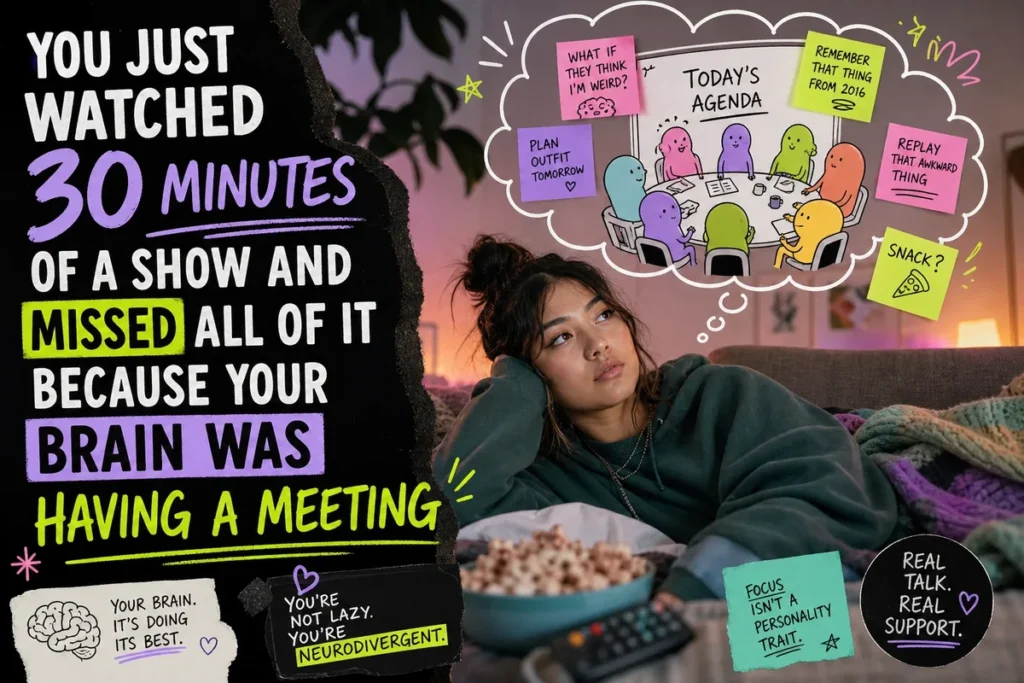
You pressed play forty minutes ago. The show is still running. You have been staring directly at the screen this entire time. And you have absolutely no idea what is happening. Not because the plot is confusing. Not because you got interrupted. But because somewhere around minute three, your brain decided to hold a full executive board meeting about whether you should text your friend back, what you are going to eat tomorrow, and that thing someone said to you in 2019 that might have been passive aggressive. Your eyes stayed locked on the TV. Your attention left the building.
This is ADHD watching TV attention absent in its most honest form. You look like you are watching. You are technically watching. But the information is entering your eyeballs and then dissolving somewhere before it reaches the part of your brain that actually processes narrative. The characters are moving. Things are happening. You are registering none of it. And by the time you surface from whatever internal dimension you just visited, everyone on screen is crying and you do not know why.
Why ADHD Watching TV Attention Absent Is So Universal
If you have ever felt like you must be uniquely bad at the simple act of watching television, let me be clear: this experience is so common among ADHDers that it is practically diagnostic. The inability to stay present during passive entertainment is one of the most underrecognized symptoms of ADHD, partly because it seems so minor. You are not failing a test. You are not missing a deadline. You are just rewinding Netflix for the fourth time. Nobody talks about this in clinical settings.
But the frequency tells the real story. Most ADHDers do not just occasionally zone out during shows. They do it constantly. Chronically. To the point where rewinding is not an occasional correction but a default mode. You are not watching a 45 minute episode in 45 minutes. You are watching it in 70 minutes because you have to keep going back. Or you are watching it twice. Or you are giving up entirely because the cognitive cost of staying present exceeds the enjoyment.
This happens because ADHD fundamentally affects the brain's ability to sustain attention on information that is not actively demanding it. A TV show, no matter how good, is passive. It does not require your input. It does not punish you for looking away. There are no consequences for missing a scene. Your ADHD brain registers this lack of urgency and decides: perfect, this is the ideal time to process every unfinished thought loop I have been avoiding.
The Difference Between Looking and Processing
There is a distinction that neurotypical people often do not understand, and it is crucial for making sense of ADHD attention patterns. Visual attention and cognitive attention are not the same thing. Your eyes can be pointed at something. Your brain can be absolutely somewhere else.
Think of it like a camera versus a hard drive. The camera is recording. The hard drive is full, or busy, or saving something else entirely. The footage exists, technically. But it is not being stored in a way you can access later. You saw the scene. You did not process the scene. And when someone asks "what happened?" you have nothing to report because nothing made it past the visual cortex into actual memory.
Research on ADHD and attention confirms this split. A 2021 study in the Journal of Attention Disorders1 found that individuals with ADHD showed normal eye tracking patterns during visual tasks but significantly reduced retention and comprehension of the material they were ostensibly watching. The eyes worked fine. The executive function system that should have been encoding that information was doing something else entirely.
You are not bad at paying attention. Your attention is just distributed differently than the task assumes it will be.
This is why you can watch an entire movie and remember three scenes, or know that you definitely saw a character die but have no memory of how or when. The information entered. It just did not stick. And the most frustrating part is that you often do not realize you have drifted until you have already missed significant chunks of plot.
Your Internal Dialogue During Media Is Louder Than the Media
Here is what nobody warns you about: ADHD comes with a near-constant internal monologue, and that monologue does not pause just because you have decided to relax and watch something. In fact, passive entertainment often makes it louder. Because you are not actively doing something, your brain has bandwidth to spare. And it will use that bandwidth. It will use all of it.
So you sit down to watch a show, and within minutes you are: Replaying a conversation you had last week. Planning what you are going to say in a conversation you might have next week. Worrying about something you forgot to do. Remembering something embarrassing from high school. Mentally redesigning your bedroom. Composing a text you will never send. Solving a problem that does not exist yet.
All while the show plays. All while your eyes stay on the screen. All while you technically "watch."
This ADHD internal dialogue during media is not voluntary. You are not choosing to think about other things instead of the show. Your brain is running background processes that you cannot fully shut down, and those processes are often more compelling to your attention system than whatever is happening on screen. The show requires sustained focus without novelty. Your internal monologue is all novelty: jumping from thought to thought, idea to idea, worry to worry.
ADHD Dissociation Entertainment and the Zone-Out State
Sometimes it goes beyond just thinking about other things. Sometimes you enter a state that feels closer to dissociation: you are not really thinking anything in particular, you are just gone. The show becomes visual wallpaper. You are aware it is happening. You are not registering any of it. Time passes and you surface and you have no idea where you went.
ADHD dissociation entertainment is different from active distraction. Active distraction means your brain is busy with competing thoughts. Dissociation means your brain has kind of left the building entirely. You are not processing the show, but you are also not processing much of anything else. You are in a low-attention holding pattern, present enough to keep your eyes open but not present enough to actually engage with reality.
This often happens when you are tired, overwhelmed, or using entertainment as a decompression tool after a demanding day. Your brain is so depleted that it cannot sustain attention on anything, including the thing you chose specifically to relax with. So it just floats. And the show keeps playing. And later you have a vague sense that you watched something without any real memory of what it was.
This is not laziness: Zoning out during entertainment is a sign your brain's attention regulation system is working differently, not a personal failure to "just pay attention." You cannot willpower your way into sustained passive focus when your executive function is depleted.
Why Rewatching Is the Norm, Not the Exception
If you have ever felt weird about how many times you rewatch shows, or how many times you rewind during a single episode, let me reframe this for you: rewatching is not a sign you are doing something wrong. It is the accommodation your brain needs to actually absorb content.
Most ADHDers do not watch things once. They watch things multiple times because the first viewing was mostly about getting the gist, and subsequent viewings fill in everything they missed. This is not inefficient. It is just how your attention system processes passive media. The first pass is surface level. Repeated exposure deepens it.
This is also why many ADHDers gravitate toward rewatching favorite shows rather than starting new ones. A new show requires full attention to track characters, relationships, and plot. A familiar show requires less: you already know the scaffolding, so your brain can drift without losing the thread entirely. Rewatching is lower cognitive cost. It accommodates your attention style instead of fighting it.
There is no shame in being a rewatcher. You are not failing to engage with new content. You are working with your brain instead of against it.
ADHD Presence Attention Watching and What Actually Helps
So what do you do when you want to actually watch something and retain it? The goal is not to force yourself into sustained attention you do not have. The goal is to create conditions where your attention has more anchor points.
Subtitles help enormously. Adding a second sensory channel, reading along with what you hear, gives your brain another way to stay tethered to the content. Many ADHDers find they cannot watch anything without subtitles because the visual text forces a level of engagement that audio alone does not demand.
Choosing the right time matters. Trying to watch something complex when you are already depleted is setting yourself up for dissociation. If you actually want to follow a new show with intricate plot, schedule it for when your attention resources are highest, not as a wind-down activity after a demanding day.
ADHD presence attention watching is not about trying harder. It is about reducing the competition for your attention and giving your brain more ways to stay anchored.
Some people find that doing something with their hands helps. Folding laundry, crocheting, playing with a fidget toy. This seems counterintuitive, but occupying the part of your brain that wants to wander can actually free up attention for the show. The physical task absorbs restless energy that would otherwise fuel internal dialogue.
And sometimes, the most helpful thing is just accepting that you are going to miss things, and that is okay. Not every viewing needs to be complete. Not every show needs full attention. Some things are fine as background. Some things you will rewatch later. You do not have to perform neurotypical viewing habits to enjoy entertainment.
When Your Brain Will Not Stop Having Meetings
If the internal dialogue feels constant, if you cannot turn it down no matter what you try, that is worth paying attention to. Sometimes the thoughts that hijack your TV watching are thoughts that actually need processing: unresolved stress, anxiety, decisions you are avoiding, emotions you have been suppressing.
Your brain uses low-demand moments like watching TV to surface things it could not address while you were busy. If the same thoughts keep interrupting, that might be your brain's way of saying: this needs attention. Not the show. This.
Sometimes the most effective thing is to pause the show, write down what you were thinking about, and ask yourself if that thought needs action or if it can wait. Giving the thought a container can reduce its urgency. It no longer needs to interrupt because you have acknowledged it exists.
And if the internal dialogue is genuinely uncontrollable, if it causes distress beyond just mild annoyance, tools like emotional regulation support can help you build patterns that quiet the noise. This is not about silencing your brain permanently. It is about developing capacity to shift your attention more deliberately when you want to.
Try Steady: If your internal dialogue feels relentless, especially when you are trying to rest, Steady can help you build patterns for recognizing and redirecting runaway thoughts before they take over your entire evening.
You Are Not Failing at Relaxation
This might be the most important reframe: struggling to stay present during entertainment is not evidence that you are bad at relaxing. It is evidence that ADHD affects attention across all domains, including ones that are supposed to be fun and easy.
Nobody talks about this because it seems trivial compared to work struggles or relationship difficulties. But the experience of not being able to engage with the things you chose for enjoyment is its own kind of exhausting. You wanted to unwind. Instead, you spent an hour in your own head and have nothing to show for it. That gap between intention and experience matters.
Recognizing that ADHD watching TV attention absent is a symptom, not a personal failing, changes the emotional weight of the experience. You are not broken. You are not lazy. You are not uniquely incapable of simple tasks. Your brain processes attention differently. That includes entertainment attention.
Work with it. Use subtitles. Rewatch freely. Let some things be background noise. Pause when your brain clearly needs to address something else. You do not owe anyone neurotypical viewing habits, and you definitely do not owe yourself guilt for missing half the plot because you were accidentally solving a problem from 2019.
Your brain had a meeting. Now you know what happened. Rewind the show and try again, or do not. Either way, you are not doing this wrong.
1 Friedman, L. M., & Rapport, M. D. (2021). Attention during passive viewing in children with ADHD: Eye tracking versus comprehension. Journal of Attention Disorders, 25(8), 1098-1110.
Rate this article
Was this a useful hit?