The Sounds and Fabrics and Lighting Conditions That Make You Want to Leave Your Own Skin

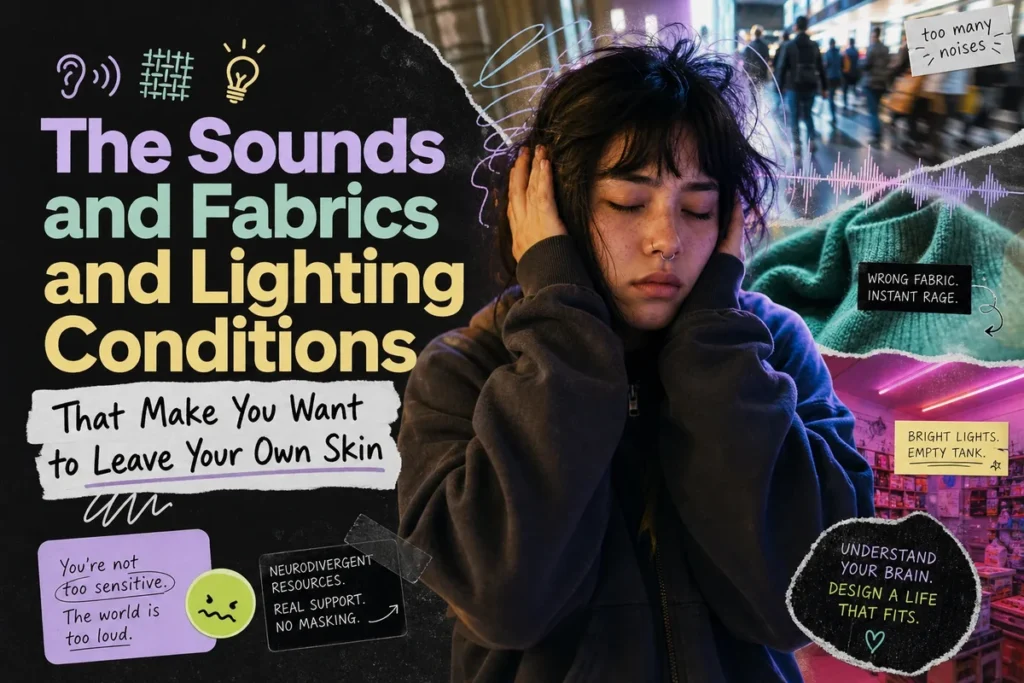
You're at dinner with friends and someone across the table is chewing with their mouth slightly open and you cannot hear a single word of the conversation because your entire nervous system has locked onto that sound like a heat-seeking missile. You're smiling and nodding but inside you're calculating exactly how rude it would be to leave right now. Or maybe it's the fluorescent lights at work that feel like they're drilling into your skull, even though nobody else seems to notice them flickering. Or the tag on your shirt that you've already cut out twice but somehow there's still a seam touching your neck and you want to rip the whole thing off in the middle of a meeting.
If you've ever described a sensory experience as wanting to "leave your own skin," you're not being dramatic. You're describing what ADHD sensory overload in adults actually feels like from the inside.
ADHD Sensory Overload Adults: The Thing Nobody Told You About
Here's what probably happened: you got diagnosed with ADHD, or you started suspecting it, and you read about the attention stuff, the executive function stuff, maybe the emotional dysregulation stuff if you got lucky with your sources. But nobody mentioned that roughly 69% of adults with ADHD have clinically significant sensory processing difficulties.1 Nobody explained why you've owned four identical black t-shirts for years because finding a comfortable fabric feels like winning the lottery, or why you need headphones just to exist in public spaces.
Sensory processing issues weren't even in the ADHD conversation until recently. They're still not in the diagnostic criteria. But researchers are finally catching up to what you've known your whole life: your nervous system processes sensory input differently, and "differently" often means "at maximum volume with no filter."
The neurotypical brain is constantly filtering sensory information, deciding what's relevant and what can be safely ignored. The ADHD brain often struggles with this filtering. Every input gets flagged as potentially important. The hum of the refrigerator, the texture of your jeans, the brightness of your phone screen, the smell of someone's lunch three desks away. Your brain treats all of it as urgent information that demands attention, even when you desperately need to focus on something else.
Why Certain Sounds Bother You So Much It Feels Personal
Let's talk about sound specifically, because this is the one that makes people feel the most crazy. The term for extreme sound sensitivity is misophonia, and while it's a distinct condition, it overlaps significantly with ADHD. Research suggests that people with ADHD are far more likely to experience misophonia than the general population.2
When someone is chewing, clicking a pen, tapping their foot, or breathing in a particular way, your brain might register that sound as not just annoying but genuinely threatening. Your fight-or-flight response activates. Your heart rate increases. You experience actual physical distress that you then have to mask because "the sound of someone eating shouldn't make you this angry."
The worst part isn't the sound itself. It's knowing your reaction is "disproportionate" while being completely unable to stop having it.
This isn't a willpower issue. The sound is triggering your autonomic nervous system in ways you cannot consciously control. Your body is responding to chewing sounds the way it might respond to a predator. The fact that you know this is irrational changes nothing about the physical response.
ADHD sensory sensitivity to noise and clothing textures operates on the same principle: your nervous system's volume control is broken, and it's stuck on loud. What neurotypical people experience as background noise, you experience as foreground noise. Always. Constantly. With no off switch.
The Clothing Thing Is Not You Being Picky
You probably have a complicated relationship with getting dressed. There are shirts you've worn exactly once because something about the fabric was wrong in a way you couldn't articulate. Tags are obviously unacceptable. Certain seams feel like they're actively attacking you. Waistbands can ruin your entire day. You've learned which brands and materials work for your body, and you buy multiples of the same item like you're building a sensory-safe uniform.
This is called tactile defensiveness, and it's extremely common in ADHD. Your skin is processing touch information at a heightened level. What feels neutral to someone else feels actively uncomfortable to you. The sensation doesn't fade into the background the way it should. It stays present, demanding attention, pulling cognitive resources away from whatever you're actually trying to do.
The Cognitive Cost: Every moment you spend being aware of an uncomfortable fabric is a moment you're not spending on the task in front of you. Sensory discomfort isn't separate from your focus issues. It's directly competing for the same limited attention.
This is why the "just ignore it" advice is so useless. You can't ignore it any more than you could ignore someone poking you in the arm repeatedly. Your nervous system won't let you. The sensation keeps registering as new information that requires processing.
Fluorescent Lights and the Office Environment Conspiracy
Modern open-plan offices were basically designed by people who have never experienced neurodivergent sensory processing. Fluorescent lighting, constant visual movement in your peripheral vision, multiple conversation streams happening simultaneously, climate control that's never quite right, the omnipresent hum of electronics. It's a sensory assault that you're expected to function normally within for eight hours a day.
The fluorescent light issue deserves special attention. These lights flicker at a frequency that most people can't consciously perceive, but your brain might be picking it up anyway. Research shows that people with ADHD often have heightened sensitivity to visual stimulation, and fluorescent lighting has been linked to increased stress responses in sensitive individuals.3
You're not imagining that the lights feel wrong. Your nervous system is detecting something real that other people's nervous systems are successfully filtering out. This is what neurodivergent sensory processing looks like in practice: accurate detection of stimuli that causes distress because there's no filter preventing that detection.
Why Parties and Crowds Drain You Faster Than Everyone Else
You've probably noticed that you hit your social limit faster than your friends. An hour into a party and you're calculating exit strategies while everyone else is just getting started. Crowded restaurants, concerts, busy streets. All of it costs you more energy than it costs the people around you.
It's not that you don't like people. It's that being around people in loud, visually busy environments requires you to process ten times more sensory information than anyone else in the room.
Your brain is tracking every conversation fragment, every movement in your peripheral vision, every shift in music volume, every change in lighting. You can't turn this off. You can't "just relax and have fun" because your nervous system is working overtime to process an environment that was designed without you in mind.
This is why you might prefer one-on-one hangs, or quiet bars, or hanging out at someone's apartment. It's not antisocial. It's strategic. You've learned which environments allow you to actually enjoy being social versus which ones will drain your battery in an hour.
ADHD Sensory Overload and Emotional Regulation
Here's the connection that took me forever to make: sensory overload directly triggers emotional dysregulation. When your nervous system is overwhelmed by sensory input, your emotional regulation capacity tanks. The snap of irritation, the tears that come out of nowhere, the sudden desperate need to be alone. These aren't separate from the sensory experience. They're downstream effects.
Think about the last time you were in a sensory-overwhelming environment for too long. You probably became short-tempered, or weirdly emotional, or completely checked out. Your nervous system was overloaded, and your emotional regulation suffered because you were out of bandwidth.
The Shame Spiral: You get sensory overloaded, you snap at someone or start crying or have to leave abruptly, then you feel ashamed of your "overreaction," which adds emotional load to an already overloaded system. Breaking this cycle starts with recognizing that the original sensory response was real and valid.
Adults with ADHD sensory overload aren't choosing to be difficult. Your nervous system hit its limit, and the emotional fallout was the predictable result. Understanding this changes how you talk to yourself about these moments.
What Actually Helps (Beyond "Just Deal With It")
The good news is that sensory management is learnable. You can't fix your nervous system's sensitivity level, but you can build systems and environments that work with your brain instead of against it.
Headphones are non-negotiable. If you don't already own noise-canceling headphones or earbuds, this is your sign. The ability to control your auditory environment is life-changing for sensory-sensitive ADHDers. Yes, they're expensive. Yes, they're worth it. Think of them as medical equipment.
Know your triggers with specificity. "Loud noises" is too vague. "Chewing sounds, pen clicking, and bass-heavy music in enclosed spaces" is actionable. The more specifically you can identify what overloads you, the better you can plan around it or advocate for accommodations.
Build in recovery time. If you know you'll be in a sensory-intense environment, schedule alone time before and after. This isn't being antisocial. It's managing your nervous system like the biological reality it is.
Create a sensory-safe home base. Your living space should be optimized for your nervous system. Dimmable lights or lamps instead of overhead lighting. Textures you can actually tolerate. A quiet space to retreat to. You spend significant time here. Make it work for you.
Communicate before you're overloaded. Tell people you're close to about your sensory needs before you're in crisis. "Hey, I need to leave when I get overwhelmed, and it's not personal" is easier to say when you're calm than when you're already at capacity.
The Permission You Didn't Know You Needed
You are not high-maintenance, difficult, or too sensitive. You have a nervous system that processes sensory information differently than the majority, and you've been trying to function in environments designed for that majority your entire life. The exhaustion makes sense. The frustration makes sense. The elaborate coping strategies you've built make sense.
Sixty-nine percent. That's how many adults with ADHD have significant sensory processing issues. You're not alone in this, even though sensory experiences are by definition internal and isolating. Other people are also calculating exit strategies at parties. Other people also own four of the same shirt. Other people are also wearing headphones not because they're antisocial but because the world is too loud.
Understanding your sensory needs isn't about limitation. It's about finally having accurate information about what your nervous system requires to function.
Adults with ADHD sensory overload deserve environments and relationships that don't require them to constantly override their own nervous systems. You deserve to know why certain experiences feel unbearable when they don't seem to bother anyone else. You deserve strategies that actually work instead of advice to "just relax."
Your sensory experience is real. Your nervous system is doing exactly what it does. And now that you have language for this, you can start building a life that accounts for it instead of constantly fighting against it.
1 Ghanizadeh, A. (2011). Sensory processing problems in children with ADHD: a systematic review. Psychiatry Investigation.
2 Rinaldi, L. J., et al. (2022). Misophonia is associated with altered brain activity in the auditory cortex and salience network. Scientific Reports.
3 Küller, R., & Laike, T. (1998). The impact of flicker from fluorescent lighting on well-being, performance, and physiological arousal. Ergonomics.
Rate this article
Was this a useful hit?