Your Phone Has Six Reminders Going Off Right Now. You Have Ignored All Six. Here Is Why That Is Not Failure.

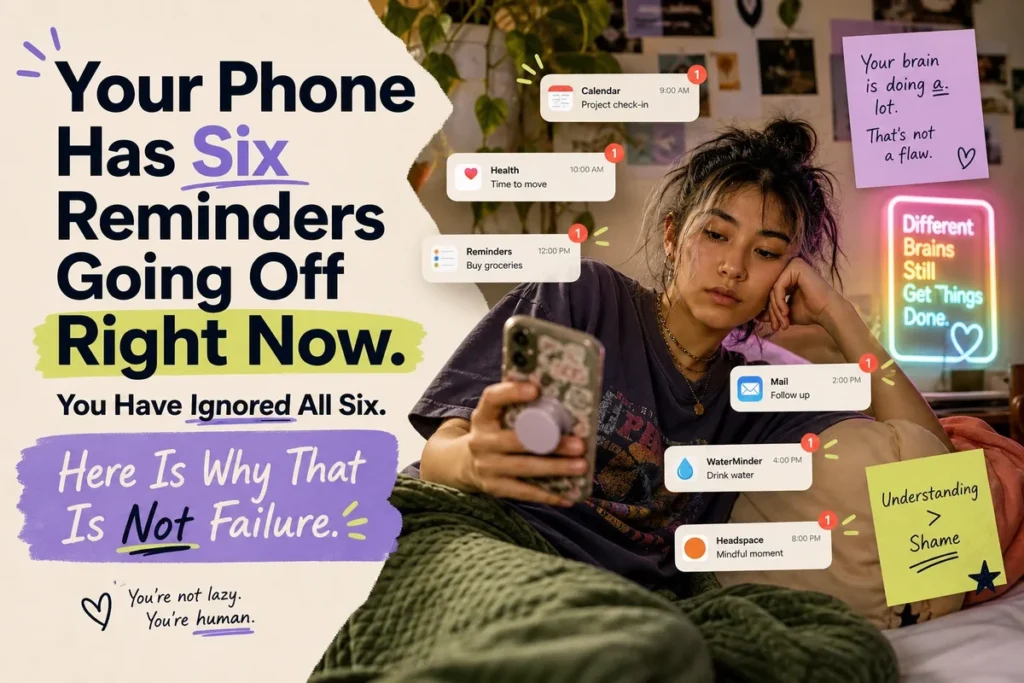
The alarm goes off at 2pm. You set it yourself, three weeks ago, when you genuinely believed that a daily reminder would finally help you remember to take your medication. You hear the sound. You see the notification. And then your thumb swipes it away before your conscious brain even registers what it said. You do not take the medication. You will not remember that this happened until 11pm tonight, when you are lying in bed wondering why you feel off.
Six reminders. You currently have six recurring reminders on your phone. You could probably only name three of them if someone asked. The others have become part of the ambient noise of your life, no different from the hum of your refrigerator or the sound of traffic outside. They were supposed to fix things. They were supposed to be the system that finally worked. And now they are just more evidence of something you already suspected about yourself: that you are somehow fundamentally incapable of doing what needs to be done.
Except that is not what is happening. What is happening is called ADHD alarm notification blindness, and it is not a character flaw. It is a predictable, documented feature of how brains process repeated stimuli. Specifically, brains like yours.
ADHD Alarm Notification Blindness Is Not a Willpower Problem
Here is what happens when you set a reminder for the same time every day: Your brain, doing exactly what brains are designed to do, starts categorizing that stimulus. The first few times the alarm goes off, it is novel. Your attention snaps to it. You actually read the notification. You might even do the thing.
Then your brain learns the pattern. It goes: "Oh, this is the 2pm sound. We have heard this sound before. It does not indicate danger. It does not indicate reward. It indicates that we are supposed to stop what we are doing and do something else, which requires effort, which we do not want to do." And then your brain does something very efficient: it stops allocating conscious attention to that stimulus at all.
This process is called habituation, and it happens in every human brain. It is why you stop noticing the smell of your own apartment after ten minutes, why you do not consciously feel the sensation of your clothes against your skin all day, why you can tune out a ticking clock. Your brain cannot possibly pay attention to everything, so it learns to filter out stimuli that are repetitive and non-threatening.
The problem is that the ADHD brain habituates faster and more completely than neurotypical brains, particularly to stimuli that are not immediately rewarding or threatening.1 That alarm you set with hope and intention? Within a week, your brain has already filed it under "ignorable background noise." It is not that you are choosing to ignore it. It is that the conscious, decision-making part of your brain never even gets the memo that the alarm happened.
The Clown Nose You Wear Is Actually a Brain Feature
There is a specific experience that almost every ADHDer knows: the moment when the alarm goes off and some part of you watches yourself dismiss it. You see your own thumb swiping. You know, on some level, what is happening. But there is a disconnect between knowing and doing, and the knowing part just sort of shrugs while the doing part carries on with whatever you were already doing.
One person described it as their ADHD saying: "That alarm will not stop me. Turn it off. We are hyperfocusing, doing nothing, self-loathing, anything other than what we are supposed to do right now." And then they added: "I wear the clown nose in this relationship."
That clown nose feeling is the gap between intention and action. You had every intention of responding to that alarm. You set the alarm because you wanted to respond to it. But somewhere between the sound and the doing, your brain dropped the ball. And then you blame yourself for having a brain that works this way.
The ADHD brain does not lack the desire to follow through. It lacks the consistent neural machinery to translate external reminders into internal action without significant environmental support.
This is not you being lazy. This is not you not caring enough. This is a neurological difference in how your brain processes routine cues. And the system you are using, the same-time daily alarm, is specifically designed in a way that plays into your brain's greatest weakness.
Why Same-Time Reminders Are Set Up to Fail
Think about what a recurring daily alarm actually requires from your brain:
It requires you to be in a state where you can act on it. If the alarm goes off while you are in a meeting, in the shower, driving, or mid-hyperfocus, you cannot act on it immediately. You tell yourself you will do it after. You will not remember this plan five minutes later.
It requires the alarm to still feel meaningful after weeks of repetition. It will not. Habituation will drain all the urgency out of that sound within days.
It requires you to have the activation energy to start a task at an arbitrary time. ADHD brains struggle to generate activation energy on demand. A clock saying "now is the time" does not give you the momentum to begin.
It requires the alarm to survive your brain's tendency to dismiss threats to your current activity. If you are doing something, anything, even scrolling your phone mindlessly, your brain will protect that activity from interruption. The alarm is an interruption. Your brain will eliminate it.
This is why the ADHD reminder ignore pattern is so consistent. You are not uniquely broken. You are using a tool that was designed for brains that work differently than yours.
What Your Brain Actually Responds To
If predictable, same-time alarms do not work, what does? The answer is anything that your brain cannot habituate to easily.
Novelty. Change your alarm tone every few days. Use an app that randomizes the sound or the wording. Your brain cannot tune out something it has not heard before. This is a temporary fix, because eventually the novelty wears off, but it buys you time.
Context-specific cues. Instead of setting a time-based reminder, set a location-based one. "Remind me when I arrive at the grocery store" uses a different part of your brain than "remind me at 3pm." Your phone can trigger reminders based on where you are, and that context is harder for your brain to ignore because it is tied to a concrete environment.
Environmental triggers. Put your medication bottle on top of your coffee maker. Put your running shoes in front of the door. Put the thing you need to remember in a place where you cannot avoid seeing it before you do the other thing you were going to do anyway. Physical objects in physical space work better than digital sounds because they require you to physically interact with them to continue your routine.
The Obstacle Method: Make the reminder impossible to ignore by making it an actual physical obstacle to something you will definitely do. Pills on the coffee maker. Gym bag blocking your TV. The thing in the way of the other thing.
External accountability. Here is the uncomfortable truth: the ADHD brain often responds more reliably to other people than to its own reminders. Someone asking "did you do the thing?" activates a different motivational system than an alarm you set for yourself. Body doubling, accountability partners, and shared check-ins work because they introduce a social element that your brain cannot habituate to in the same way.
There is a reason why one person noted that their dog gets perfect care while their houseplants die: the dog pesters them. The dog knocks the controller out of their hand. The dog provides ongoing, impossible-to-ignore accountability. The plant just sits there, silently hoping to be remembered, like your alarms.
ADHD Phone Alerts Become Useless on a Predictable Timeline
Here is the timeline of most ADHD reminder systems:
Week 1: You set the alarm. It feels like a solution. You respond to it almost every time. You feel like you have finally cracked the code.
Week 2: You miss a couple of alarms. You tell yourself it is just because you were busy those times. You still mostly respond.
Week 3: You are dismissing the alarm before you consciously register what it says. When someone asks if your reminder system is working, you say "yeah, mostly" because you have not yet realized how often you are missing it.
Week 4 and beyond: The alarm is just a sound your phone makes sometimes. It has no more meaning than a notification from an app you forgot you installed. You keep it running because turning it off would feel like giving up, but it is not doing anything anymore.
This is not failure. This is just what happens when you use the wrong tool for your brain type. Understanding this timeline means you can plan for it instead of being surprised by it.
Building Systems That Survive Habituation
The goal is not to find the one perfect reminder system. The goal is to accept that any system you build will have a shelf life, and to plan for rotating systems before they stop working.
Some people cycle between different alarm apps, using each one for a few weeks before switching. The switch itself creates novelty that buys more time. Others build in manual variety: instead of the same alarm every day, they set alarms at slightly different times, with different messages, so the pattern is harder for their brain to predict and dismiss.
The people who have the most success tend to combine multiple types of reminders. A phone alarm plus a physical object in their space plus a check-in from another person. Redundancy means that if your brain habituates to one reminder, another one might still get through.
The "cheap version" trick works for some people: when the alarm goes off and you do not want to do the full thing, do the smallest possible version. Not a full workout, just put on the shoes. Not a full email, just open the draft. Sometimes that small action creates enough momentum to carry you into the rest.
And sometimes it does not work. Sometimes you cannot even do the cheap version. Sometimes you are cranky or depleted or in a state where no amount of clever reminder systems will help. That is real too. The goal is not perfection. The goal is to set yourself up to succeed more often than you would without any system at all.
The Permission to Stop Blaming Yourself
Here is what ADHD notification habituation brain actually means for your self-image: every time you ignored an alarm, you were not failing at being a functional adult. Your brain was doing exactly what brains do. It was filtering out repeated stimuli to save cognitive resources for things it judged more important or more novel or more rewarding.
The problem was never your willpower. The problem was a mismatch between the tool and the brain. You were using a hammer to screw in a lightbulb and wondering why you kept shattering glass.
Reframe the narrative: Every dismissed alarm is data about what does not work for your brain, not evidence of your inadequacy. You have been running experiments this whole time. Now you can use the results.
Those six ignored reminders on your phone are not proof that you are broken. They are proof that you have been trying, using the only tools anyone ever taught you to use, and those tools were not designed for you. The fact that you kept setting new alarms, kept hoping this one would work, kept trying despite repeated failure: that is not the behavior of someone who does not care. That is the behavior of someone who cares deeply but has not yet found the right approach.
What Happens When You Stop Fighting Your Brain
ADHD alarm notification blindness does not go away. You cannot willpower your way into a brain that does not habituate to repetitive cues. What you can do is work with how your brain actually functions instead of against it.
You can accept that alarms have a shelf life and plan for rotation. You can use physical cues instead of digital ones where possible. You can enlist other people as external reminders when the stakes are high. You can stop measuring yourself against a standard that assumes your brain works like a neurotypical one.
The reminder system that works is the one that accounts for how your specific brain processes information. Not the one that works for your neurotypical roommate. Not the one that productivity influencers swear by. The one that actually gets through your brain's filters and results in you doing the thing.
You have been trying. The alarms prove it. Now you have better information about why the alarms stopped working, and you can use that information to build something that actually helps. Your brain is not the enemy here. It is just a brain that needs different tools. And understanding ADHD alarm notification blindness is the first step toward finding them.
1 Sergeant, J. (2000). The cognitive-energetic model: an empirical approach to attention-deficit hyperactivity disorder. Neuroscience & Biobehavioral Reviews, 24(1), 7-12.
Rate this article
Was this a useful hit?