You Are Not Resting. You Are Not Working. You Are Just Existing in the Void Between Them.

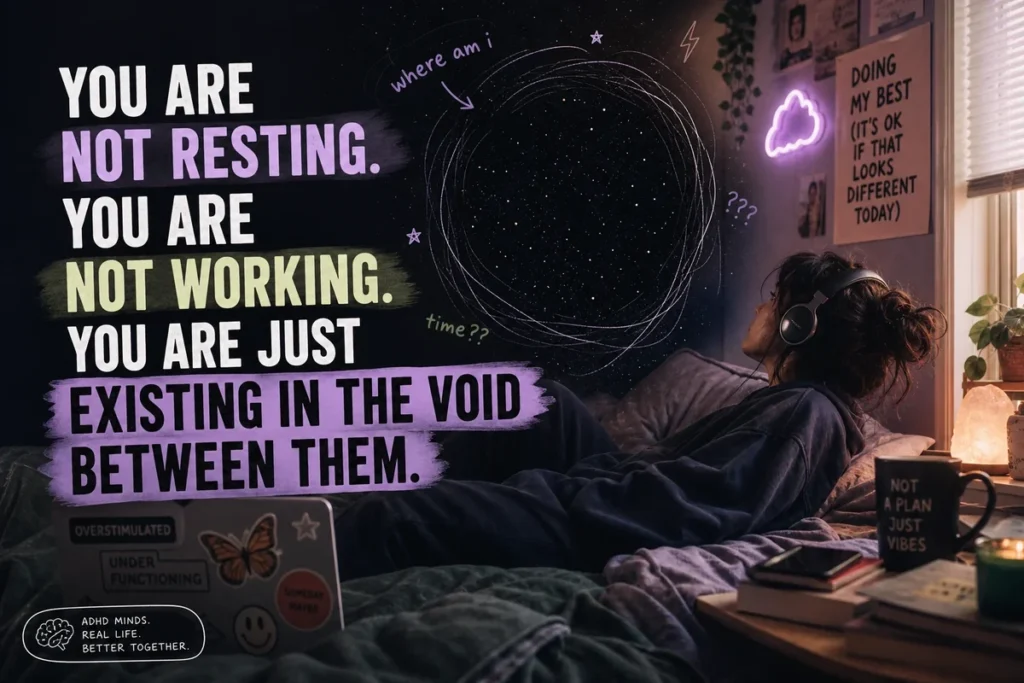
You're on your phone. You've been on your phone for three hours. You're not enjoying it. You're not even really looking at what's on the screen anymore. You're just scrolling, and somewhere in the back of your skull there's a voice screaming that you need to be working, you need to be productive, you have things to do. But you also can't stop. And you definitely can't start. So you just exist there, in this horrible middle place where nothing gets done and nothing feels good and time just evaporates. This is ADHD productivity void paralysis, and if you've lived it, you know it's worse than regular procrastination. At least procrastinators are having fun.
You won't let yourself go hang out with friends because you're "supposed to be working." You won't watch that show you've been excited about because that would be "wasting time." But you also won't do the work. So instead of wasting time in a way that actually recharges you, you waste it in the worst possible way: stuck, guilty, and exhausted, doing the most useless things imaginable while mentally beating yourself up for every passing minute.
Days of this. Weeks. Months. Years, sometimes. Not spent relaxing. Not spent being productive. Just gone. Burned away in the void between two states you can't reach.
What ADHD Productivity Void Paralysis Actually Is
Let's name this thing properly because "procrastination" doesn't cover it. Procrastination implies you're putting something off to do something else. This isn't that. This is a neither-state. A limbo. You're not choosing rest over work. You're not choosing work over rest. You're frozen in a place where both options feel equally impossible.
The productivity void has two locked doors. One is the activation barrier: the neurological wall that makes starting tasks feel like trying to push through concrete. The other is the guilt barrier: the mental block that won't let you actually rest because you "should" be doing something. With both doors locked, you're trapped in the hallway. Scrolling. Refreshing. Checking the same three apps in rotation. Watching your life tick away while doing nothing that counts as living.
This isn't a character flaw. It's not laziness. It's what happens when your brain's regulatory systems are working against each other. The ADHD brain struggles with both task initiation (getting started) and emotional regulation (letting go of guilt). Put those together and you get the void: a state where you can't do the thing, but you also can't not think about the thing, so you can't do anything else either.
Why You Can't Just "Start Working" or "Let Yourself Rest"
People love to give advice like "just do it" or "give yourself permission to relax." They say it like it's simple. Like you haven't tried. Like the problem is that you just forgot to flip the switch.
Here's what they don't understand: for the ADHD brain, task initiation requires a level of activation that doesn't always show up on command. Dr. Russell Barkley's research on ADHD and executive function shows that the prefrontal cortex, which handles planning, initiation, and self-direction, is underactivated in ADHD.1 You're not choosing not to start. The neurological resources required to begin simply aren't available. It's like trying to start a car with a dead battery. You can turn the key all you want.
But the rest side is just as broken. Your nervous system is stuck in a low-level stress response. The sympathetic nervous system, the fight-or-flight system, stays activated because there's an undone task pinging in the background of your awareness. You know you should be doing something. That knowledge keeps your body in a state of readiness that prevents actual relaxation. You might be lying on the couch, but your cortisol levels say otherwise. Your muscles are tense. Your mind is racing. You're physically incapable of the parasympathetic downshift that real rest requires.
So you're stuck. Too stressed to rest. Too depleted to work. Neither option is available, so you default to the only thing that takes zero activation and provides a tiny dopamine drip: your phone. Scroll. Refresh. Repeat. Hours dissolve.
The ADHD Guilt Spiral That Keeps You Stuck
The worst part of ADHD productivity void paralysis isn't the lost time. It's the internal monologue that plays while you're losing it.
You're wasting your life. Everyone else can just do things. Why can't you just do things? You're so lazy. You're going to fail at everything. You don't deserve to have fun. You haven't earned rest. You haven't done anything.
That voice is constant. It's the background static of the void. And here's the cruel irony: the guilt and self-criticism actually make the paralysis worse, not better. Shame is not motivating for ADHD brains. Research on ADHD and motivation shows that shame and self-criticism increase avoidance behaviors.2 The more you beat yourself up, the harder it becomes to start. The harder it becomes to start, the more you beat yourself up. It's a feedback loop with no exit.
The guilt also prevents rest from working. Even if you forced yourself to watch a movie or take a nap, you wouldn't actually recharge because you'd spend the whole time feeling terrible about not being productive. Rest requires your nervous system to believe it's okay to rest. When the guilt voice is screaming, that belief is impossible.
So the guilt doesn't help you work. It doesn't help you rest. It just keeps you in the void, maximizing suffering while minimizing both productivity and recovery.
Why Your Phone Is the Default Destination
There's a reason the void always ends up on your phone. It's not because you're addicted to social media, though that might also be true. It's because your phone is the only thing that requires zero activation energy while providing just enough stimulation to keep the panic at bay.
Real tasks require initiation. Real rest requires release. Your phone requires neither. You can scroll indefinitely without ever making a decision, starting a project, or letting go of tension. It's the perfect limbo machine. It keeps you technically occupied so you don't have to face the full horror of the void, but it provides nothing of substance. No accomplishment. No restoration. Just time, evaporating.
The trap: Your phone feels like a choice, but it's actually what happens when all your choices are blocked. It's the default state when both working and resting are inaccessible. You're not choosing your phone over other options. You're falling into it because the other options require something you don't have right now.
This matters because people will tell you to "put down your phone" like that solves the problem. It doesn't. If you put down your phone without addressing the underlying paralysis, you'll just stare at the wall feeling terrible. Or you'll pick the phone back up in ten minutes. The phone isn't the cause. It's the symptom.
ADHD Productivity Void Paralysis and the Grief of Lost Time
Let's talk about something that doesn't get discussed enough: the grief. The genuine, legitimate grief of looking back at months or years spent in the void and realizing that time is gone.
If you'd spent that time working, you'd have something to show for it. If you'd spent it relaxing, you'd at least have the memories, the experiences, the recovery. But you didn't get either. You got nothing. Just the vague, sick memory of being stuck. Of days that blur together because nothing distinguished them. Of potential that evaporated while you watched, unable to move.
That grief is real and you're allowed to feel it. You're allowed to be angry. You're allowed to mourn the person you could have been if your brain worked differently. The friendships you didn't nurture because you were "supposed to be working." The projects you never finished. The fun you didn't let yourself have.
But, and this matters: that grief is about the past. It's information about what wasn't working. It's not a sentence for the future. Understanding what the void actually is, neurologically and psychologically, is the first step toward spending less time in it.
Breaking Out of the Neither-State
You can't just willpower your way out of ADHD productivity void paralysis. If you could, you would have already. But there are strategies that work with your brain instead of against it.
The first principle is reducing the activation energy for tasks. The reason you can't start isn't that you're lazy. It's that the gap between "not doing" and "doing" is too large for your brain to bridge without external support. So you make the gap smaller. Don't commit to "working on the project." Commit to opening the document. Don't commit to "cleaning the apartment." Commit to putting one thing in the trash. Make the first step so small that it barely counts as a step. Your brain might not be able to cross a chasm, but it can probably step over a crack.
The second principle is externalizing the task list. Part of why you can't rest is because you're holding everything in your head. The undone tasks are bouncing around your working memory, keeping your stress response activated. Write them down. All of them. Not because you're going to do them all right now, but because once they're on paper, your brain can stop trying to remember them. One list for things that actually need to happen today. One list for things that can wait. The act of getting it out of your head and onto a physical surface can break the mental loop that keeps you stuck.
The third principle is giving yourself actual permission to rest, and that means making rest an active choice rather than a default. The void happens when rest is something you "fall into" while feeling guilty. Real rest happens when you consciously decide: "For the next hour, I am off duty. I am going to watch this show. I am going to take this walk. I am not available for productivity, and that's okay." Schedule it. Put it in your calendar. Make it a commitment you keep with yourself.
The void thrives on ambiguity. When you're vaguely supposed to be doing something, you can't do anything. When you know exactly what you're supposed to be doing, or when you know that right now you're supposed to be doing nothing, the paralysis loosens.
The Permission You're Not Giving Yourself
Here's a truth that might hurt: you're punishing yourself, and the punishment isn't working. Refusing to let yourself rest because you "haven't earned it" doesn't make you more productive. It just makes you exhausted and stuck. The guilt doesn't motivate you. It immobilizes you.
You have ADHD. Your brain works differently. The strategies that work for neurotypical people, the ones who can just "decide to start" or "choose to relax," don't work for you. That's not a moral failing. It's neurology. And continuing to treat yourself like a neurotypical person who's just being lazy is continuing to set yourself up for the void.
What if you gave yourself permission? Not permission to be irresponsible, but permission to work with your actual brain. Permission to rest without earning it. Permission to break tasks into embarrassingly small pieces. Permission to stop pretending you can operate like everyone else and start figuring out what actually works for you.
The paradox: When you give yourself real permission to rest, you often become more productive. When you reduce the activation barrier to near-zero, you often accomplish more than when you're trying to force yourself to do big things. The void exists because you're being too hard on yourself, not too easy.
Moving Forward Without the Void
You're not going to eliminate ADHD productivity void paralysis entirely. Your brain is still your brain. There will still be days when the activation barrier is insurmountable and the guilt is overwhelming. But you can reduce the time you spend in the void. You can learn to recognize when you're entering it and intervene earlier. You can build systems that work with your neurology instead of against it.
The key insight is that the void is a symptom, not a cause. It's what happens when your executive function is depleted and your self-compassion is absent. Address those root causes: reduce the demands on your executive function through externalization and micro-steps, and increase your self-compassion through actual permission to rest. The void shrinks when you stop fighting your brain and start accommodating it.
You've already lost enough time. The months and years spent stuck, neither working nor resting, just existing in that horrible middle place: they're gone. You can't get them back. But you can stop losing more. You can learn what the void actually is, why it happens, and how to spend less of your life trapped in it. Not through willpower. Not through shame. Through understanding your brain and building a life that works with it.
The ADHD productivity void paralysis you've been experiencing isn't laziness. It isn't a character flaw. It's a predictable neurological response to an impossible situation: being unable to start and unable to stop caring that you haven't started. You've been trapped between two locked doors, and you've been blaming yourself for not walking through them. The real answer is finding the keys. Or building a window. Or learning that sometimes, sitting in the hallway for a minute is okay, as long as you don't stay there forever.
You deserve rest that actually restores you. You deserve work that actually gets done. You deserve a life that isn't just time evaporating while you scroll and scream at yourself internally. That life is possible. It starts with understanding what's actually happening in your brain when you're stuck in the void.
Rate this article
Was this a useful hit?