The Moment You Realized You Were Reading the ADHD Evaluation Paperwork About Yourself

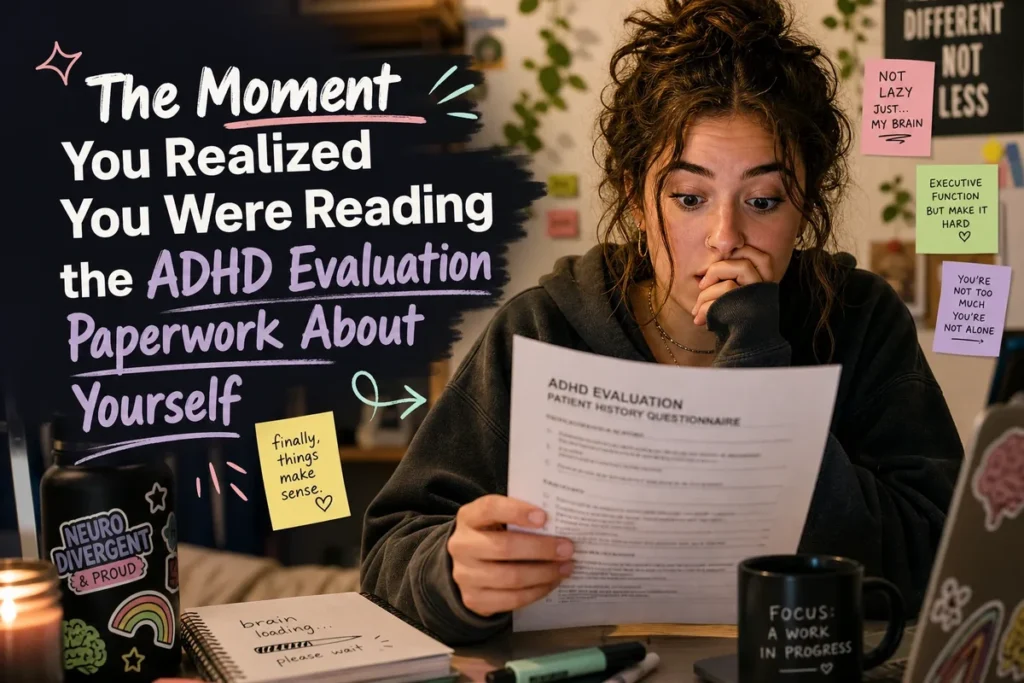
You are sitting in a plastic chair in a waiting room that smells like industrial carpet cleaner. Your kid is in the other room with the psychologist. You are filling out the parent questionnaire for their ADHD evaluation, and somewhere around question seven, your hands go still.
Does your child have difficulty sustaining attention in tasks or play activities?
Yes. Obviously yes, that is why you are here. But also: you. You, right now, who checked your phone twice while reading the first six questions. You, who forgot to bring the insurance card and had to dig through your car for ten minutes. You, who has been meaning to schedule this appointment for eight months.
The questionnaire keeps going. Does your child often lose things necessary for tasks and activities? You think about your car keys. Your wallet. The permission slip you signed and then could not find for three days. Does your child have difficulty organizing tasks and activities? You think about the seventeen open tabs on your laptop. The pile of mail on your kitchen counter that you have been "getting to" since February.
This is the moment. The one nobody warns you about when you become a parent with ADHD child diagnosed in the family. You came here for your kid. You did not expect to find yourself in every single question.
When a Parent with ADHD Child Diagnosed Finds Their Own Brain
ADHD is one of the most heritable conditions in psychiatry. The research puts the genetic component at 74 to 80 percent, according to meta-analyses by Faraone and colleagues.1 If your child has ADHD, there is a better than even chance that one of their biological parents does too. This is not a personality quirk or a parenting failure. This is genetics doing what genetics does.
But here is what the statistics do not capture: the specific, disorienting experience of reading clinical language that describes your inner life for the first time. Language you never had. Questions that name things you thought were just you being lazy, or dramatic, or not trying hard enough.
Researchers at UC Berkeley, including Stephen Hinshaw, have documented that this is actually the most common pathway to ADHD diagnosis in adult women: a child gets evaluated, and the parent recognizes themselves in the criteria.2 You are not imagining this. You are not being dramatic. This is literally how most women your age find out.
The Waiting Room Recognition Is Its Own Kind of Crisis
Nobody talks about what happens in the minutes after you put the clipboard down. The evaluation continues in the other room. Your child is doing block puzzles or answering questions about how they feel when homework gets hard. And you are sitting there with your entire life rearranging itself.
This is what I mean by recognition, not discovery. Discovery implies you went looking. Recognition is what happens when something finds you. When you are minding your own business, trying to be a good parent, and suddenly your whole autobiography rewrites itself in real time.
Every struggle you attributed to moral failure. Every time you thought you just needed to try harder. Every relationship that fell apart because you forgot, or interrupted, or could not follow through. It was never about effort. It was always about a brain that works differently than you were told brains work.
If you are sitting in that recognition right now, or if you sat in it six months ago and have not known what to do with it: this article is for you. Not to tell you what to do next. Just to say: this moment is real, it matters, and you are not alone in it.
My Child Has ADHD and I Think I Do Too: The Private Recognition
There is a version of this story that moves quickly. The parent with ADHD child diagnosed gets their own evaluation, starts medication, transforms their life, posts a before-and-after on social media. That version is real for some people. It is not the whole story.
The private recognition, the one that happens before you tell anyone, is different. It is slower and stranger. It involves sitting with information you do not know how to hold.
You might find yourself going back through childhood memories with new eyes. The time you got in trouble for not listening when you were actually hyperfocused on something else. The report cards that said "does not work up to potential." The friendships that faded because you forgot to call back, or showed up late too many times, or said the wrong thing at the wrong moment because you could not read the room.
You might feel grief. Grief for the version of yourself who tried so hard and still could not make the pieces fit. Grief for the years you spent thinking you were broken. Grief for the relationship damage you attributed to personal failure when it might have been something more understandable, more treatable, more nameable than "I am just like this."
The grief is not a detour: ADDitude's framework for late discovery identifies grief as a core stage, not a sign you are handling this wrong. Grief, relief, anger, and acceptance do not happen in order. They happen in waves, sometimes all in the same afternoon.
You might also feel relief. The relief of finally having language for something you have been fighting alone. Relief that there might be tools, strategies, medication, support. Relief that your child will not have to wait as long as you did to understand their own brain.
Both the grief and the relief are true. You do not have to pick one.
ADHD Runs in Families: What That Actually Means for You
When clinicians say ADHD runs in families, they are talking about more than genetics. They are talking about environments. If you have ADHD, you probably grew up with at least one parent who had it too, whether they knew it or not. That shapes everything.
Maybe your household was chaotic in ways you normalized because you had never seen anything different. Maybe your parent was emotionally volatile, or checked out, or could not help you with homework because they did not understand how to organize it either. Maybe you learned to mask early because your family was already dealing with enough and you did not want to be another problem.
This is not about blaming your parents. It is about recognizing that ADHD runs in families parent diagnosis pathways are complicated. Your parent might have had untreated ADHD their whole life and never known. They might have masked so well that no one ever questioned it. They might have self-medicated with caffeine or alcohol or workaholism. They might have been told they were lazy or difficult or too much, just like you were.
When you recognize yourself in your child's evaluation, you are also potentially recognizing a pattern that goes back generations. That is a lot to hold.
ADHD Recognition Parent Evaluation: The Gap Between Knowing and Doing
One of the cruelest ironies of ADHD is that the very thing that makes you need help also makes it harder to get help. Executive dysfunction does not take a break just because you have had a revelation in a waiting room.
After the ADHD recognition parent evaluation moment, you might find yourself stuck. You know you should probably get evaluated yourself. You know there are resources out there. You know that understanding your own brain would help you parent your kid better. And yet: the phone call feels impossible. The research feels overwhelming. The idea of explaining this to your partner, your parents, your friends feels exhausting before you even start.
This is not you failing to act on important information. This is ADHD doing what ADHD does. The gap between knowing and doing is one of the core features of the condition. If you are struggling to take next steps, that is actually more evidence, not less.
You do not have to solve this today. The recognition is already doing something. It is already changing how you see yourself, even if no one else knows yet.
What the Evaluation Paperwork Cannot Tell You
The questionnaire you filled out is a screening tool. It is designed to identify patterns, not to capture the full texture of a life. There are things it cannot ask.
It cannot ask about the way you feel at 2am when everyone else is asleep and your brain is finally quiet enough to think. It cannot ask about the projects you started with genuine excitement and abandoned when the novelty wore off. It cannot ask about the relationships you sabotaged because being known felt terrifying in a way you could not explain.
It cannot ask about the specific shame of watching yourself do the thing you told yourself you would not do, again, while some part of your brain observes from a distance and wonders why you are like this. It cannot ask about the relief of finding someone who gets it, and the grief of realizing how rare that relief has been.
A formal evaluation, if you choose to pursue one, will capture more than the screening questionnaire. But even that has limits. The fullest understanding of your own brain will come from you: from the memories you revisit with new context, the patterns you start to notice, the language you finally have for experiences you have been having your whole life.
The Parent You Are Now Versus the Parent You Could Be
Here is something the waiting room moment gives you, if you let it: a chance to parent your kid with more understanding than you received.
You know what it feels like to be told you are not trying. You know what it feels like to want to do the thing and still not be able to do the thing. You know what it feels like to be punished for symptoms you could not control. You can choose to not pass that on.
This does not mean you have to be a perfect parent. ADHD makes consistency hard, and you are going to mess up, and that is okay. What it means is that you can meet your kid with recognition instead of frustration. When they cannot start their homework, you can remember that you have 47 unfinished projects in your mental queue right now. When they interrupt you for the tenth time, you can remember that impulse control is a skill that develops slowly, not a moral choice.
Your kid has something you did not have: a parent with ADHD child diagnosed awareness who gets it. Who has lived it. Who can say "I know this is hard, and it is not your fault, and we will figure it out together."
You do not have to have all the answers: Being a parent who recognizes ADHD in themselves and their child does not mean being an expert. It means being honest. It means saying "my brain does this too" when your kid is struggling. That alone is more than many of us ever got.
The Moment After the Moment
At some point, the psychologist will open the door. Your kid will come out, probably tired, maybe asking if they can have screen time now. You will gather your things and drive home and make dinner and do bedtime, and the whole time, this new information will be sitting in your chest like a second heartbeat.
You do not have to do anything with it today. You do not have to tell anyone. You do not have to schedule your own evaluation or start researching treatment options or have a big conversation with your partner. Those things can come later, if you want them to.
Right now, you can just know. You can just sit with the recognition and let it be what it is: a door that opened when you were not expecting it. A piece of information that changes everything and nothing. A moment that belongs to you before it belongs to anyone else.
The waiting room recognition, for a parent with ADHD child diagnosed in the family, is not the end of anything. It is not even really a beginning. It is more like a hinge: a place where your life pivots, quietly, while no one is watching. What you do with it is up to you. But the fact that you are reading this, that you recognized something in those questions, that you are sitting with the possibility: that already matters. That is already something.
You came here for your kid. You found yourself. Both of those things are true, and neither of them is a mistake.
The parent with ADHD child diagnosed pathway is not the story you expected. It is the story you have. And there is more of it to write.
Rate this article
Was this a useful hit?