You Set Six Reminders. Your Brain Ignored All Six. This Is Not a Character Flaw.

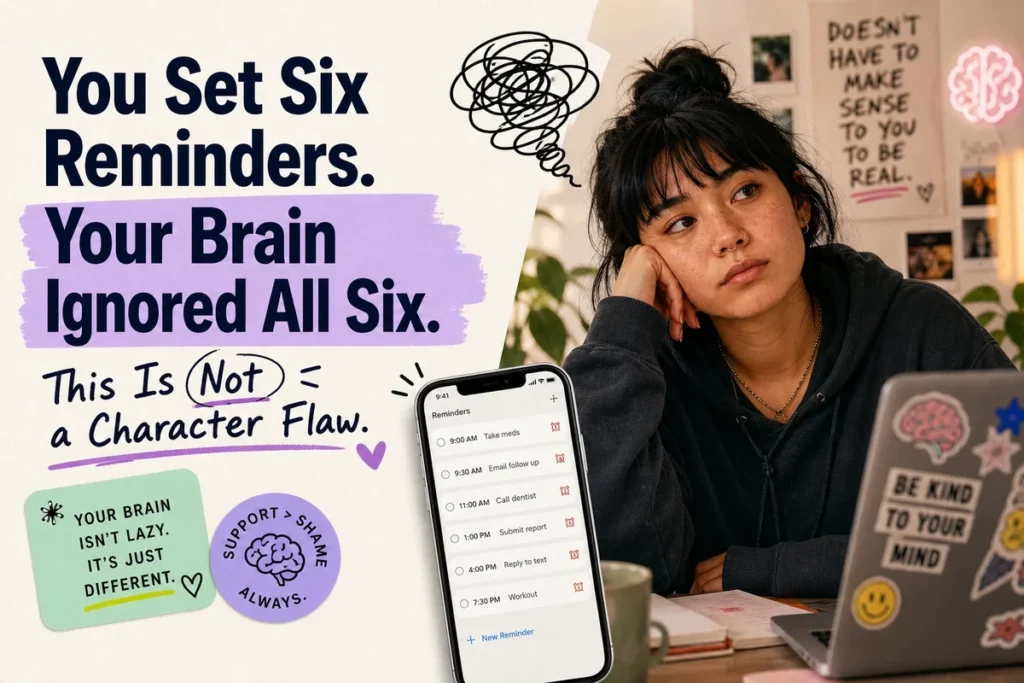
You have five alarms set for today. Three of them went off while you were looking directly at your phone. You heard them. You saw them. You swiped them away and continued scrolling, and now you genuinely cannot remember what any of them were for. Tomorrow, the same notifications will still be sitting there, plus whatever new ones you add tonight when you're feeling motivated at 11 PM. This is not laziness. This is not forgetfulness in the way people usually mean it. This is ADHD notification blindness to your own reminders, and it is one of the most frustrating experiences of having this brain.
The reminders you set are supposed to work. That is literally what they are designed for. You did the responsible thing. You anticipated the forgetting, you planned ahead, you used the tools everyone says to use. And somehow, your brain decided those tools are now invisible. Your notification bar has become a graveyard of good intentions, and every time you look at it, you feel worse about yourself.
Here is what nobody tells you: the problem is not your follow-through. The problem is that the entire alarm and reminder system most people rely on is fundamentally mismatched to how ADHD attention works. Your brain is not broken. It is operating exactly as ADHD brains do. And once you understand why, you can stop blaming yourself and start building systems that actually have a chance.
Why ADHD Notification Blindness Happens to Your Own Reminders
The first time you set a reminder for something, your brain registers it as novel. Novel means potentially important. Novel means pay attention. That first alarm genuinely gets through. But here is the problem: your brain is designed to habituate to repeated stimuli. This is actually a survival mechanism. If your brain paid full attention to every single sound and visual input in your environment, you would be overwhelmed within minutes. So it learns to filter out the familiar and predictable.
For neurotypical brains, this habituation is balanced by executive function. They hear the alarm, they habituate to the sound, but their prefrontal cortex can still override the filtering and say "this is important, act on it now." ADHD brains have weaker executive function override.1 Once habituation kicks in, the alarm becomes background noise. Your brain has categorised it as "safe to ignore" because it keeps happening and nothing catastrophic follows when you ignore it.
This is why you can hear your alarm, look at your phone, and still not register what it means. The sound and the visual notification are being processed at a sensory level, but they are not breaking through to the part of your brain that initiates action. Your attention system has literally stopped flagging them as worthy of conscious focus.
The Cruel Irony of Setting More Reminders
When the first reminder fails, the natural response is to set more reminders. Five alarms instead of one. Multiple apps. Sticky notes on top of sticky notes. And for about three days, this works. You have overwhelmed your habituation system with sheer volume. But then your brain adapts again, and now you have five alarms that are invisible instead of one.
This is the ADHD alarm ignore habituation cycle, and it is exhausting. You are not failing to use tools. You are using tools that actively become less effective the more you use them. Every new reminder you add is teaching your brain that reminders are safe to filter out. You are inadvertently training yourself to ignore your own systems.
The more reminders you set, the less any single reminder means. Your brain cannot distinguish between "important" and "another notification" when everything is a notification.
This is also why those apps that let you set unlimited reminders often make things worse rather than better. The unlimited part sounds like a feature. For ADHD brains, it is often a trap. You end up with a notification bar that contains so much information that it contains no information at all.
What Your Brain Actually Needs: Attention Capture vs. Attention Sustaining
Here is a distinction that changed how I think about ADHD reminder effectiveness. There is a difference between capturing attention and sustaining attention. Most reminder systems are designed to capture attention: they make a noise, they pop up on screen, they interrupt what you are doing. And they succeed at that. You do notice them, at least initially.
But ADHD is not primarily an attention capture problem. It is an attention direction problem. The issue is not that you fail to notice the reminder. The issue is that noticing the reminder does not automatically translate into acting on it. Your brain sees "take out trash" and that information does not create the bridge to actually standing up and taking out the trash. The reminder captured your attention for half a second, then released it, and your attention went back to whatever it was doing before.
This is why setting louder alarms or more aggressive notifications rarely helps. You are solving for the wrong problem. The issue was never the volume or the visibility. The issue is that ADHD cue attention capture alone is not enough to produce action. You need something that captures attention and then helps direct it toward the task itself.
Why External Reminders Work Better Than Self-Set Ones
Notice something interesting: you probably respond much better to reminders from other people than to reminders from yourself. If a friend texts you "hey did you do that thing?" you are more likely to actually do the thing than if your own alarm says the exact same words. This is not coincidence.
External reminders carry social weight. They involve another human who might have expectations or reactions. Your brain categorises them differently. They are not just notifications, they are social obligations. And ADHD brains, ironically, often have stronger responses to external accountability than to internal commitments.2
The body doubling effect applies to reminders too: Having another human involved in your reminder system, even just texting you to check in, creates a different kind of cue. It is no longer your brain reminding itself. It is an external signal that bypasses some of the habituation.
This is also why accountability apps and co-working groups can be more effective than solo reminder systems. The reminder is coming from outside your own head. Your brain has not had the chance to habituate to it yet because it is not predictable. The social element adds stakes that a phone notification cannot replicate.
ADHD Notification Blindness and the Problem of Self-Generated Cues
There is another layer to this. When you set a reminder for yourself, you already know what it is going to say. Your brain has already processed that information once, when you set it. So when the reminder goes off, there is no new information. Your brain already knows. It is just being reminded of something it already dismissed or deprioritised. And dismissed information does not become more compelling just because it pops up again.
Compare this to getting an unexpected text or email. That is new information. Your brain does not know what it says until you read it. So it pays attention. The reminder for yourself is the opposite: zero novelty, zero uncertainty, zero information that your brain has not already processed and decided was not urgent enough to act on immediately.
This is why changing the content of your reminders can sometimes help, at least temporarily. If your reminder says something you did not expect to read, your brain has to actually process it rather than just filtering it as "oh that again." But this only works for so long before your brain learns to predict even the variation.
What Actually Works for ADHD Reminder Effectiveness
If standard reminders are fundamentally mismatched to ADHD attention, what does work? The research and lived experience point to a few principles.
First, novelty resets habituation. If you have been using the same alarm sound for months, your brain has completely tuned it out. Change it. Change it regularly. Some people rotate through alarm sounds on a weekly basis specifically to prevent habituation. This sounds excessive until you realise that your current system of using the same sound has a zero percent success rate, so anything is an improvement.
Second, context matters more than timing. An alarm that goes off while you are in the middle of something else will almost always get dismissed. ADHD brains struggle to switch tasks on demand. A reminder that catches you in a transition moment, when you have just finished one thing and have not started another, has a much better chance of actually landing. Some people set reminders not for specific times but for specific contexts: when they arrive home, when they close their laptop, when they finish eating.
Third, friction can be your friend. If you can dismiss a reminder with a single swipe, you will dismiss it without thinking. Some people use apps that require you to complete a small task to dismiss the alarm, like solving a simple math problem or typing out a phrase. This forces a tiny amount of engagement that can sometimes be enough to bridge the gap between noticing and acting.
The best reminder is one that makes ignoring it harder than just doing the thing it is reminding you about.
Fourth, make the reminder do some of the work. Instead of a reminder that says "do laundry," a reminder that says "put phone on top of laundry basket now" gives your brain a smaller, more concrete action. The transition from reading the reminder to doing the action is shorter. This is related to task chunking, but applied specifically to how you write your reminders.
The Deeper Problem: You Cannot Outsource Executive Function
Here is the uncomfortable truth. Reminders are an attempt to outsource executive function to your phone. And to some extent, this works. But executive function is not just remembering to do things. It is the ability to initiate action, switch between tasks, maintain focus, and regulate your response to competing priorities. A notification cannot do those things for you.
When people without ADHD set a reminder, the reminder triggers a chain of executive functions that they perform automatically: stop current task, hold reminder content in working memory, evaluate priority, shift attention, initiate action. ADHD means some or all of those steps do not fire automatically.3 The reminder is only the first trigger in a chain that your brain may not complete.
This is not to say reminders are useless. It is to say that reminders alone are often not enough. They need to be combined with other strategies that address the actual bottleneck, which is usually not remembering but initiating.
The initiation gap: The space between "I know I need to do this" and "I am actually doing this" is where ADHD notification blindness lives. Your reminders keep hitting the first part. The second part needs different tools.
Building a Reminder System That Actually Accounts for Your Brain
Given everything above, here is what a more ADHD-compatible reminder system might look like.
Fewer reminders, not more. Each additional reminder trains your brain to ignore reminders as a category. Be ruthless about what actually gets a reminder. If something is not genuinely time-sensitive, it probably does not need an alarm.
External accountability where possible. A friend who will text you is often worth more than ten phone alarms. This does not mean you need constant hand-holding. Even one check-in from another person per day can anchor your entire system.
Environment design over notifications. Instead of reminding yourself to take medication, put the medication bottle in front of your coffee maker. The reminder is now physical and unavoidable rather than digital and swipeable. This is not about having a perfect home organisation system. It is about putting one or two physical cues in places where you cannot miss them.
Treat your reminders as experiments, not solutions. No single approach will work forever. Your brain will habituate to anything that is predictable. Build in the assumption that you will need to rotate strategies, and do not treat strategy failure as personal failure. Your reminder stopped working because your brain adapted. That is normal ADHD, not a moral failing.
This Is Not About Trying Harder
If you are reading this with a phone full of unacknowledged notifications, you are not lacking effort. You are dealing with a fundamental mismatch between how tools are designed and how your brain actually processes information. The reminder system that works for most people is built on assumptions about executive function that do not apply to you.
ADHD notification blindness to your own reminders is not a discipline problem. It is an attention direction problem. It is a habituation problem. It is an initiation problem. And once you understand what the actual problem is, you can stop trying to force a solution that was never designed for your brain.
Your notifications are not a monument to your failures. They are evidence that you have been trying, repeatedly, to build systems that help you function. The fact that those systems stopped working does not mean you are broken. It means you need different systems, ones that account for how ADHD attention actually operates rather than how it is "supposed to" operate.
You set six reminders because you wanted to remember. Your brain ignored all six because that is what ADHD brains do with repetitive self-generated cues. Neither of those facts is a character flaw. One is effort. The other is neurology. The path forward is not more effort. It is understanding the neurology well enough to work with it instead of against it, and forgiving yourself for all the notification graveyards along the way.
1 Barkley, R. A. (2015). Attention-Deficit Hyperactivity Disorder: A Handbook for Diagnosis and Treatment. Guilford Press.
2 Safren, S. A., et al. (2017). Cognitive-behavioral therapy for adult ADHD: An integrative psychosocial and medical approach. Guilford Press.
3 Brown, T. E. (2013). A New Understanding of ADHD in Children and Adults: Executive Function Impairments. Routledge.
Rate this article
Was this a useful hit?