Your ADHD Brain Did Not Get Addicted to Gaming. It Found the Best Dopamine Source It Could.

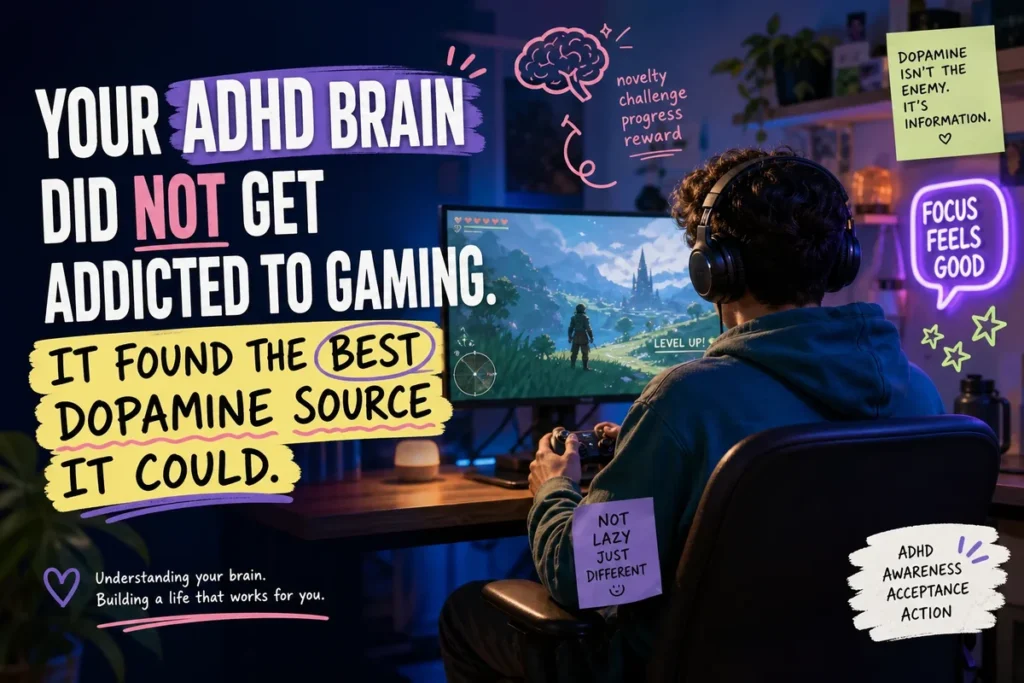
You told yourself you'd play for an hour. It's been six. Your eyes are dry, you haven't eaten, and somewhere in the back of your mind there's a list of things you were supposed to do today. The sun went down and you didn't notice. Someone who loves you has probably made a comment about how much time you spend playing, and it landed somewhere between annoying and deeply shaming. You've tried to quit, or at least cut back. You've uninstalled games only to reinstall them two days later. You've wondered if something is wrong with you, if you're weak, if maybe everyone is right and you really are just addicted.
Here's what nobody told you: if you have ADHD, what's happening in your brain when you game is not the same as what happens in a neurotypical brain. This isn't about addiction in the way people use that word. This is about a brain that has been starving for dopamine finding the one reliable source it can access without fighting itself for hours first.
What ADHD Gaming Addiction Actually Is (And Isn't)
The phrase "ADHD gaming addiction" gets thrown around a lot, usually by people who don't understand either ADHD or how gaming works for neurodivergent brains. Let's be clear about what's actually happening.
Your ADHD brain has lower baseline dopamine activity. This is not a metaphor or a mindset problem. It's neurochemistry. The prefrontal cortex, which handles executive functions like planning, prioritising, and impulse control, runs on dopamine. When there's not enough of it, everything requiring executive function becomes exponentially harder. Starting tasks. Staying focused. Switching between activities. Delaying gratification. All of it.
Video games solve this problem in ways that almost nothing else in modern life does. Every few seconds, something happens. You get feedback. You level up. You unlock something. The objectives are clear, the progress is visible, and the reward comes immediately. Your brain doesn't have to manufacture motivation from thin air because the game is handing it to you constantly.
Research shows that nearly 60% of young adults who meet criteria for "gaming addiction" also have ADHD. This is not a coincidence. It is a signal that something else is going on.
When studies look at problematic gaming, they consistently find ADHD overrepresented. A 2021 study in Psychiatry Research found that ADHD symptoms were the strongest predictor of gaming disorder symptoms, more than depression or anxiety. The connection is so strong that some researchers argue we should screen heavy gamers for ADHD rather than assuming the gaming itself is the problem.
Why Your Brain Chose Gaming Over Everything Else
Think about what a video game offers compared to, say, cleaning your room or working on a project for school or your job.
Cleaning your room: no immediate reward, no visible progress bar, no feedback until you're completely done (and even then the feedback is just "absence of mess"), unclear objectives, no novelty, and the dopamine payoff is hours away at best.
Video game: instant feedback with every action, clear objective on screen at all times, visible progress, constant novelty, immediate dopamine with every achievement, and the reward comes before you have time to get bored.
Your brain is not stupid. It's doing exactly what brains do: seeking the most efficient source of what it needs. The problem is not that you're playing games. The problem is that real life has almost nothing that competes with games for an ADHD brain.
The Feedback Loop: Neurotypical brains can generate motivation internally, then sustain it through delayed rewards. ADHD brains need external feedback loops to stay engaged. Games provide this. Most of real life does not.
This is why you can focus on a game for twelve hours but can't make yourself start a ten-minute email. It's not willpower. It's that the email offers your brain absolutely nothing while the game offers everything. Your brain is not broken for preferring one over the other. It's responding logically to the dopamine economy it's living in.
Gaming as Self-Medication (Yes, That's What This Is)
Before you discovered gaming, or TikTok, or whatever else your brain latched onto, you probably experienced something else: a constant, low-grade restlessness. The feeling that you should be doing something but you can't start anything. Boredom that feels physically painful. The inability to just sit and exist without stimulation.
Gaming medicates that. It fills the gap. It gives your understimulated brain something to lock onto so you can finally stop fighting the restlessness.
Here's where it gets complicated: there's a difference between gaming as regulation and gaming as avoidance, and the line between them is not always clear.
Gaming as regulation looks like: you're overwhelmed, you play to decompress, and afterwards you feel genuinely better. You can re-engage with life. The gaming served a purpose and then ended naturally, or you could end it when you needed to.
Gaming as avoidance looks like: you're overwhelmed, you play to escape the feeling, but the feeling is still there when you stop. Except now you've also lost six hours, the task is even more urgent, and you feel worse. So you play more to escape the worse feeling, which makes everything more urgent, which makes you feel worse, and the loop tightens.
Both of these are your brain trying to solve a real problem. The difference is whether gaming is a tool or a trap. And that difference often depends on what's going on in the rest of your life.
The Shame Spiral Nobody Talks About
You know the one. You played all day instead of doing the thing. You feel terrible about it. Someone made a comment, or maybe you just made the comment to yourself. The shame is heavy. You think about what you should have done, how far behind you are now, what this says about you as a person.
And then, because you feel terrible and ADHD brains avoid negative emotions like their life depends on it, you cope with the shame the only way you know how: you play more. Or you scroll. Or you do whatever provides the fastest exit from the feeling.
The shame does not help you play less. It makes you play more. Every lecture you've received about gaming has made the problem worse, not better.
This is not a theory. This is how avoidance works neurologically. Shame is an aversive stimulus. ADHD brains have impaired response to aversive stimuli, meaning the normal "feel bad, change behaviour" loop doesn't work properly. Instead, the bad feeling just gets escaped. The behaviour continues. The shame deepens. The cycle accelerates.
If you want to change your relationship with gaming, the first step is removing the shame. Not because shame is unpleasant (though it is), but because shame actively prevents the change you're trying to make.
What ADHD People Love About Gaming (The Neuroscience)
Researchers have identified specific features that make games uniquely compelling for ADHD brains. Understanding why ADHD people love gaming neuroscience isn't about pathologizing your hobby. It's about seeing what your brain actually needs.
Immediate feedback. Every action produces a visible response. You press a button, something happens. This external feedback substitutes for the internal feedback loop that ADHD brains struggle to generate.
Clear objectives. The game tells you exactly what to do next. No ambiguity, no need to figure out where to start, no decision paralysis. This is executive function support built into the experience.
Variable rewards. The dopamine hit comes unpredictably, sometimes big, sometimes small. This is exactly how slot machines work, and it's exactly what ADHD brains find most compelling. Predictable rewards get boring. Variable rewards keep the brain engaged indefinitely.
Sense of progress. XP bars, levels, achievements, unlocks. You can see yourself getting better. Real life offers almost no equivalent: your skills improve invisibly, your progress is unmeasured, your achievements go unacknowledged.
Social connection without social friction. Online games let you interact with people through a structured activity. Less ambiguity than unstructured conversation, less energy drain than in-person socialising, still fulfils the need for connection.
Controlled challenge. Games scale to your ability. They get harder as you improve but rarely so hard you can't progress. This keeps you in a flow state, the specific psychological zone where challenge matches skill and time disappears. ADHD brains chase flow states because flow is one of the few experiences that quiets the internal chaos.
So What Actually Helps (Not Willpower)
If willpower worked, you'd have fixed this already. You've tried willpower. You've tried discipline. You've tried wanting to change really badly. None of it worked, because none of it addresses why your brain prefers games in the first place.
What actually helps is designing your environment and systems so that real life competes with games, at least sometimes.
Make the start easier. The biggest barrier to non-gaming activities is starting them. If you want to work on something, make starting as frictionless as possible. Leave the document open. Put the thing you need right in front of you. Remove every decision between "I should do this" and actually doing it.
Build in external feedback. Your brain craves feedback. Give it what it wants. Use apps that track progress visibly. Break tasks into smaller chunks so you can check things off. Work with a body double, another person present so there's implicit external accountability.
Stop fighting hyperfocus. Redirect it. When you can't stop playing video games, the issue is rarely the gaming itself. The issue is that nothing else has captured your hyperfocus. Instead of trying to eliminate gaming, try to find other things that can generate the same pull. For some people it's creative projects. For others it's learning something new. The key is finding your version, not what worked for someone else.
The Handoff Technique: Before stopping a game, decide exactly what you'll do next. Not "something productive," but a specific action. Having the next step already loaded reduces the transition friction that usually sends you back to gaming.
Separate play from escape. Gaming isn't inherently a problem. Gaming as your only coping mechanism is a problem. Notice when you're playing because you want to play versus when you're playing because you can't face something else. This distinction matters. One is recreation. One is avoidance wearing the costume of recreation.
The Real Problem Is Not The Gaming
Here's something nobody tells you when they're lecturing you about screen time: the gaming is not usually the root problem. The gaming is usually a symptom of unmet needs, untreated ADHD, or an environment that makes real life unbearable for your brain.
If your ADHD is untreated or undertreated, your brain is going to find dopamine somewhere. If that somewhere is games, it's not because you're weak. It's because games are available and effective. Treating the ADHD, whether through medication, environmental changes, or other strategies, often changes the relationship with gaming automatically. Not because you suddenly have more willpower, but because your brain isn't as desperate.
If your life contains almost nothing that provides what games provide, no clear goals, no immediate feedback, no sense of progress, no novelty, then your brain is going to default to the one place that does. The solution is not to white-knuckle through the deprivation. The solution is to add more of what games provide to the rest of your life.
If gaming is your primary way to avoid difficult emotions, tasks, or situations, then the gaming is a symptom of the avoidance. Address the avoidance, deal with the underlying thing you're running from, and the compulsive gaming often resolves on its own.
Permission To Play (Really)
This might be the first time someone has said this to you without a "but" attached: it's okay to play video games. It's okay to enjoy them. It's okay if they're your favourite thing. You're not a failure because you like games more than you like your job or your homework. That preference makes neurological sense given how your brain works.
The goal is not to eliminate gaming from your life. The goal is to have a relationship with gaming that works for you. Where you play because you want to, not because you can't stop. Where gaming is something you do, not something you escape into because everything else is impossible.
That shift doesn't come from willpower. It comes from understanding what your brain actually needs and finding ways to meet those needs that don't leave you six hours deep in a game, wondering where the day went, again.
Your ADHD brain didn't get addicted to gaming. It found the best dopamine source available. The question is not how to cut off the source. The question is how to expand your options.
The answer to ADHD gaming addiction is not less gaming. It's more understanding of what your brain was searching for when it found games in the first place, and a life that offers at least some of that outside the screen. Not because gaming is bad. Because you deserve to have more than one place where your brain finally works.
Rate this article
Was this a useful hit?