You Do Not Say No Because Your Brain Decided Yes Was Safer

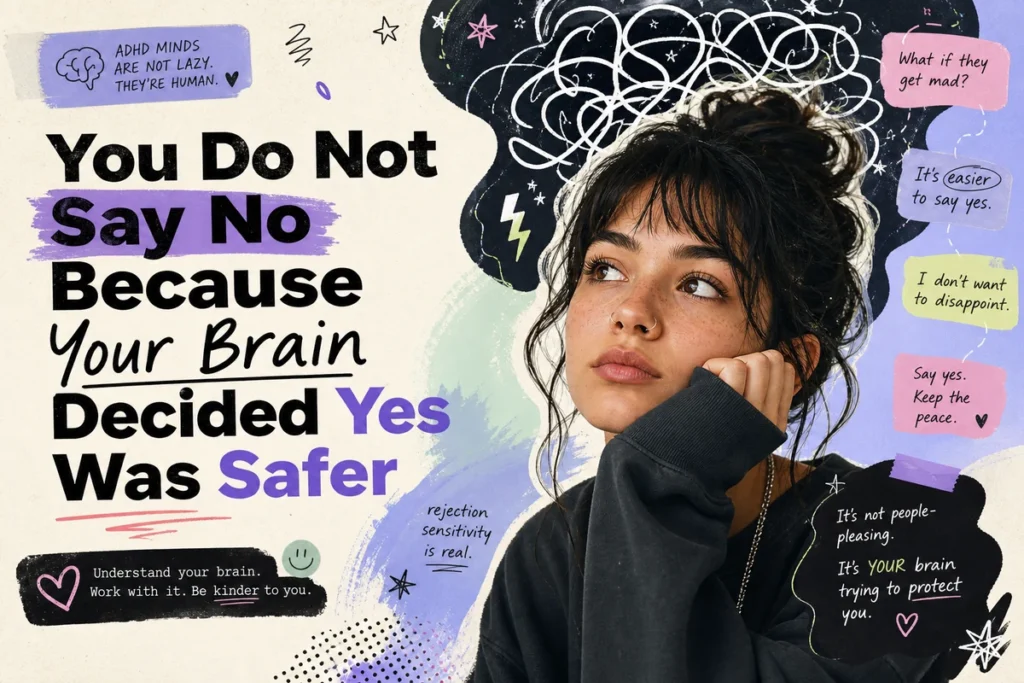
Someone asks you for a favour and your mouth says yes before your brain finishes processing the question. You are already nodding, already agreeing, already calculating how you will fit this new obligation into a schedule that was already impossible. Somewhere in your chest, a small voice is screaming that you do not want to do this. You cannot hear it over the sound of your own compliance.
This is not because you are too nice. This is not because you have no spine. This is ADHD fawn response people pleasing, and it is one of the most misunderstood survival strategies that neurodivergent brains develop. Your nervous system learned, probably very early, that saying no creates conflict. Conflict creates unpredictability. Unpredictability creates danger. So your brain did the math and decided that yes was the safest word in your vocabulary.
The problem is that you are no longer a child navigating an environment you could not control. You are an adult, and that automatic yes is costing you everything: your time, your energy, your relationships, your sense of self. Understanding where this pattern came from is the first step toward building a different one.
What the Fawn Response Actually Is
You have probably heard of fight, flight, and freeze. These are the classic stress responses that get discussed in every psychology class and wellness article. What does not get as much airtime is the fourth response: fawn. Fawning is when your nervous system decides that the safest way to survive a threat is to appease it. To make yourself agreeable, helpful, small, whatever the threat needs you to be so it does not hurt you.
The term was introduced by therapist Pete Walker in his work on complex trauma.1 He observed that some people, particularly those who grew up in environments where expressing needs or boundaries led to punishment, develop a default response of compliance. They become hyperattuned to other people's emotions and needs, often at the expense of recognising their own.
Here is where ADHD enters the equation. If you grew up with an ADHD brain in a world that was not built for it, you probably received a lot of negative feedback. You were too loud, too forgetful, too sensitive, too much. You interrupted, you forgot homework, you lost things, you could not sit still. The message, delivered hundreds of times in hundreds of small ways, was that your natural way of being was wrong and inconvenient to others.
Your fawn response did not develop because you are weak. It developed because your brain is excellent at pattern recognition and it noticed that being agreeable reduced the amount of criticism, disappointment, and rejection you experienced.
This is not a character flaw. This is your nervous system doing exactly what it was designed to do: keeping you safe in an environment that felt threatening.
ADHD Fawn Response People Pleasing Is Rooted in the Nervous System
The distinction matters. When people talk about people pleasing, they often frame it as a choice. As if you are consciously deciding to prioritise others over yourself because you want to be liked. But ADHD fawn response people pleasing operates at a much deeper level. It happens in your nervous system, often before your conscious mind even registers that a decision is being made.
Research on ADHD and emotional regulation shows that people with ADHD have differences in how their brains process threat and reward.2 The amygdala, which processes emotional information and threat detection, tends to be more reactive. The prefrontal cortex, which would normally help you pause and evaluate whether a situation is actually dangerous, is often less able to override that initial alarm signal.
So when someone asks you for something and you sense even the slightest possibility that saying no might upset them, your amygdala fires. Danger. Potential rejection. Possible conflict. Your nervous system floods with stress hormones. And your fawn response kicks in before you can think.
The yes is out of your mouth. Your body relaxes because the immediate threat has been neutralised. You will deal with the consequences of overcommitting later. Right now, the most important thing was avoiding that moment of tension.
This is not about willpower: You cannot simply decide to stop fawning any more than you can decide to stop flinching when something flies at your face. The fawn response is automatic. Changing it requires working with your nervous system, not against it.
The RSD Connection
If you have ADHD, you have probably experienced Rejection Sensitive Dysphoria. That crushing, disproportionate emotional response to perceived rejection or criticism. RSD is not officially in the diagnostic criteria, but it is one of the most commonly reported experiences among people with ADHD, and it directly fuels the fawn response.
When the pain of rejection feels unbearable, and when your brain processes social cues with extra intensity, saying no becomes genuinely terrifying. Not annoying or uncomfortable, but terrifying. Because your nervous system has learned that no leads to disappointment, disappointment leads to rejection, and rejection leads to that specific kind of emotional pain that feels like it might actually kill you.
ADHD RSD people pleasing creates a vicious cycle. You say yes to avoid rejection. You overcommit. You cannot follow through on everything you promised. You disappoint people anyway. You experience the rejection you were trying to avoid, plus shame about failing. Your nervous system concludes that you need to try even harder to please people next time.
This is exhausting. It is also unsustainable. And it often leads to the very outcomes you were trying to prevent, because chronic people pleasing eventually causes resentment, burnout, and relationship breakdowns.
Why You Cannot Trust Your First Response
One of the most disorienting aspects of having a strong fawn response is that you often do not know what you actually want. You have spent so long automatically scanning for what other people want and need that your own desires have become background noise. When someone asks what you want to do, where you want to eat, how you feel about something, you might genuinely not know.
This is not because you are indecisive or do not have preferences. It is because your brain deprioritised that information as non-essential to survival. What mattered was knowing what the other person wanted, so you could provide it and stay safe.
The ADHD brain that cannot say no is not a brain that lacks opinions. It is a brain that learned to suppress those opinions so quickly that they never reach conscious awareness.
This creates problems in relationships, in work, in every area of your life. Partners get frustrated because they feel like they are always making the decisions. Bosses take advantage because you never push back. Friends stop inviting you to things because you always agree but then cancel. You start to feel like a ghost in your own life, going through motions you never chose.
ADHD Threat Minimisation and the Cost of Safety
The fawn response is ultimately a threat minimisation strategy. Your brain identified conflict, rejection, and disappointing others as threats. It developed a strategy to minimise those threats: agree, appease, accommodate. And for a while, this probably worked. You probably did experience less overt conflict. Fewer explosive arguments. Fewer moments of being yelled at or rejected.
But ADHD threat minimisation through fawning has hidden costs. You may have avoided external conflict, but you created internal conflict instead. The war between what you said yes to and what you actually have the capacity to do. The grinding resentment of consistently putting yourself last. The confusion of not knowing who you are outside of who other people need you to be.
People with chronic fawn responses often report feeling like frauds. Like they are performing a version of themselves that does not really exist. This is because in some ways, they are. The agreeable, helpful, always-available person is not your authentic self. It is the self your nervous system created to survive.
The paradox of fawning: The strategy that was supposed to keep you connected to others often ends up making you feel more alone. Because the connections you maintain through chronic people pleasing are not with you. They are with your performance.
What Recovery Actually Looks Like
Changing a nervous system pattern that has been running for years or decades is not a matter of reading one article and deciding to do better. It requires patience, practice, and a lot of self-compassion for the times you slip back into old patterns.
The first step is simply awareness. Noticing when your fawn response activates. Not trying to stop it yet, just observing. Where do you feel it in your body? Is there tension in your shoulders, a tightness in your chest, a clenching in your stomach? What thoughts accompany the physical sensation? Learning to recognise your fawn response while it is happening gives you a small window, a moment of space between the trigger and the automatic yes.
The second step is buying time. You do not have to go from automatic yes to confident no. You can start with maybe. With "let me think about it." With "I need to check my schedule." These phrases are not dishonest. They are giving your nervous system time to calm down so your prefrontal cortex can actually evaluate whether you want to agree to this thing.
The third step is tolerating the discomfort. When you do not immediately comply, you will probably feel anxious. Your nervous system will interpret this as danger. You have to learn, slowly, that this discomfort is survivable. That the other person's momentary disappointment or confusion does not actually hurt you. That you can handle the tension of not immediately making everything okay.
ADHD Fawn Response in Relationships
Romantic relationships are often where fawning becomes most visible and most damaging. If you have ADHD and a strong fawn response, you may have noticed a pattern: relationships that start intense and end with you feeling completely depleted and unseen.
This happens because fawning creates an unsustainable dynamic. In the beginning, you are hyper-attuned to your partner's needs and wants. You are flexible, accommodating, always available. This can feel wonderful to the other person, and it can feel wonderful to you too, because the dopamine of a new relationship temporarily overrides your own needs.
But eventually, the relationship stops providing enough novelty to sustain that level of self-abandonment. Your own needs start surfacing. And you do not know how to express them, because you never practiced. Or you try to express them and your partner is confused, because the person they thought they were dating never had needs before.
Healthy relationships require two people who can show up as themselves. ADHD fawn response people pleasing makes that nearly impossible, because you are not showing up as yourself. You are showing up as whoever you think the other person needs.
Relearning What You Want
Recovery from chronic fawning includes a process of rediscovering yourself. This sounds dramatic, but it is literal. You have to relearn what you like, what you want, what you need. These are things that got buried under years of prioritising everyone else.
Start small. When you are alone and no one is watching, notice what you gravitate toward. What do you want to eat when no one else's preferences matter? What do you want to do on a Saturday when you have no obligations? What topics make you lose track of time when you are reading or watching videos?
This information about yourself has not been deleted. It has just been deprioritised. With practice, it becomes accessible again. And as you get clearer on what you actually want, saying no becomes easier, because you have something you are saying yes to instead: your own life.
You are allowed to have needs. You are allowed to have boundaries. You are allowed to disappoint people who have gotten used to you having neither.
The Nervous System Needs New Evidence
Your fawn response developed because your nervous system collected evidence that compliance was necessary for survival. To change it, you need to provide new evidence. Evidence that conflict does not always lead to catastrophe. That people can be disappointed in you and still love you. That you can have boundaries and still have relationships.
This is slow work. Your nervous system is not going to trust new information after one or two experiences. It needs repeated, consistent evidence that the old threat is no longer present, or that you can handle it if it is.
Each time you set a boundary and the relationship survives, you are giving your nervous system new data. Each time you say no and the world does not end, you are rewiring the pattern. It does not feel dramatic in the moment. It feels mundane. But it is the actual mechanism of change.
Understanding ADHD fawn response people pleasing is not about blaming yourself for a survival strategy that made sense at the time. It is about recognising that you are no longer in the environment that required that strategy. You have options now. You can learn to tolerate the discomfort of not automatically agreeing. You can build relationships that have room for your actual self, not just your performing self.
Your brain chose yes because it was safer. Now you get to teach it that no can be safe too.
1 Walker, P. (2013). Complex PTSD: From Surviving to Thriving. Azure Coyote Publishing.
2 Shaw, P., et al. (2014). Emotion dysregulation in attention deficit hyperactivity disorder. American Journal of Psychiatry, 171(3), 276-293.
Rate this article
Was this a useful hit?