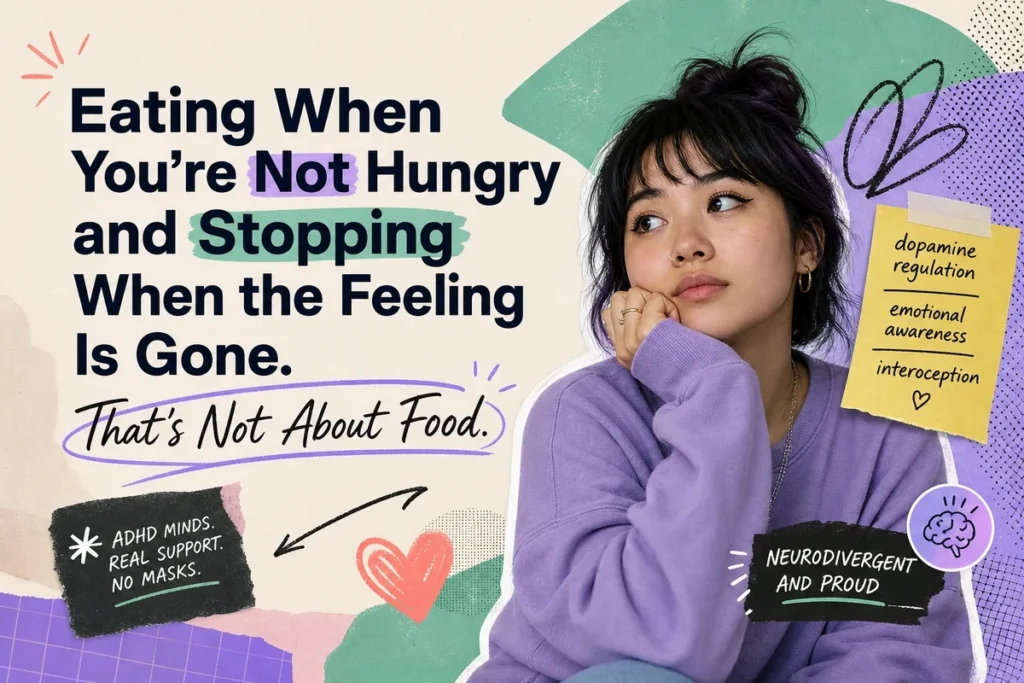
Eating When You're Not Hungry and Stopping When the Feeling Is Gone. That's Not About Food.

You weren't hungry when you opened the fridge. You knew that. You opened it anyway, stood there with the cold air on your face, and grabbed something. You ate it standing up, not tasting it, not enjoying it, just doing it. Then you grabbed something else. Then something else. And then, somewhere in the middle of the third thing, the feeling that drove you there in the first place finally quieted down. So you stopped. Not because you were full. Because whatever you were trying to fix had been temporarily fixed. And now you're wondering what the hell that was about.
That pattern has a name. It's called ADHD emotional eating dopamine seeking, and it's one of the most misunderstood behaviors in the ADHD experience. It's not about hunger. It's not about willpower. It's not about loving food too much or having no self-control. It's about a brain that's desperately trying to regulate itself with the tools it has available. And food, for the ADHD brain, is an extremely effective tool.
Why ADHD Emotional Eating Feels Like a Compulsion, Not a Choice
Here's what's actually happening in your brain when you eat emotionally. Your prefrontal cortex, the part responsible for impulse control and emotional regulation, is already running on a dopamine deficit. That's the core of ADHD. When you experience a strong emotion, like boredom, anxiety, rejection, or overwhelm, your brain needs dopamine to process and regulate that emotion. But you don't have enough. So your brain starts scanning for the fastest dopamine source it can find.
Food, especially highly palatable food with sugar, fat, or salt, triggers an immediate dopamine release. Your brain learns this fast. By the time you're an adult, the pathway between "I feel bad" and "I need to eat something" is so automatic it doesn't even feel like a decision. It feels like a compulsion. Because, neurologically, it kind of is.
This isn't weakness. This is your brain doing exactly what it's designed to do: find dopamine when dopamine is low. The problem is that food was never meant to be your primary emotional regulation tool. But nobody taught you what else to use.
You're not eating because you're hungry. You're eating because your brain is trying to feel okay, and food is the fastest way it knows how.
The Forgetting to Eat Then Bingeing Cycle
There's another pattern that shows up constantly for ADHDers, and it makes the emotional eating even harder to untangle. You forget to eat all day. You get hyperfocused on something, or you just can't make yourself stop and prepare food, or the executive function required to decide what to eat feels impossible. So you don't eat. For hours. Sometimes until 4pm. Sometimes until dinner.
And then, when you finally do eat, you can't stop. You eat fast, you eat too much, you eat past the point of fullness because your body is simultaneously starving and your brain has finally found dopamine and doesn't want to let go. This isn't a binge in the clinical sense, but it feels like one. It feels out of control. It feels like you have no off switch.
The truth is, your body has been in survival mode all day. By the time you eat, your blood sugar has crashed, your hunger hormones are screaming, and your brain is so depleted that it can't send accurate fullness signals. You're not lacking willpower in that moment. You're dealing with a cascade of physiological responses that started eight hours ago when you skipped breakfast because you couldn't make yourself stop scrolling long enough to pour cereal.
ADHD Binge Eating Is Not About Willpower
Let's talk about the research for a second, because this matters. Studies show that people with ADHD are approximately four times more likely to develop binge eating disorder than the general population.1 That's not a small increase. That's a significant neurological connection.
The link makes sense when you understand that binge eating disorder and ADHD share overlapping brain pathways. Both involve dopamine dysregulation. Both involve impulse control difficulties. Both involve executive function impairments that make it hard to plan, prepare, and follow through on consistent eating patterns. ADHD binge eating is not a willpower problem. It's a dopamine problem, an executive function problem, and often a trauma response problem all tangled together.
The numbers don't lie: ADHDers are four times more likely to struggle with binge eating. This is neurology, not character. Treating yourself like a failure for a brain pattern you didn't choose only makes the pattern worse.
Here's what nobody tells you: shame makes emotional eating worse. Every time you berate yourself for eating emotionally, you increase your stress, lower your dopamine even further, and make it more likely that you'll eat emotionally again to cope with the shame. It's a brutal cycle. And the first step out of it isn't eating less or having more control. It's understanding that your brain has been doing exactly what it needed to do to survive.
ADHD Eating When Bored or Overwhelmed: Same Behavior, Different Causes
One of the confusing things about ADHD emotional eating is that it looks the same regardless of the trigger. You eat when you're bored. You eat when you're overwhelmed. You eat when you're avoiding something. You eat when you're procrastinating. You eat when you're sad. You eat when you're anxious. You eat when you're happy. You eat when you feel nothing at all.
From the outside, this looks like a food problem. From the inside, it's obvious that food is just the messenger. The real issue is that your brain struggles to identify and regulate emotional states, and eating is the universal response that temporarily works for all of them.
Boredom eating is dopamine seeking. Your brain is understimulated, so it reaches for the fastest stimulation available. Overwhelm eating is nervous system regulation. Your brain is overstimulated, and the repetitive motion of eating plus the dopamine hit creates a calming effect. Procrastination eating is task avoidance with a side of dopamine reward. You can't make yourself start the thing, so you eat instead, because at least eating is doing something.
Understanding which type of eating you're doing matters because the interventions are different. Boredom eating needs more stimulation, not less food. Overwhelm eating needs nervous system support, not willpower. Procrastination eating needs task initiation strategies, not meal plans.
What Actually Helps: Working With Your Brain
Okay, so your brain uses food as a regulation tool. What now? The goal isn't to stop emotional eating entirely through sheer force of will. That doesn't work, and it often backfires. The goal is to add other tools to your toolkit so food isn't the only option. And to set up your environment so the emotional eating that does happen is less damaging to your body and your self-image.
First: keep easy protein available. The forgetting-to-eat cycle is worse when all your food requires preparation. If you have protein-rich snacks that require zero executive function, like cheese sticks, nuts, protein bars, hard-boiled eggs, you're more likely to eat something when your brain first signals hunger instead of ignoring it for six hours and then bingeing. This isn't about eating perfectly. It's about eating something before your blood sugar crashes so hard that you lose all capacity for mindful choices.
Second: name the feeling before you eat. This sounds simple, but it's surprisingly powerful. When you find yourself reaching for food and you're not hungry, pause for three seconds and say out loud what you're actually feeling. "I'm bored." "I'm anxious about that email." "I'm avoiding starting work." "I don't know what I'm feeling but something is off." This interrupts the automatic loop just enough that you can make a slightly more conscious choice. You might still eat. But you'll eat with awareness instead of in a dissociative fog.
You don't have to stop yourself from eating emotionally. You just have to know that's what you're doing while you do it.
Third: find other fast dopamine sources. Your brain needs dopamine. That's non-negotiable. The question is where it's going to get it. Make a list of things that give you a dopamine hit in under five minutes that aren't food. Watching one short video. Texting a friend. Stepping outside. Playing one round of a phone game. Listening to a song you love. Dancing for sixty seconds. Cold water on your face. These aren't replacements for food, they're additions to your toolkit. Sometimes you'll reach for them instead. Sometimes you won't. Both are okay.
The ADHD Eating Disorder Connection Nobody Talks About
This article is not a weight loss piece. This is not about eating less or controlling your body. But we need to talk about something that the ADHD community doesn't discuss enough: the overlap between ADHD and eating disorders is significant, and it goes both directions.
ADHDers are at higher risk for binge eating disorder. They're also at higher risk for restrictive eating patterns that come from hyperfocus, forgetting to eat, or sensory issues with food textures. The combination of restricting (accidentally or intentionally) and bingeing creates a chaotic eating pattern that can escalate into a clinical eating disorder over time.
If you recognize yourself in this article and you're also dealing with significant distress around eating, body image, or feeling out of control with food, please know that help exists. Eating disorder treatment that understands ADHD is different from treatment that doesn't. Look for providers who specialize in neurodivergent clients or who explicitly mention ADHD in their approach.2
This is not about willpower: If your relationship with food feels genuinely out of control, that's not a character flaw. It might be a sign that you need support from someone who understands both ADHD and disordered eating. Those providers exist.
The Dopamine Loop Isn't Your Enemy
Here's the reframe that changed everything for me. The ADHD emotional eating dopamine loop isn't a bug. It's a feature that's been misapplied. Your brain figured out, probably very early in your life, that food was a reliable source of regulation when nothing else was available. That's smart. That's adaptive. That kept you functioning when you didn't have any other tools.
The problem isn't that you learned to use food this way. The problem is that you never learned anything else. And now that pathway is so strong, so automatic, so deeply grooved into your neural architecture, that it fires before you even realize what's happening.
You can build new pathways. You can add new tools. You can create an environment that makes the old pattern less necessary and less harmful. But you can't do any of that from a place of shame. You can only do it from a place of understanding that your brain has been doing its best with what it had.
The eating wasn't the problem. The eating was the solution to a problem you didn't know how to solve any other way. Now you can learn other ways. That's not failure. That's growth.
Moving Forward Without the Shame
ADHD emotional eating dopamine seeking is one of the most common experiences in the ADHD community, and one of the least talked about with any real compassion or accuracy. You're not broken for doing this. You're not weak for not being able to stop. You're not a lost cause because you've tried a hundred times to eat differently and it hasn't stuck.
You're a person with a dopamine-seeking brain living in a world full of highly palatable food that was literally engineered to hijack your reward system. The odds were never in your favor. And you've been surviving anyway.
What helps: eating before you're starving, naming your feelings, having multiple dopamine sources available, removing shame from the equation. What doesn't help: meal plans that require executive function you don't have, willpower-based approaches, treating food like the enemy, hating yourself for patterns you didn't choose.
Your brain uses food to regulate because food works. Now it's time to give your brain some other things that work too. Not instead of food. Alongside it. That's not failure. That's the ADHD emotional eating dopamine loop meeting its match: a brain that finally understands what it's been doing all along.
1 Nazar, B.P., et al. (2016). The risk of eating disorders comorbid with ADHD: A systematic review and meta-analysis. International Journal of Eating Disorders, 49(12), 1045-1057.
2 Levin, R.L., & Riley, E.N. (2021). Treating Eating Disorders in Patients with ADHD: Clinical Considerations. Current Psychiatry Reports, 23(9), 54.
Rate this article
Was this a useful hit?