ADHD and Depression Together Is a Specific Kind of Hell That Not Enough People Are Talking About

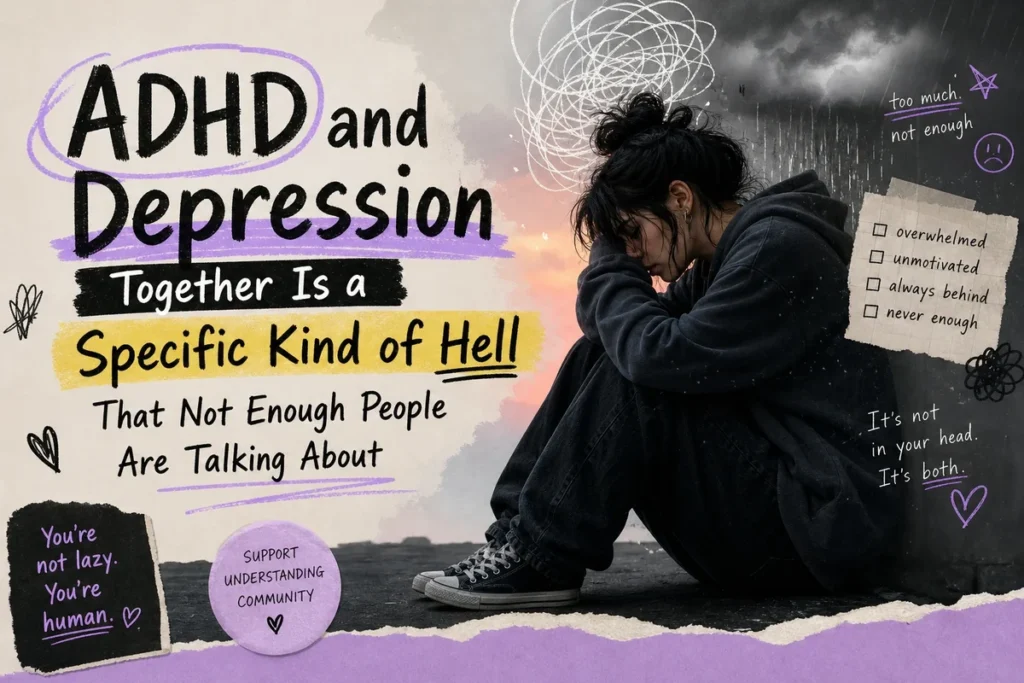
You wake up and feel horrible. You don't want to get up. And your ADHD, the thing everyone says gives you boundless energy, won't let you override that feeling. So you lie there while dozens of alarms go off, staring at the ceiling, not even able to move your hand three inches to turn off the sound. You're not lazy. You're not dramatic. You're experiencing the ADHD depression comorbidity experience in its most visceral form: the moment when your brain demands activation but your body has none to give.
This is the loop nobody warned you about. ADHD needs stimulation to function. Depression removes your ability to feel stimulation. And you end up trapped in a kind of perpetual nothingness that makes the standard advice for either condition completely useless.
Why the ADHD Depression Comorbidity Experience Hits Different
Let's get the numbers out of the way because they matter: adults with ADHD are nearly three times more likely to develop depression than their neurotypical peers.1 Some studies put comorbidity rates between 18.6% and 53.3%, depending on the population studied.2 This is not a rare overlap. This is one of the most common experiences in the ADHD community, and it's still wildly undertreated and misunderstood.
Here's what makes this combination so brutal. ADHD is fundamentally a disorder of motivation and reward processing. Your dopamine system works differently. You need external stimulation, novelty, or urgency to activate the parts of your brain that let you start tasks, sustain attention, and feel satisfaction from completing things. Without that activation, you're stuck. Paralyzed. Unable to start even things you want to do.
Depression, meanwhile, flattens everything. It removes pleasure from activities that used to feel good. It makes getting out of bed feel like climbing Everest. It whispers that nothing matters and everything is pointless.
Now combine them. Your ADHD brain is screaming for stimulation, desperately searching for something, anything, that will make the prefrontal cortex come online. But depression has turned down the volume on every reward signal. The game you used to hyperfocus on for twelve hours? You open it, play for three minutes, feel nothing, and close it. The hobby you spent $800 on? It sits in the corner untouched for five years, a monument to the person you were before this particular flavor of hell took hold.
The Fridge Door Moment and Why It Matters
You're hungry. You know you should eat. You walk to the fridge, open it, and stare inside for minutes. You can't decide what to make. More accurately, nothing sounds appealing enough to overcome the activation energy required to prepare it. So you close the fridge and walk away, still hungry.
This moment perfectly captures the ADHD depression dual diagnosis experience. It's not that you can't make decisions. It's that ADHD decision paralysis and depressive anhedonia have teamed up to make every choice feel both impossible and pointless. The neurotypical advice of "just pick something" assumes you have access to preference. Depression removed your preferences. ADHD removed your ability to act without them.
The same thing happens with everything else. Getting ready for class. Responding to texts. Doing the assignment that's been sitting open in a tab for four days. You're not avoiding it because you don't care. You're trapped because your brain's systems for caring and acting have both gone offline simultaneously, and each one needs the other to reboot.
ADHD demands stimulation in order for you to function, and depression takes away the feeling of stimulation. The result is perpetual nothingness.
How Standard Treatment Misses the Point
Here's where it gets genuinely infuriating. Most mental health professionals are trained to treat one thing at a time. If you walk in reporting low mood, fatigue, loss of interest, and difficulty concentrating, there's a very good chance you'll walk out with a depression diagnosis and an SSRI prescription. The ADHD component gets missed entirely, especially if you're not the hyperactive-bouncing-off-walls stereotype.
The problem is that standard depression treatment often doesn't work when ADHD is in the mix. SSRIs can help with mood regulation, but they do nothing for executive function. You might feel slightly less hopeless, but you still can't start tasks. You still can't make decisions. You still can't override the paralysis. And then you feel like a failure because the medication "should" be working and you're still stuck.
Meanwhile, if someone correctly identifies the ADHD and prescribes stimulant medication, that can help with activation and focus, but it depends on having some baseline motivation to work with. Stimulants don't create motivation from nothing. They amplify what's there. And when depression has flattened your motivation to zero, you end up with a medication that makes you really focused on how pointless everything feels.
The ADHD depression treatment overlap issue is real: these conditions need to be addressed together, with an understanding of how they interact. That rarely happens in fifteen-minute psychiatry appointments where you're one of thirty patients seen that day.
The Lived Compound Effect Nobody Explains
The clinical definitions describe symptoms. They don't describe what it actually feels like to live in this state. Let me try.
You browse through YouTube or Discord, not because you enjoy them, but because you're searching for something, anything, that will produce a flicker of interest. You scroll past hundreds of videos. None of them appeal. You're not being picky. Your brain is scanning for dopamine and finding none. So you keep scrolling, hours passing, getting increasingly desperate and increasingly numb at the same time.
You try to play a game you used to love. The one that used to give you that locked-in flow state where hours would vanish. You open it. You look at the screen. You feel nothing. The grinding parts that used to be tolerable because they led to rewards now feel like an insurmountable wall. Why would you push through repetitive gameplay when there's no reward waiting at the other end? The dopamine payoff that made the grind worth it has been cancelled by depression. So you close the game and feel worse because now you can't even escape into fiction.
At night, your body is exhausted but your brain won't stop. This is another cruel joke of the ADHD depression comorbidity experience: depression gives you fatigue but ADHD gives you racing thoughts. You're too tired to get up but too wired to sleep. You lie there until 2am, thinking about everything you didn't do and won't do tomorrow, finally passing out from pure exhaustion rather than any actual relaxation.
The panic at sunset: That specific dread when the day ends and you realize you didn't live through any of it. You existed, but you weren't present for any of it. And tomorrow will be the same.
Why This Creates a Downward Spiral
Here's the part that makes this combination genuinely dangerous rather than just miserable: ADHD and depression feed each other in a self-reinforcing loop.
ADHD creates failure experiences. You miss deadlines, forget commitments, underperform at things you're capable of, disappoint people you care about. Over time, these failures accumulate into shame. And chronic shame is one of the most reliable pathways to depression.3
Depression, once it arrives, makes ADHD symptoms worse. You have even less access to motivation. Your executive function, already impaired, gets buried further under cognitive fog. You fail at more things. You disappoint more people. The shame deepens. The depression worsens. The ADHD symptoms intensify.
This is the ADHD depression lived compound effect. Each condition makes the other worse in a feedback loop that's incredibly difficult to interrupt. The standard approach of treating one condition at a time often fails because treating depression alone doesn't fix the executive dysfunction creating constant failure experiences, and treating ADHD alone doesn't fix the motivation flatline that stimulants need to amplify.
What Actually Helps When You're in the Loop
I'm not going to give you a list of ten things to try that will fix everything. That's not how this works, and pretending otherwise is part of why so much ADHD and depression content is useless. What I can do is tell you what people who've lived through this say actually made a difference.
First: getting both conditions properly diagnosed and treated together. This often requires advocating hard for yourself or finding a provider who specializes in ADHD and its comorbidities. Generic psychiatrists often default to treating depression first and waiting to see what happens. You may need to push back on this approach.
Second: medication combinations that address both issues. For some people, this means an SSRI plus a stimulant. For others, it's bupropion (Wellbutrin), which has both antidepressant properties and mild effects on dopamine and norepinephrine that can help with ADHD symptoms. The right combination is intensely individual and usually requires trial and error. The point is that you may need medication addressing both conditions simultaneously.
The trick with comorbid conditions is that improving one often improves the other. Getting ADHD treated reduces failure experiences. Fewer failures mean less shame fuel for depression. Less depression means more baseline motivation for ADHD meds to amplify.
Third: radical acceptance of low-capacity days. This sounds like therapy-speak, but hear me out. The shame spiral depends on you beating yourself up for not functioning. Every time you lie in bed unable to move and think "I'm so lazy, what's wrong with me, why can't I just get up," you're adding shame to the pile. That shame feeds the depression. That depression makes tomorrow worse.
What if, on the worst days, you gave yourself permission to just survive? Not thrive. Not be productive. Just exist. Eat something, even if it's crackers from the box. Watch something, even if you don't absorb it. Be horizontal if that's all you can manage. Interrupting the shame spiral won't fix everything, but it can slow the downward momentum enough to give treatment time to work.
The Small Things That Aren't Small
One person dealing with this combination started writing in a journal at sunset, the exact moment when the panic usually hit. Not morning pages, not gratitude lists, just writing down everything that happened that day. It forced them to notice that things had happened, that time had passed with them in it. It slowed time down enough to create meaning.
Another person scheduled calls with a different friend every day during bad weeks. Not long calls. Just ten minutes of actual human connection. Something to break the isolation that makes both ADHD and depression worse.
These aren't cures. There is no hack that will make the ADHD depression comorbidity experience disappear. But there are interventions that interrupt the spiral. That's what you're looking for: not a solution, but an interruption. Enough of a pause in the downward slide that you can catch your breath and try something else.
On external structure: When internal motivation is completely offline, external accountability can function as a substitute. A body double. A scheduled call. An app that checks in on you. It's not the same as internal drive, but it can get you moving when nothing else will.
What This Looks Like When It Gets Better
Better doesn't mean cured. Better means the loop gets interrupted often enough that you're not in freefall anymore. You have bad days, but they're days, not months. You can sometimes feel the reward from finishing things. The fridge door moment still happens, but you've developed workarounds: pre-made food, zero-prep options, the knowledge that eating crackers is better than eating nothing.
Better means understanding that your brain has two overlapping conditions that create a uniquely brutal experience, and that experience is not your fault. You're not weak. You're not lazy. You're dealing with neurochemistry that most people, including many mental health professionals, don't fully understand.
The ADHD depression dual diagnosis experience is one of the most under-discussed, under-treated realities in mental health. If you're living it, you're not imagining how hard it is. It really is that hard. And the first step toward making it less hard is understanding what you're actually dealing with: not a character flaw, not a motivation problem, but two neurological conditions that amplify each other's worst aspects.
Finding treatment that addresses both. Building in structure when internal motivation fails. Interrupting the shame spiral wherever you can. These aren't guaranteed solutions. They're the beginning of a different kind of relationship with a brain that's working against itself. And that beginning matters more than any productivity hack ever could.
1 Kessler RC, et al. "The prevalence and correlates of adult ADHD in the United States." American Journal of Psychiatry, 2006.
2 Katzman MA, et al. "Adult ADHD and comorbid disorders: clinical implications of a dimensional approach." BMC Psychiatry, 2017.
3 Beaton DM, et al. "How does self-esteem mediate the relationship between ADHD symptoms and depression?" Journal of Attention Disorders, 2022.
Rate this article
Was this a useful hit?