Why Criticism Hits You So Much Harder Than It Hits Other People

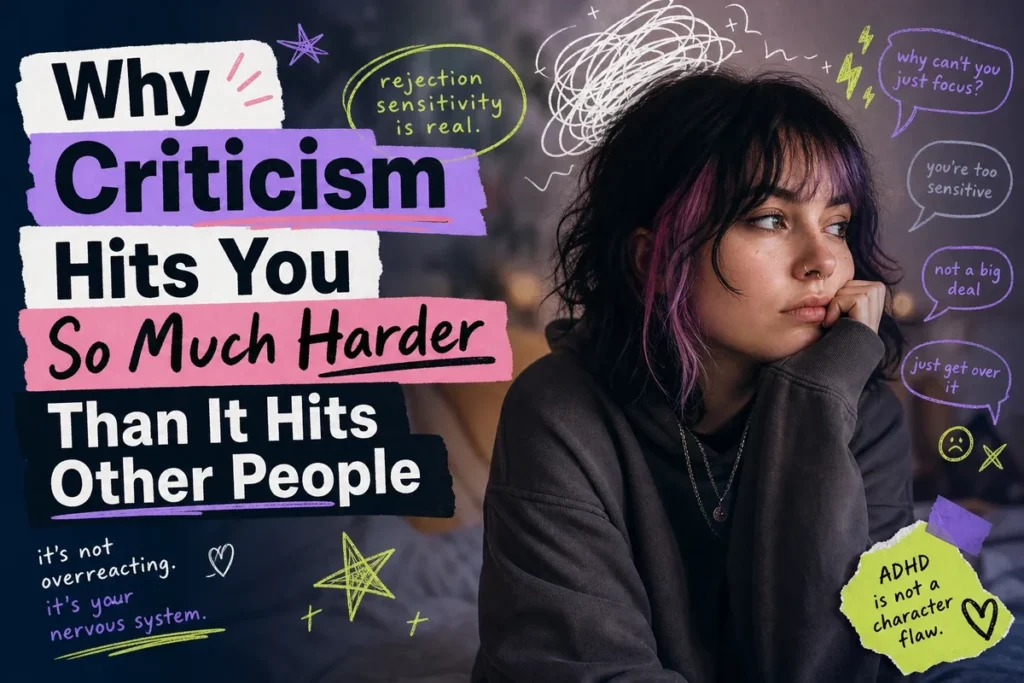
Your boss sends you a Slack message: "Hey, can we chat for a sec?" And suddenly your entire body is on fire. Your heart rate spikes. Your brain immediately starts running through every single thing you could have possibly done wrong in the last six months. By the time you walk to their desk, you've already catastrophized yourself out of a job, replayed every mistake you've ever made, and convinced yourself that everyone secretly hates you.
Then it turns out they just wanted to ask about your vacation days.
This experience, this complete emotional hijacking from the smallest possible trigger, is something people with ADHD know intimately. And if you've ever wondered why criticism, even constructive criticism, even criticism that isn't actually criticism, hits you like a truck when everyone else seems to just shrug it off: you're not being dramatic. Your brain is literally wired to feel this more intensely. This is RSD ADHD in action, and understanding it might be the most important thing you do for your mental health this year.
The Emotional Sunburn That Explains RSD ADHD
Here's the analogy that finally made this click for me: imagine you have a severe sunburn covering your entire body. Now imagine someone pats you lightly on the shoulder. To them, it's a friendly gesture. To you, it's excruciating. You flinch, you pull away, you might even cry out. And if someone watched this interaction without knowing about the sunburn, they might think you were overreacting.
That's what living with rejection sensitivity feels like. Your emotional skin is constantly sunburned. What registers as a gentle touch for neurotypical people registers as a slap for you. The stimulus is the same. Your experience of it is completely different.
This isn't a character flaw. This isn't you being "too sensitive" or "unable to take feedback." This is your nervous system responding to a lifetime of accumulated criticism, correction, and social rejection that most ADHD brains experience from childhood onwards. You developed this sunburn because you've been burned, over and over, often before you even knew you had ADHD.
The problem isn't that you feel things too deeply. The problem is that your brain never learned how to regulate the intensity because no one told you your nervous system was playing on hard mode.
Why Your Brain Processes Rejection Differently
Let's talk neuroscience for a second, because understanding the why helps you stop blaming yourself for the what.
ADHD brains have differences in how they process dopamine, the neurotransmitter that handles reward, motivation, and emotional regulation. When you receive positive social feedback, your dopamine system gives you a little boost. When you receive negative feedback or perceive rejection, that same system crashes harder and faster than it does in neurotypical brains.1
But there's more. The prefrontal cortex, the part of your brain responsible for putting emotions in context and telling your amygdala to calm down, also works differently in ADHD. So when rejection triggers your emotional alarm system, you have fewer resources available to regulate that response. It's like having a fire alarm that goes off at maximum volume, but the mute button is broken.
Research from Dr. William Dodson, who has spent decades studying rejection sensitivity ADHD, suggests that up to 99% of adults with ADHD experience this to some degree.2 Ninety-nine percent. This isn't a rare complication. This is a core part of how ADHD affects emotional processing.
Not in the DSM, but still real: Rejection sensitive dysphoria isn't an official diagnosis, which is why many people with ADHD go years without understanding why they react so intensely to perceived criticism. The clinical establishment is catching up, but slowly.
The Three Flavors of ADHD Emotional Pain
RSD ADHD doesn't just show up one way. It tends to manifest in three distinct patterns, and recognizing yours is the first step toward managing it.
The Explosion. This is the one most people recognize. Someone says something that feels like criticism, and you immediately snap. You get defensive, angry, tearful, or all three at once. The emotion bypasses your rational brain entirely and comes out of your mouth before you can stop it. Five minutes later, you're horrified at your own reaction, but by then the damage is done.
The Implosion. This one is sneakier. Instead of directing the pain outward, you turn it inward. You don't argue or cry. You just... crumble inside. You become convinced that the person is right, that you're worthless, that everyone secretly agrees with the criticism. You might smile and nod while internally spiraling into a shame pit that takes days to climb out of.
The Avoidance. This is the long-term adaptation. When rejection hurts this much, your brain eventually decides to stop putting you in situations where rejection is possible. You don't apply for the job. You don't send the text. You don't share your creative work. You become a master of staying small because small feels safer than hurt.
Most people with ADHD experience all three at different times, but you probably have a default. Knowing yours helps you see it coming.
The Childhood Origins Nobody Talks About
Here's the part that makes all of this make sense, and also the part that might make you want to cry.
By the time the average person with ADHD reaches adulthood, they've received over 20,000 more corrective or negative messages than their neurotypical peers. Twenty thousand. "Sit still." "Pay attention." "Why can't you just try harder?" "You're so smart, if you would just apply yourself." "That's not what I asked you to do." "You forgot again?"
These messages don't bounce off. They accumulate. They create that emotional sunburn, layer by layer, year by year. And if you had a late discovery of your ADHD, you spent all those years absorbing criticism without any framework for understanding why you kept failing at things that seemed easy for everyone else.
So when your boss sends you that Slack message, you're not just responding to the Slack message. You're responding to decades of conditioning that taught you that feedback equals failure, that correction equals rejection, that any hint of disapproval means you're fundamentally broken.
Your reaction isn't about what's happening now. It's about what your nervous system learned to expect from twenty years of being criticized for things you couldn't control.
What Actually Helps in the Moment When RSD ADHD Hits
When that wave of rejection pain crashes over you, you have about a 90-second window before it becomes a full emotional spiral. Here's what can actually help during that window.
Name it before it names you. Say out loud, or think very deliberately: "This is rejection sensitivity. This is my ADHD. This feeling is real, but it's not proportional." This sounds too simple to work, but labeling emotions actually decreases amygdala activity. Your brain responds differently to a feeling you've named than to a feeling that's consuming you.
Get physical. Put your hand on your chest. Feel the sensation of your palm on your body. This sounds like woo-woo advice, but it's actually about activating your parasympathetic nervous system. Your body and brain are connected, and sometimes you have to calm the body to calm the brain. Three slow breaths, hand on chest. Do it before you respond to anything.
Buy yourself time. You do not have to respond to the criticism or perceived criticism in real time. "Let me think about that and get back to you" is a complete sentence. "I need a minute" is a complete sentence. The worst decisions happen in the first 90 seconds. Give yourself permission to delay.
Reality-check with someone who gets it. Text a friend who understands ADHD emotional pain. Not to fix the situation, just to say "my brain is telling me I'm about to get fired because my boss said my email was unclear." Sometimes just externalizing the catastrophe helps you see how distorted it is.
The 24-hour rule: If rejection sensitivity ADHD is hitting you hard, try not to make any major decisions or send any important messages for 24 hours. Your perception of the situation will be dramatically different once the initial wave passes.
The Long Game: Building Rejection Resilience
Managing RSD ADHD isn't just about crisis intervention. It's about gradually reducing that emotional sunburn over time so that normal feedback doesn't feel like an attack.
Track your triggers. Start noticing what specifically sets you off. Is it text messages with periods at the end? Certain tones of voice? Feedback in public versus private? Criticism from specific people? The more specifically you can identify your triggers, the more you can prepare for them or address them directly.
Build a rejection file. This sounds counterintuitive, but it works. Keep a record of times when you were convinced something was a rejection or criticism that turned out to be nothing. Your boss who "hated your presentation" and then promoted you. The friend who didn't text back and wasn't mad at all. Over time, this file becomes evidence your brain can reference when it starts catastrophizing.
Practice micro-exposures. Avoidance feels protective, but it actually makes rejection sensitivity worse over time. You need small, manageable experiences of criticism that don't destroy you to teach your nervous system that feedback isn't fatal. Start small. Ask for feedback on something low-stakes. Notice that you survive it.
Separate feedback from identity. This is the hardest one and the most important. When someone criticizes your work, they're criticizing your work, not your worth. When someone expresses disappointment, they're disappointed in a situation, not in your entire existence. Learning to hold this distinction is a practice, not a destination.
Having the Conversation: Telling People About Your RSD ADHD
One of the most powerful things you can do is tell the important people in your life about how you process rejection. Not as an excuse, but as context.
"Hey, I want to tell you something about how my brain works. I have ADHD, and one of the things that comes with it is that I process criticism really intensely. It's not that I can't handle feedback, I actually want it. But I might need a minute to process before I respond, and if I seem to react strongly, know that it's not about you."
This isn't asking for special treatment. This is giving people the information they need to communicate with you effectively. Most people, once they understand, are happy to adjust small things. Deliver feedback in writing so you have time to process. Start with what's working before what isn't. Give you a heads-up before difficult conversations.
You deserve relationships where people understand that your emotional intensity isn't a manipulation tactic or a character flaw. It's just how your brain works.
When ADHD Emotional Pain Needs More Support
Sometimes rejection sensitivity ADHD can't be managed with techniques alone. If you're experiencing any of the following, it might be time to explore additional support.
You're avoiding major life activities because the possibility of rejection is too painful. You're having suicidal thoughts when faced with criticism or social rejection. Your relationships are repeatedly damaged by your reactions. Your ability to work or function is significantly impaired.
Therapy, particularly approaches like CBT, DBT, or EMDR, can help you process both the accumulated trauma of years of criticism and develop more robust tools for managing emotional intensity. Some people also find that ADHD medication helps regulate emotional responses, not just attention. These are conversations worth having with professionals who understand ADHD.
The Reframe That Changes Everything
Here's what I want you to take from all of this: RSD ADHD is not a weakness. Your emotional intensity is not a flaw that needs to be fixed.
The same sensitivity that makes rejection feel unbearable also makes connection feel incredible. The same depth of feeling that creates the pain also creates your capacity for empathy, for passion, for noticing what others miss. You feel things bigger because you experience everything bigger. That's not a bug; it's a feature with some really inconvenient side effects.
The goal isn't to stop feeling. The goal is to create enough space between the trigger and your response that you can choose what happens next. To build relationships where your people understand the sunburn and adjust their touch accordingly. To accumulate enough evidence that feedback doesn't mean failure until your nervous system starts to believe it.
You're not too sensitive. You're exactly as sensitive as your brain made you. And now that you know why, you can start working with that sensitivity instead of being ashamed of it. That shift, from shame to understanding, is where healing actually begins.
1 Volkow, N.D., et al. (2009). Evaluating dopamine reward pathway in ADHD. JAMA, 302(10), 1084-1091.
2 Dodson, W. (2020). Emotional Regulation and Rejection Sensitivity in ADHD. ADDitude Magazine clinical review.
Rate this article
Was this a useful hit?