What Is AuDHD? When Autism and ADHD Exist Together

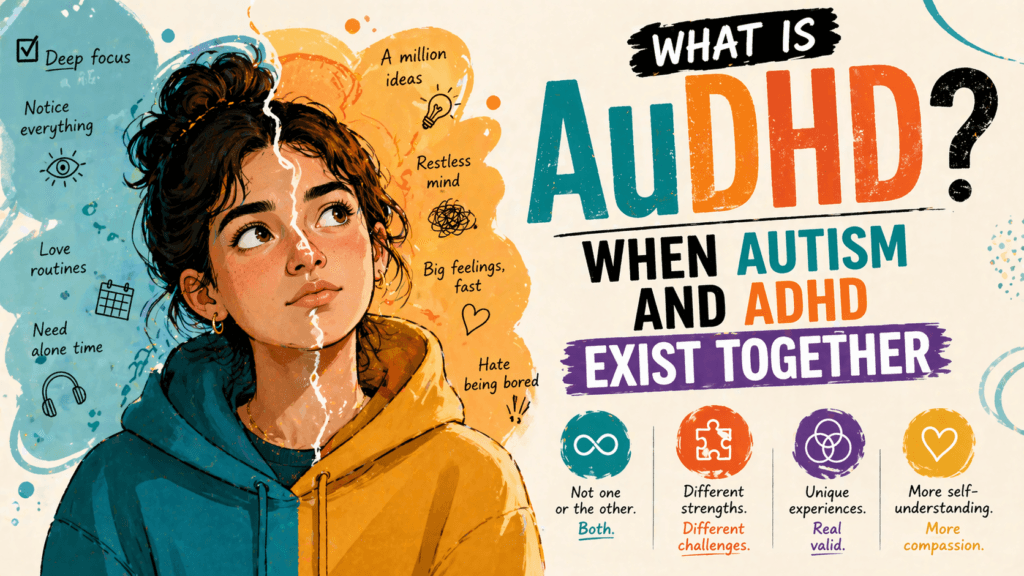
You have probably seen the word AuDHD appearing across neurodivergent communities online and wondered whether it is a clinical term, a self-diagnosis trend, or something with actual research behind it. The answer is that it is all three of those things simultaneously, which is exactly the kind of complexity that defines the condition itself. AuDHD refers to the co-occurrence of autism spectrum disorder (ASD) and attention-deficit/hyperactivity disorder (ADHD) in the same person, and it represents one of the most underdiagnosed and misunderstood presentations in neurodevelopmental science.
The Numbers Are Not Small
Research consistently finds that the overlap between autism and ADHD is substantial. Studies estimate that between 50 and 70 percent of autistic individuals also meet diagnostic criteria for ADHD, and between 20 and 50 percent of people with ADHD meet criteria for autism (Leitner, 2014, Translational Psychiatry; Antshel et al., 2013, Expert Review of Neurotherapeutics). These are not fringe findings. A large population-based study by Lundstrom et al. (2015, Journal of Child Psychology and Psychiatry) found the genetic correlation between the two conditions was high enough to suggest they share a significant portion of their biological underpinnings. Until 2013, the DSM-IV actually prohibited diagnosing both conditions in the same individual, which means an entire generation of people received one diagnosis and had the other dismissed entirely. The DSM-5 removed that prohibition, but the diagnostic backlog it created has not resolved itself.
Why Each Condition Masks the Other
The diagnostic difficulty with AuDHD is not simply that two things are happening at once. It is that the two conditions actively obscure each other during clinical evaluation. Autism involves a tendency toward routine-seeking, repetitive behavior, and intense focus on specific interests. ADHD involves difficulty sustaining attention, impulsivity, and distractibility. When both are present, the autistic drive for structure can suppress the visible hyperactivity of ADHD, while the ADHD-driven impulsivity can make the pattern-seeking of autism appear inconsistent rather than systematic.
A clinician looking for textbook ADHD may see someone who appears organized and rule-bound in certain contexts. A clinician looking for textbook autism may see someone whose social difficulties seem too inconsistent to fit the profile. The result is that many AuDHD adults are diagnosed with neither, or with only one, for years or decades (Young et al., 2020, Journal of Attention Disorders).
"The co-occurrence of ASD and ADHD is associated with greater functional impairment than either condition alone, suggesting that additive or synergistic effects are present across multiple domains of daily life." (Leitner, 2014, Translational Psychiatry)
What the Combined Presentation Actually Looks Like
Living with AuDHD is not like having autism and ADHD sitting neatly side by side. The conditions interact in real time. A person might desperately need routine because their autistic nervous system requires predictability to function, while their ADHD makes maintaining that routine nearly impossible. They may experience hyperfocus states that look like autistic special interest absorption but are driven by dopamine-seeking behavior. They may have sophisticated social scripts memorized from years of autistic masking, but their ADHD impulsivity causes them to break those scripts at critical moments.
The experience of time is particularly disrupted. Autistic individuals often rely on rigid time structures. ADHD profoundly disrupts time perception and time management (Barkley, 2011, Journal of Attention Disorders). Together, the result is someone who is acutely aware that time management is critical and structurally unable to execute it consistently, which creates a specific kind of shame cycle that neither condition generates quite as intensely on its own.
The Masking Overlap: Many AuDHD adults spend enormous energy masking both conditions simultaneously, using autistic social scripts to hide social confusion while also suppressing ADHD impulsivity. This dual masking is cognitively exhausting in ways that single-condition masking is not, and it significantly increases burnout risk.
The Double Demand on Executive Function
Executive function is the set of cognitive processes governing planning, flexible thinking, working memory, and impulse control. Both autism and ADHD independently affect executive function, though through somewhat different pathways. Autism is associated with difficulties in cognitive flexibility and shifting attention. ADHD is associated with deficits in working memory, inhibition, and task initiation (Pennington and Ozonoff, 1996, Journal of Child Psychology and Psychiatry).
When both are present, the executive function load is not simply doubled. The areas of difficulty overlap and interact. Working memory deficits from ADHD make it harder to hold social scripts in mind, which worsens the social processing difficulties of autism. Cognitive inflexibility from autism makes it harder to use the compensatory strategies typically recommended for ADHD. This is why standard ADHD coaching strategies often partially fail for AuDHD individuals, and why autism-focused supports often feel incomplete. Both sets of interventions were designed for profiles that do not account for the interaction effects.
Initial Diagnosis Patterns and What They Cost
When AuDHD individuals do receive diagnoses, the sequencing matters. Many receive an ADHD diagnosis in childhood, particularly if they presented with hyperactivity, and the autistic features are attributed to ADHD or to being "quirky." Others receive an autism diagnosis and have their attention difficulties attributed to autistic overwhelm rather than a separate neurological profile. A study by Miodovnik et al. (2015, Journal of Developmental and Behavioral Pediatrics) found that children with both conditions had significantly longer diagnostic journeys and higher rates of psychiatric comorbidities than those with either condition alone, partly because each diagnosis kept the other from view.
For adults seeking diagnosis today, the situation is complicated further by the reality that most diagnostic tools were designed and normed on children, and often on male children specifically. The Female Autism Phenotype and similar research has documented how women and gender-diverse individuals with autism and ADHD present differently from the male-dominated research samples (Lai et al., 2015, Brain). AuDHD adults who present with internalized rather than externalized symptoms face significant barriers to accurate identification.
"Recognition of the co-occurrence of ASD and ADHD has been hampered by historical diagnostic practices that treated the two conditions as mutually exclusive, despite substantial clinical and genetic evidence suggesting otherwise." (Antshel et al., 2013, Expert Review of Neurotherapeutics)
If You Were Diagnosed with Only One: If you have an autism diagnosis and have always struggled with attention, impulsivity, or task initiation beyond what your autism resources address, asking a clinician to evaluate specifically for ADHD is reasonable and supported by research. The same applies in reverse. Neither diagnosis cancels out the other.
What This Means for Support and Self-Understanding
Understanding AuDHD as a distinct profile rather than two separate conditions piled on top of each other has practical consequences. It changes which supports are likely to help, which workplace accommodations make sense to request, and how to interpret your own behavior when systems that work for other people do not work for you. Strategies designed for ADHD often assume neurotypical social processing. Strategies designed for autism often assume sustained attention capacity. AuDHD adults are frequently left filtering through both sets of advice and finding that each one solves part of the problem while creating friction elsewhere.
The research literature on AuDHD-specific intervention is still developing, but what already exists makes clear that the combination is not simply additive. It is interactive. Recognizing that interaction is the starting point for finding approaches that actually fit.
Rate this article
Was this a useful hit?