Pathological Demand Avoidance in AuDHD: When Every Request Feels Like a Threat

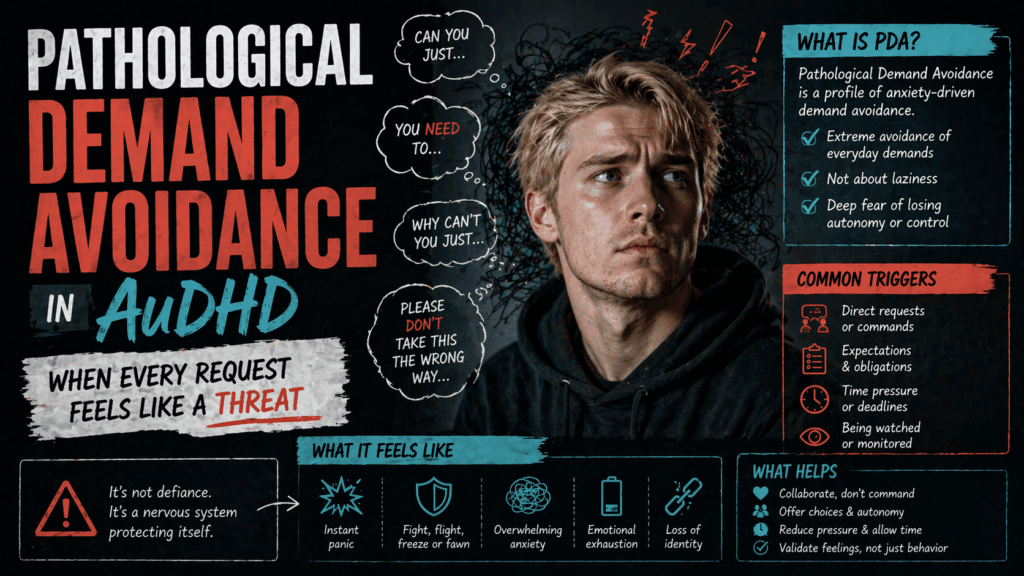
Pathological Demand Avoidance is one of the most misunderstood profiles in neurodevelopmental research, partly because the name itself invites misreading. It sounds like a behavior problem. It is not. PDA describes a neurological profile in which demands, including routine expectations, social obligations, and even internally generated goals, trigger an automatic threat response that the person cannot override through effort or motivation. Understanding what that means, and what it does not mean, is foundational to working with the profile rather than against it.
What PDA Is and What It Is Not
PDA was first described by Elizabeth Newson in the 1980s and has been increasingly recognized as a distinct profile within the autism spectrum, though debate continues about its precise classification (Newson et al., 2003, Archives of Disease in Childhood). It is not a separate diagnosis in the DSM-5 or ICD-11, and it is not a behavioral choice. The current understanding, supported by work from researchers including Gillberg et al. (2015, Research in Developmental Disabilities) and the PDA Society's clinical resources, frames PDA as a profile characterized by an extreme need for autonomy driven by anxiety-based threat responses to perceived demands.
In this profile, the nervous system interprets demands as threats to safety or control, and the avoidance behavior is the person's response to that threat signal, not a response to the demand's content. This is why standard motivational strategies, including rewards, consequences, and structured incentive systems, frequently fail or backfire. The demand to comply with the reward system is itself a trigger. The threat response does not evaluate whether the demand is reasonable or whether the consequences of avoidance are significant. It fires first, and reasoning follows after, if at all.
How PDA Presents in AuDHD Adults
Most of the published literature on PDA focuses on children, but the profile does not disappear at adulthood. In adults with AuDHD, PDA often presents in ways that are less overtly dramatic than childhood presentations but are equally disruptive. An adult with a PDA profile may find that they cannot complete tasks they genuinely want to complete once those tasks acquire the status of an obligation. A project that was absorbing and voluntary becomes impossible to approach the moment it has a deadline attached. A self-directed goal becomes avoidable the moment someone else expresses an expectation about it.
Adults with PDA frequently describe a pattern of starting things with intense interest and then experiencing a complete shutdown of motivation that they cannot explain or reverse. This is often misattributed to ADHD alone, but the trigger is different. ADHD task avoidance is typically driven by insufficient dopamine to sustain engagement with low-interest tasks. PDA avoidance is triggered by the demand quality of the task, and it can affect high-interest tasks equally once they are perceived as required (Green et al., 2018, Journal of Child Psychology and Psychiatry).
"Unlike demand avoidance in other contexts, the avoidance in PDA profiles appears to be automatic, anxiety-driven, and resistant to consequence-based intervention, suggesting a fundamentally different underlying mechanism from oppositional or motivationally driven avoidance." (Gillberg et al., 2015, Research in Developmental Disabilities)
PDA vs ADHD Avoidance: The Key Distinction: ADHD avoidance tends to respond to interest, urgency, challenge, or novelty. If reframing a task to make it more interesting or urgent reduces the avoidance, that is consistent with ADHD. If the avoidance persists even when the task is genuinely interesting and the person wants to do it, and the primary change is that it now feels like an obligation, that pattern is more consistent with a PDA profile.
Why Standard ADHD Strategies Often Backfire
The evidence-based strategies typically recommended for ADHD include external accountability structures, deadline systems, body-doubling, rewards tied to task completion, and habit stacking. For a straightforward ADHD profile, these reduce the activation energy required to initiate tasks and provide dopamine scaffolding around low-interest work. For a PDA profile, each of these interventions introduces a demand. Accountability structures create an obligation to report to someone. Deadline systems make the task formally required. Body-doubling generates social expectation. Rewards become contingencies that must be met. Each of these additions can increase the threat response rather than reducing avoidance.
This creates a genuinely difficult situation for AuDHD adults with PDA who seek support, because they may be advised by ADHD coaches and clinicians to implement systems that make their functioning worse. When those systems fail, the person is often told they are not trying hard enough or not following the system correctly. Neither of those attributions is accurate. The systems are the wrong tool for the profile (Newson et al., 2003, Archives of Disease in Childhood).
What Actually Helps
The strategies that have the strongest support for PDA profiles share a common structure: they reduce the demand quality of tasks rather than increasing pressure to comply with demands. Framing tasks as options rather than obligations, even when they are not technically optional, reduces the threat signal. Working with indirect language, including suggesting rather than instructing, offering choices within constrained situations, and removing visible tracking of compliance, can lower the activation threshold enough to allow engagement.
For AuDHD adults specifically, this often means developing a personal system that looks different from standard ADHD advice and may be difficult to explain to others. Tasks that are framed as exploratory rather than required, environments with maximum autonomy over when and how work happens, and reduction of external performance monitoring tend to be more workable than accountability-based systems.
"Interventions for PDA profiles require a fundamental shift from compliance-based frameworks toward autonomy-supportive approaches. Standard behavioral interventions that increase structure and accountability are often counterproductive and can worsen avoidance." (Green et al., 2018, Journal of Child Psychology and Psychiatry)
Self-Advocacy with a PDA Profile
Advocating for yourself in professional and healthcare settings when you have a PDA profile involves explaining something that most people, including many clinicians, will not immediately recognize. The framing that tends to be most useful is to describe the specific pattern: the difference between avoiding tasks because of low interest versus avoiding tasks because they have acquired the quality of being required, even when you want to do them. That distinction is legible to clinicians who work with anxiety, even if they are not familiar with PDA specifically, because it maps onto the threat-response framework of anxiety research.
On Workplace Accommodations with PDA: The accommodations most likely to help a PDA profile are autonomy-based: flexible scheduling with outcomes rather than hours tracked, reduced mandatory meeting attendance, project structures with genuine choice about approach and timeline, and removal of real-time performance monitoring where possible. These are the same accommodations that benefit many AuDHD adults, which makes them reasonable to request even if PDA is not formally recognized in your jurisdiction's disability frameworks.
Recognizing a PDA profile in yourself does not require a formal diagnosis of PDA, which is not currently available as a standalone diagnosis in most clinical settings. It requires accurate self-knowledge about what is driving your avoidance and what kinds of support are likely to help versus harm. That knowledge is not a luxury. For AuDHD adults whose avoidance has been pathologized as laziness, resistance, or poor character for years, it is the foundation of building a functional life on accurate terms.
Rate this article
Was this a useful hit?