AuDHD Burnout: Why It Hits Differently Than ADHD or Autism Burnout Alone

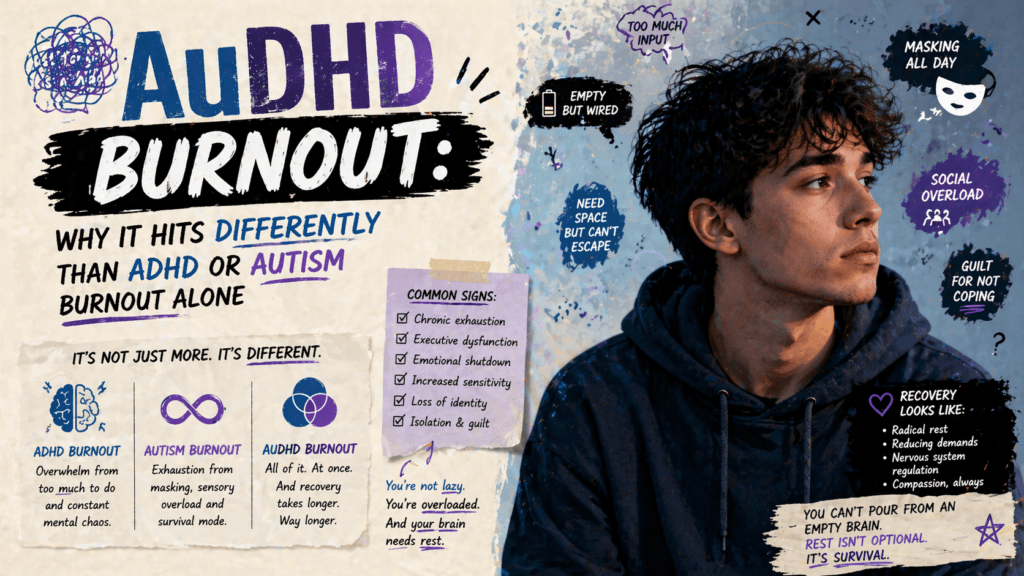
Burnout in neurodivergent adults is not a metaphor for being tired. It is a documented state of functional collapse with a specific neurological profile and a recovery timeline that most people around you will not understand or accommodate. AuDHD burnout, the version that occurs when both autism and ADHD are present, operates differently from either autism burnout or ADHD burnout in isolation, and understanding those differences is not academic. It determines what recovery actually requires.
What Autism Burnout Is
Autism burnout is a state of chronic exhaustion resulting from sustained masking, sensory overload, and the demands of navigating a world structured for neurotypical processing. Raymaker et al. (2020, Autism in Adulthood) conducted one of the most cited qualitative studies of this phenomenon, describing autistic burnout as characterized by pervasive exhaustion, reduced capacity to manage sensory and social inputs, and loss of skills that previously appeared functional. That last point is significant. Autistic burnout can cause adults to lose abilities they had developed, including speech, self-care capacity, and social functioning, which are abilities that neurotypical observers assumed were stable. The research indicates that autistic burnout typically requires months to years for meaningful recovery, not days or weeks.
What ADHD Burnout Is
ADHD burnout is a different mechanism. It tends to result from sustained hypercompensation: the relentless effort of managing executive dysfunction through willpower, elaborate systems, and social performance. ADHD adults frequently push through periods of high demand by borrowing neurological resources they do not have in steady supply, relying on adrenaline, urgency, and interest-based motivation (Barkley, 2015, Attention Deficit Hyperactivity Disorder: A Handbook for Diagnosis and Treatment). When that borrowed energy runs out, the collapse is characterized by motivation shutdown, emotional dysregulation, and the inability to initiate even tasks the person genuinely wants to do. ADHD burnout recovery is typically faster than autism burnout recovery, measured in days to weeks rather than months, but it is cyclical in a way that makes the pattern difficult to interrupt.
"Autistic burnout involves a prolonged period of reduced functioning with impacts across multiple life domains. Participants consistently described it as qualitatively different from ordinary tiredness, requiring specific recovery conditions that were rarely available in standard environments." (Raymaker et al., 2020, Autism in Adulthood)
Why AuDHD Burnout Combines and Amplifies Both
When both conditions are present, the burnout mechanisms do not simply alternate. They interact. The autistic drive for predictability and routine is constantly undermined by ADHD-driven inconsistency, which means the autistic nervous system never fully achieves the stability it needs to regulate. Meanwhile, the ADHD compensatory hyperactivity that might otherwise allow a person to push through a difficult period is running simultaneously with the autistic masking load, meaning both systems are depleting the same limited cognitive and emotional resources at the same time.
The result is a burnout state that combines the skill-loss profile of autism burnout with the motivation-collapse profile of ADHD burnout, while adding a dimension specific to the AuDHD experience: the loss of the compensatory strategies that each condition separately uses to manage the other. In autistic burnout, a person may fall back on ADHD-driven urgency and novelty-seeking to get through minimum requirements. In AuDHD burnout, that fallback is also unavailable. The scaffolding collapses from both sides at once.
The Masking-Plus-Dysregulation Feedback Loop
A specific pattern characterizes many AuDHD burnout trajectories. Masking, suppressing both autistic and ADHD traits to appear functional in social and professional contexts, generates cognitive load. That cognitive load reduces the executive function capacity available for actual tasks, which triggers ADHD compensatory behaviors like urgency-seeking and hyperfocus sprints. Those sprints are not sustainable, and when they collapse, the autistic system is left even less regulated than before. The person tries to mask the dysregulation, which generates more cognitive load, and the cycle accelerates.
Pearson and Rose (2021, Autism in Adulthood) documented that autistic masking is significantly associated with poorer mental health outcomes, anxiety, and burnout risk. For AuDHD individuals, masking is not one behavior but several layered ones: masking sensory responses, masking social processing difficulties, masking attention failures, and masking the emotional dysregulation that both conditions contribute to. Each layer adds to the load.
Warning Signs Specific to AuDHD Burnout: Watch for the simultaneous loss of both routine and motivation, which distinguishes AuDHD burnout from either condition alone. If you can no longer maintain your usual structures AND cannot access interest-based motivation, you are not simply tired. This pattern warrants deliberate intervention, not pushing through.
Recovery Timeline and What It Actually Requires
AuDHD burnout recovery is slow by the standards of either condition alone. Because both burnout mechanisms are active, the recovery conditions required are compounded. Autism burnout recovery requires reduced sensory and social demands, reduced masking requirements, and access to the kind of predictable low-stimulation environment that allows the nervous system to down-regulate. ADHD burnout recovery requires reducing the hypercompensation load and allowing the dopamine system to stabilize, which often means reducing high-urgency demands and restoring intrinsic motivation through low-stakes engagement with preferred activities.
These two sets of recovery requirements overlap significantly, which is useful information. Both benefit from reduced external demands. Both benefit from increased autonomy over environment and schedule. Both are actively harmed by the expectation that the person will recover on a neurotypical timeline and return to previous performance levels without structural change.
"The expectation that autistic individuals will recover from burnout by resting briefly and returning to prior levels of functioning is inconsistent with the available evidence. Burnout in this population frequently requires months of reduced demand and specific environmental accommodation." (Raymaker et al., 2020, Autism in Adulthood)
When to Seek Help
AuDHD burnout that includes loss of previously held skills, inability to meet basic self-care needs, or a return or worsening of traits that had previously been managed is not something to address alone or with productivity tools. These are signals that the nervous system has exceeded what self-management can address. A clinician familiar with both autism and ADHD in adults (not just children) is worth seeking out specifically. Explaining to that clinician that you are looking for AuDHD-informed support, not generic ADHD coaching or autism-specific social skills training, is appropriate and increasingly recognized in neurodevelopmental practice.
On Recovery Timelines: If you are three weeks into burnout recovery and still cannot function at previous levels, that is not a failure of effort. AuDHD burnout can require three to six months of significantly reduced load before baseline function returns. Calibrating your expectations to the actual research timeline is part of protecting the recovery process itself.
Rate this article
Was this a useful hit?