ADHD Procrastination Is Not a Time Management Problem. It Is an Emotion Regulation Problem.

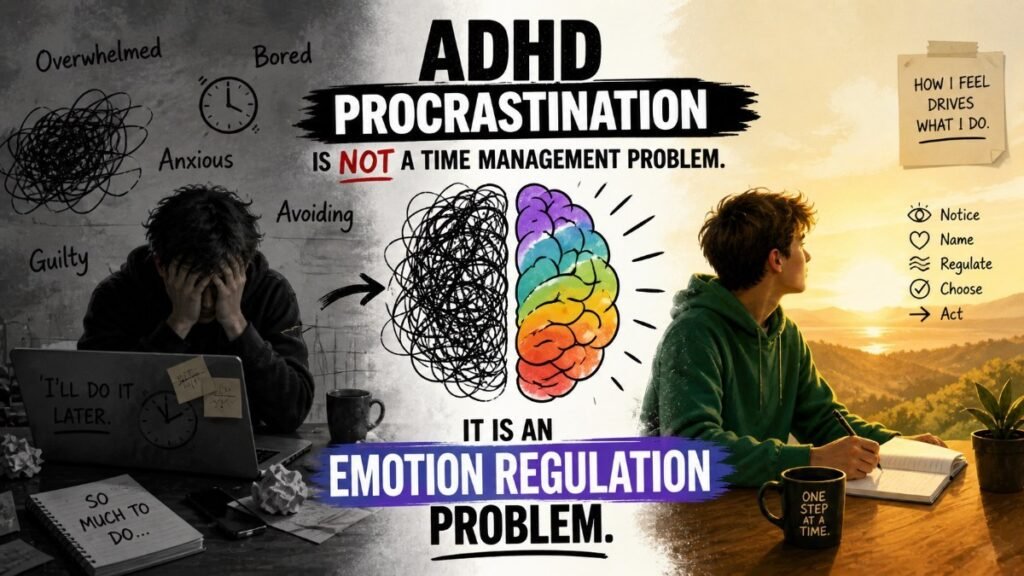
If you have ADHD and you procrastinate, you have almost certainly been handed some version of the same explanation: you are disorganized, you have poor time management, you just need a better system. Maybe you believed it for a while. You tried planners, time-blocking, countdown timers, color-coded calendars. Some of it helped some of the time. But the procrastination kept coming back, especially on the tasks that mattered most, and especially when the stakes were highest. The reason those interventions kept failing is not that you did not try hard enough. It is that the explanation was wrong. ADHD procrastination is not primarily a time management problem. The research now positions it as an emotion regulation problem. That is not a semantic distinction. It changes everything about what actually works.
The Old Story: Time Blindness and Disorganization
The traditional framing of ADHD procrastination borrows from the broader executive function literature. The argument goes roughly like this: ADHD impairs the prefrontal systems responsible for planning, sequencing, and temporal reasoning. People with ADHD have difficulty perceiving time accurately, struggle to estimate how long tasks will take, and cannot hold future deadlines as psychologically real and present. Therefore they delay. Russell Barkley’s work on time blindness is the most cited version of this model, and it is not wrong exactly. The time perception deficits are real and well-documented.
But time blindness explains why someone might underestimate how long a project will take. It does not fully explain why a person sits at their desk for three hours, knowing the deadline is tomorrow, aware of exactly how much time they have, and still cannot make themselves open the file. Something else is happening there. The executive function model has difficulty accounting for the emotional texture of procrastination: the dread, the low-grade nausea, the relief that floods in the moment you switch to literally anything else.
Procrastination is not a time management failure. It is an emotion management failure that happens to involve time.
Fuschia Sirois and the Emotion Regulation Model
Fuschia Sirois, a researcher at Durham University, has spent over two decades building the case that procrastination is fundamentally about negative affect avoidance. Her core argument, developed across multiple studies, is that procrastination functions as a short-term mood repair strategy. When a task generates negative emotions, including anxiety, boredom, self-doubt, frustration, or resentment, the fastest available way to feel better is to stop thinking about it. The relief is immediate and neurologically real. The costs are deferred. For a brain that heavily weights present reward over future consequence, this is a completely rational calculation in the moment (Sirois, 2014, Self and Identity).
In a 2023 paper, Sirois and colleagues conducted a comprehensive meta-analysis examining procrastination and health outcomes. One of the consistent findings across studies was the mediating role of emotion regulation difficulties: people who procrastinate chronically are not simply bad at managing time, they are using delay as a coping mechanism for negative emotional states (Sirois et al., 2023, British Journal of Health Psychology). This is not unique to ADHD, but the mechanisms that make it worse in ADHD are specific and worth understanding precisely.
Key finding: Sirois’s meta-analytic work shows procrastination is significantly predicted by poor emotional regulation, not by poor time management skills. In ADHD populations, deficits in emotional regulation are both more severe and more persistent than in neurotypical controls, compounding the baseline tendency toward avoidance.
Why ADHD Amplifies Every Part of This Loop
Understanding ADHD procrastination requires understanding that ADHD is not just an attention disorder. It is a disorder of emotional regulation as much as anything else. Shaw et al. (2014, American Journal of Psychiatry) identified emotion dysregulation as a core feature of ADHD, present across the lifespan and significantly impairing independent of the inattention and hyperactivity symptoms. Barkley has argued similarly that emotional impulsivity, the rapid and intense experience of negative emotions with diminished ability to modulate them, belongs in the diagnostic criteria and has been consistently underweighted in the DSM framework.
What this means practically is that when an ADHD brain encounters a task that generates mild negative affect, the emotional response is not mild. The boredom is not background boredom. The anxiety about being evaluated is not a manageable low hum. The frustration at not knowing where to start is not a passing irritation. These states arrive faster, hit harder, and are harder to move out of, which makes the avoidance response proportionally stronger. The person is not being dramatic when they describe a simple email as feeling impossible. Their nervous system is generating a genuinely disproportionate aversive signal in response to it.
Layer on top of this the dopamine system differences in ADHD. Dopamine is central to the brain’s ability to bridge present effort and future reward. When dopamine signaling is disrupted, as it is in ADHD, the motivational pull of a reward that exists only in the future is substantially weakened (Volkow et al., 2011, JAMA). This means the task needs to generate its own interest, urgency, or challenge in the present moment to compete with the immediate relief of avoidance. If the task is boring, ambiguous, or associated with previous failure, it cannot generate enough present-moment pull. Avoidance wins.
The Specific Tasks That Get Avoided and Why
Not all tasks get procrastinated equally, and the pattern is informative. Research and clinical observation converge on a consistent profile of high-procrastination tasks for ADHD adults: tasks that are ambiguous or poorly defined, tasks associated with previous failure or criticism, tasks that require sustained effortful output without immediate feedback, tasks that feel meaningless or disconnected from personal interest, and tasks where the fear of doing them imperfectly is significant enough to make starting feel dangerous.
That last category connects directly to what Sirois’s work describes as the role of self-worth protection in procrastination. If your identity is entangled with your performance, and if a history of ADHD-related failures has left you with a fragile or highly conditional sense of competence, then not starting a task is genuinely protective. You cannot fail what you have not attempted. This is not irrational. It is a self-protective strategy that made sense at some point in development and got encoded as a default response. It is also, at scale, deeply destructive.
The ADHD brain avoids the task because the task feels dangerous, not because the person lacks discipline. Discipline-based interventions miss the actual mechanism entirely.
Why “Just Start” Advice Fails at the Neurological Level
The standard productivity advice for procrastination, just begin, lower the bar, do two minutes, eat the frog, applies pressure to the behavioral output level without addressing the emotional input level. For a neurotypical person with mild task avoidance, this sometimes works because their baseline emotional response to the task is manageable and the small action provides enough momentum to carry them through. For an ADHD brain, the two-minute rule runs directly into an amygdala that has already flagged the task as aversive and a prefrontal cortex that is not well-positioned to override that signal.
This is not about motivation or attitude. Functional neuroimaging studies show that ADHD is associated with reduced activation in prefrontal-striatal circuits during tasks requiring inhibitory control and self-regulation (Cortese et al., 2012, Neuroscience and Biobehavioral Reviews). The biological substrate of “just push through the discomfort” is underperforming. Telling someone to use a tool they do not have is not a strategy. It is blame dressed up as advice.
Why time-management apps often backfire: Productivity tools that add scheduling pressure without addressing the emotional drivers of avoidance can actually increase negative affect around the task, making procrastination worse. The calendar reminder becomes another aversive stimulus to avoid.
The Self-Compassion Intervention: What the Evidence Actually Shows
Sirois has also been one of the primary researchers investigating self-compassion as an intervention for procrastination, and this is where the research gets both surprising and practically useful. Self-compassion, as defined by Kristin Neff and operationalized in research, involves three components: self-kindness rather than self-judgment, recognizing one’s experience as part of common humanity rather than isolated failure, and mindful awareness of difficult emotions rather than suppression or over-identification with them (Neff, 2003, Self and Identity).
Sirois and Pychyl (2013, Self and Identity) found that self-compassion predicted lower procrastination independently of conscientiousness and negative affect, which is a meaningful finding because it suggests self-compassion is not just a proxy for feeling good. The mechanism appears to be that self-compassion reduces the self-threat that makes task engagement feel dangerous. If you are not defining your worth by your performance, then an imperfect attempt is less catastrophic, and the emotional cost of starting drops enough to allow initiation. In subsequent work, Sirois (2014) found that self-compassion buffered the relationship between procrastination and health outcomes, particularly stress and wellbeing, and that it did so through reducing the ruminative self-criticism that follows procrastination episodes.
For ADHD adults specifically, this matters because the relationship with procrastination is often compounded by shame. Years of being told you are lazy, irresponsible, or not living up to your potential create a thick layer of self-judgment that activates every time a task gets avoided. That self-judgment is not just emotionally painful. It is neurologically counterproductive: shame and self-criticism activate threat responses that further impair prefrontal function, making the next initiation attempt even harder. The self-compassion research suggests that interrupting this cycle at the self-evaluation level, rather than at the behavioral output level, may be more effective than any scheduling system.
Self-compassion is not about letting yourself off the hook. It is about removing the threat signal that makes the hook so hard to reach in the first place.
Emotional Identification as a First-Line Skill
If the core mechanism of ADHD procrastination is negative affect avoidance, then one of the highest-leverage skills is the ability to identify what specific emotion is being avoided before the avoidance behavior kicks in. This sounds deceptively simple. It is not. ADHD adults frequently have difficulty with emotional awareness and labeling, in part because the rapid onset and intensity of ADHD-related emotional states makes them hard to observe before they are already driving behavior. Research on alexithymia, which refers to difficulty identifying and describing emotions, shows elevated rates in ADHD populations (Donfrancesco et al., 2013, ADHD Attention Deficit and Hyperactivity Disorders).
The practical implication is that the emotion driving procrastination is often described in vague terms: “I just don’t want to,” “it feels impossible,” “I can’t make myself do it.” These descriptions are accurate in that they reflect the felt experience, but they do not give the prefrontal cortex enough information to work with. When the vague aversion gets named precisely, such as “I am afraid this draft will reveal that I am not as smart as people think I am,” or “I am angry that this task exists at all and was dumped on me without enough information,” the emotional content becomes something that can be addressed rather than just endured or escaped. Affective labeling research by Lieberman et al. (2007, Psychological Science) demonstrated that naming emotions reduces amygdala reactivity, a finding that has direct relevance here. The act of labeling makes the emotional threat slightly less threatening.
Interest-Based Approaches and the Dopamine Bridge
One area where the time management framing does capture something real is in its implicit recognition that ADHD brains respond to urgency and novelty. The problem is that urgency and novelty are treated as moral failings to overcome rather than as features of the dopamine system to work with. A more neurologically honest approach asks: what conditions allow this brain to engage with this task? Sometimes the answer involves genuine interest. Sometimes it involves competition, novelty, social stakes, or a tight external deadline. These are not character weaknesses. They are the conditions under which the dopamine system can generate enough present-moment motivational pull to compete with the pull of avoidance.
William Dodson’s interest-based nervous system model, while not peer-reviewed in the same way as the Sirois work, maps onto the dopamine reward signaling literature in ways that are clinically useful. The framing that ADHD brains are not motivation-deficient but rather interest-contingent in their motivation reorients the problem. Instead of trying to force engagement with intrinsically aversive tasks through willpower, the question becomes whether there is a way to restructure the task environment so that interest, challenge, urgency, or social connection can be recruited as motivational scaffolding. This is not always possible, but it is more actionable than “try harder.”
The practical reframe: Before labeling a task as something you are procrastinating on, ask what emotion you are avoiding and whether there is a structural way to reduce that emotion’s intensity rather than relying on willpower to override it. This shifts the problem from a character question to a design question.
What Actually Helps: A Research-Grounded Summary
The evidence base for ADHD procrastination interventions is still developing, but several directions have support. Emotion-focused interventions, including mindfulness-based approaches and self-compassion practices, show consistent effects on procrastination in general populations (Sirois and Tosti, 2012, Journal of Rational-Emotive and Cognitive-Behavior Therapy), and the mechanisms align closely with what we know about ADHD-specific emotion dysregulation. Cognitive behavioral therapy adapted for ADHD, which includes explicit work on the emotional components of avoidance, outperforms purely behavioral or skills-training approaches in several clinical trials (Solanto et al., 2010, American Journal of Psychiatry).
Medication is relevant here because stimulant medications work in part by improving the dopamine and norepinephrine signaling that underlies both emotional regulation and the ability to sustain effortful engagement with low-interest tasks. They do not fix procrastination directly, but they raise the baseline capacity for prefrontal regulation that makes all the other strategies more accessible. For many ADHD adults, the experience of being medicated is described as the tasks feeling less emotionally loaded, not as suddenly enjoying them, which is consistent with the emotion regulation model rather than the time management model.
Body doubling, the practice of working alongside another person either physically or virtually, has a strong anecdotal evidence base in ADHD communities and plausible mechanisms: social presence activates different motivational circuits, adds mild positive arousal, and introduces a form of external accountability that substitutes for underdeveloped internal regulatory capacity. Research on social facilitation effects and the role of co-regulation in executive function support the mechanism even in the absence of large randomized trials specifically in ADHD adults.
Finally, and this is the piece most often missing from popular ADHD productivity content, addressing the shame and self-judgment that accumulate around chronic procrastination is not optional. It is not a soft add-on to the real work. The self-criticism loop actively impairs the prefrontal function you need to break the avoidance cycle. Any approach to ADHD procrastination that does not take the emotional and self-evaluative layer seriously is working with one hand tied behind its back. Sirois’s self-compassion research is not telling you to be easy on yourself as a consolation prize. It is pointing at a leverage point that the time management model never located.
The task is not the enemy. The feeling the task generates is the enemy. Strategies that target the feeling directly will always outperform strategies that target the task directly.
Changing the Internal Conversation
None of this means ADHD procrastination is inevitable or untreatable. It means the treatment target is more specific than most productivity advice acknowledges. The work is not to become someone who loves doing hard things. It is to become someone who can tolerate the negative affect that hard things generate without immediately escaping it, who can hold the self-compassion to continue attempting things despite imperfect outcomes, and who can design environments that reduce the emotional load of high-avoidance tasks enough to make initiation possible.
That is a different project than buying a better planner. It takes longer and it touches more vulnerable territory. But it is also the project that actually corresponds to what is happening in your brain, and for most ADHD adults, being given an accurate explanation after years of inaccurate ones is itself a meaningful shift. You were not lazy. You were not irresponsible. You were managing emotions with the tools you had, in a brain that generates those emotions with higher intensity and less regulatory support than the world was designed for. Understanding that is not the end of the work. It is the beginning of doing the right work.
Quick Dopamine Hits:
- Before you open the task you are avoiding, write one sentence naming exactly what feeling you expect to have when you start it. Naming the emotion takes it from a vague threat into something your prefrontal cortex can work with.
- Set a two-minute timer and work on the avoided task with the explicit goal of feeling bad. Remove the pressure to perform. Your only job is to tolerate the discomfort for 120 seconds and then decide whether to continue.
- After you finish or abandon an avoided task today, write one sentence of self-compassion directed at yourself as if you were advising a friend in the same situation. Keep it factual, not cheerful: ‘This was genuinely hard, not a character flaw.’
Rate this article
Was this a useful hit?