The ADHD Masking Tax: What Suppressing Your ADHD Costs You

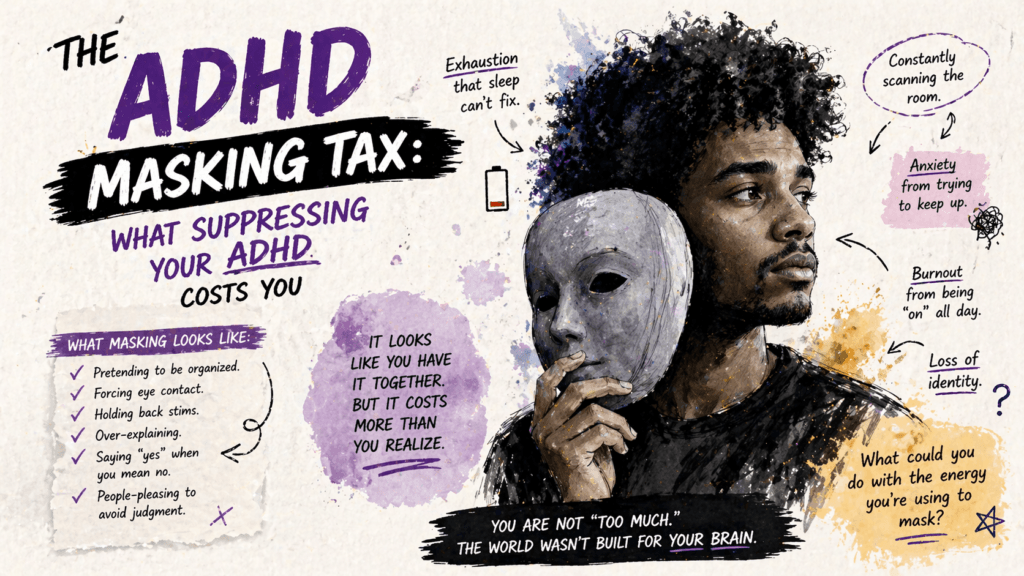
Masking is the practice of suppressing, hiding, or performing over your natural neurological tendencies in order to appear more acceptable to the people around you. For ADHD adults, this is not an occasional social strategy. It is often a constant background process running throughout every professional interaction, every meeting, every conversation where the cost of appearing "off" feels too high to risk. The research on what sustained masking costs is growing, and the numbers are not good.
What Masking Is and What It Is Not
Masking is frequently confused with coping strategies, and the distinction matters. A coping strategy is a behavior that genuinely reduces the impact of a difficulty. A person with ADHD who uses a structured checklist to manage task completion is coping. A person who watches themselves carefully during meetings to catch the moment before they interrupt someone, runs an internal commentary on whether they are making too much or too little eye contact, modulates their voice to suppress the excitement that comes out when hyperfocus activates, and rehearses responses to questions they anticipate being asked, that person is masking. The checklist helps. The surveillance does not reduce the difficulty; it just hides it from observers.
Hull et al. (2017, Journal of Autism and Developmental Disorders) developed one of the first validated measures of masking behavior in autism, and their framework has been applied to ADHD contexts as well. Their research identified three components of masking: assimilation (fitting in through observed behavior), compensation (developing strategies to work around neurological differences), and masking proper (actively hiding characteristics). Compensation, in their framework, can be functional. Masking proper is where the costs accumulate.
Why ADHD Adults Mask
The motivation for masking is not vanity. It is survival learning from years of social feedback. ADHD adults who interrupted frequently in childhood learned, often through harsh correction, that their natural response patterns were unwelcome. Those who struggled to sit still during school absorbed the message that their bodies were a problem. Adults who talk quickly, shift topics, lose track of conversations, or go quiet during hyperfocus states have typically received enough social correction that masking the behavior feels safer than living with the consequences of not masking it.
In workplace settings, the stakes are financial. A study by Adamou et al. (2013, ADHD Attention Deficit and Hyperactivity Disorders) found that adults with ADHD reported significantly higher rates of job loss, interpersonal conflict at work, and underemployment relative to peers. These consequences are the direct outcome of the social and professional penalties for visible ADHD traits. Masking is a rational response to a real threat.
"Masking was described by autistic and ADHD adults as a learned survival strategy developed in response to negative social feedback, not a freely chosen social performance. Participants consistently framed it as exhausting and identity-distorting." (Hull et al., 2017, Journal of Autism and Developmental Disorders)
The Documented Costs of Sustained Masking
The costs of masking have been studied most extensively in autism research, and that research increasingly applies to the AuDHD population and to ADHD broadly. Pearson and Rose (2021, Autism in Adulthood) found that masking was significantly associated with anxiety, depression, and burnout in autistic adults, with particularly strong associations in women and gender-diverse individuals. The cognitive load of sustained masking is not metaphorical. Suppressing automatic responses, monitoring others' reactions in real time, modulating speech and movement, and maintaining a performed version of yourself requires genuine executive function resources that are then unavailable for the tasks you are supposed to be completing.
For ADHD adults specifically, the costs cluster in several areas. Late diagnosis is one of the most significant: adults whose masking was effective enough to obscure their ADHD from clinicians and teachers often reach their thirties or forties before receiving any assessment, by which point they have spent decades interpreting their struggles as character flaws rather than neurological differences (Young et al., 2020, Journal of Attention Disorders). Identity confusion is another cost. When the version of yourself you present to the world is built on suppression, distinguishing between "who I am" and "who I perform" becomes genuinely difficult.
The Masking Tax Calculation: If you arrive at work and leave at roughly the same energy level, masking load is probably manageable. If you arrive with moderate energy and leave depleted in a way that affects your evenings and recovery on weekends, the gap between those two states is a reasonable estimate of your current masking tax. That gap is real, it is neurological, and it belongs in any honest conversation about your capacity.
How This Affects the AuDHD Population Specifically
For AuDHD adults, the masking load is compounded in ways that deserve specific attention. Autism masking involves suppressing sensory responses, scripting social interactions, monitoring body language and facial expression, and managing the gap between how social situations feel and how the person is required to respond to them. ADHD masking involves suppressing impulsivity, managing visible attention drift, controlling the external signs of time blindness, and performing the organizational competence that neurotypical professional culture expects.
These two masking projects use overlapping neurological resources and are both running simultaneously. The AuDHD adult in a standard workplace is not managing one masking burden but two interlocking ones, and they interact in ways that make each more costly than it would be if the other were not present. Research specifically on AuDHD masking is still emerging, but the framework established by Pearson and Rose (2021) and Hull et al. (2017) provides a clear basis for understanding why the combined burden is disproportionately high.
"The relationship between masking and poor mental health outcomes in autistic individuals was robust across multiple measures and was not explained by the presence of mental health conditions prior to masking behavior, suggesting that masking itself contributes to mental health deterioration." (Pearson and Rose, 2021, Autism in Adulthood)
Unmasking Safely
Unmasking is not a single event and it is not without risk. For adults whose livelihoods depend on professional relationships, dropping masking behaviors abruptly in environments where they have historically been penalized for ADHD traits is not a responsible recommendation. What is possible is a gradual, strategic reduction in masking in contexts where safety exists: with trusted people, in environments with genuine flexibility, and in domains where the stakes of visibility are lower.
Starting Points for Safer Unmasking: Identifying one environment where you can reduce masking effort, even partially, gives the nervous system practice at the lower load. Therapy with a clinician who has direct experience working with ADHD and autism in adults is the most supported context for this process, because unmasking often surfaces the identity questions that sustained masking has deferred for years.
The goal of recognizing the masking tax is not to eliminate all social adaptation. It is to distinguish between adaptive strategies that genuinely support functioning and performance behaviors that only protect the perception of functioning while systematically depleting the person doing the performing. That distinction, once made, changes how you allocate the resources you actually have.
Rate this article
Was this a useful hit?