The Inattentive ADHD Tax: All the Money That Quietly Disappears When Your Brain Loses Track

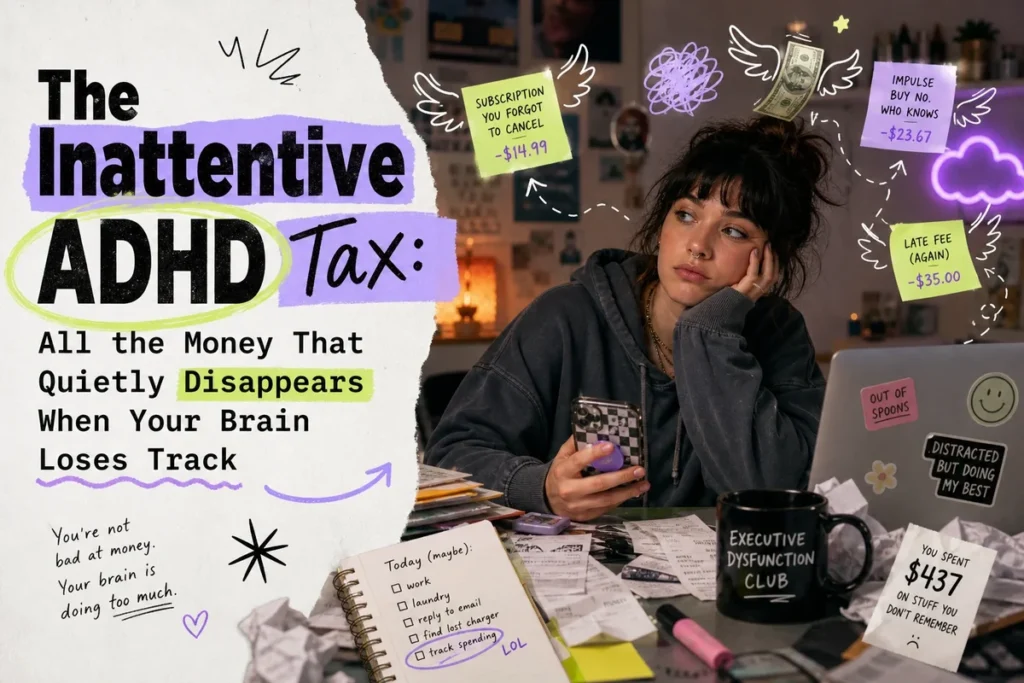
You're on your fourth pair of wireless headphones since January. You told yourself you'd put them in the same place every time. You bought a little tray for them and everything. And somehow, impossibly, they are gone. Again. And now you're standing in Best Buy spending another $80 you don't have because you need headphones for work and you can't figure out where the last pair went because you swear you put them on the nightstand but also maybe the couch but also maybe they fell behind something and you don't have time to look because you have a meeting in twenty minutes.
The ADHD inattentive type financial cost isn't the dramatic kind. It's not the "I bought a boat" story people laugh about on podcasts. It's quieter than that. It's the $35 late fee on your credit card because you meant to pay it and then you blinked and it was due yesterday. It's the gym membership you've paid for six months straight but can't use anymore because you lost the keycard and replacing it requires going in person during hours you always forget exist. It's the groceries that spoiled because you set the milk on a shelf next to the fridge, not in it, and you literally told yourself not to leave it there while you were doing it.
This is the part nobody warns you about when they talk about ADHD. The money doesn't leave in big chunks. It leaves in small, constant, invisible ones.
Why the ADHD Inattentive Type Financial Cost Is Different
When people talk about ADHD and money, they usually mean impulse spending. The dopamine-chasing purchases. The 2 AM Amazon carts. And sure, that's real. But inattentive ADHD has a different financial profile. It's not about buying things you don't need. It's about paying extra for things you already bought, losing things you need, and missing deadlines that cost money.
The research backs this up. A 2020 study in the Journal of Attention Disorders found that adults with ADHD pay significantly more in fees, penalties, and replacement costs than neurotypical adults, even when controlling for income.1 The researchers called these "indirect costs," but anyone living with inattentive ADHD knows they're actually very direct. They hit your bank account every month.
The difference is visibility. Impulse spending shows up on your credit card statement as a clear line item: "Urban Outfitters, $147." You can look at it and know what happened. The inattentive tax doesn't announce itself. It hides in late payment interest. In the second bottle of shampoo you bought because you forgot you already had one. In the library fine that became a collections notice. The money disappears, and you can't point to any single decision that caused it.
Every time it happens, you go through the same shame and anger, and the process repeats itself in this cruel infinite loop, because no matter how many calendars and sticky notes and reminders you use, it still happens. You still inevitably put it off and pay.
The Taxonomy of Quiet Costs
Let's name the specific ways this shows up. Not because listing your financial failures is fun, but because seeing the pattern is the first step to interrupting it.
Late fees and penalties. The credit card you meant to pay. The rent that was due on the first but you submitted it on the third and now there's a $50 charge. The quarterly taxes on your small business that you absolutely knew about and definitely intended to file and then suddenly it was July and you owed the IRS interest. The late fees don't care that you tried. They don't care that you have seventeen reminders set. They just charge.
Subscription leakage. The streaming service you signed up for to watch one show eight months ago. The app that auto-renewed because you forgot to cancel during the trial period. The gym membership you pay for but haven't used since February because going requires remembering to pack a bag and you never remember to pack a bag. These amounts are small individually. They are not small when you add them up across a year.
Replacement costs. Headphones. Phone chargers. Umbrellas. Sunglasses. Water bottles. The specific adapter your laptop needs. You have bought each of these items multiple times. Not because you wanted duplicates. Because you lost them, or can't find them, or put them somewhere "safe" that your brain promptly deleted from memory.
Spoilage and waste. The groceries that went bad. The leftovers you meant to eat. The meal kit subscription that seemed like a good idea until you forgot to skip the weeks you were traveling and now you have $200 worth of rotting ingredients on your porch. The food goes in the trash. The money went with it.
Double purchasing. You needed shampoo. You bought shampoo. You got home and found shampoo under the sink that you bought last week and forgot about. Now you have three bottles of shampoo and zero bottles of the conditioner you actually ran out of. This is not the worst financial mistake a person can make. It is, however, the most annoying.
The ADHD Inattentive Money Management Trap
Here's what makes this especially cruel: the standard advice for fixing financial problems requires exactly the executive functions that inattentive ADHD impairs.
"Make a budget and stick to it." Cool, except sticking to things over time is the core deficit here. You can make an excellent budget. You will forget to check it.
"Set reminders." You have 47 reminders. You have learned to dismiss them automatically. The reminder is not the problem. The gap between "seeing the reminder" and "taking the action" is the problem.
"Put your important items in designated spots." You have designated spots. Multiple designated spots. So many designated spots that you now have to remember which designated spot you used this time, which means you've just added a memory task to solve a memory problem.
The cruel loop is real. You try the advice. The advice doesn't work. You conclude you're bad with money. You feel shame about being bad with money. The shame makes it harder to look at your money. Not looking at your money makes the problems worse. The problems getting worse confirms that you're bad with money. Repeat until you're 28 and genuinely afraid to open your bank app.
The shame loop is the expensive part: The actual late fee is $35. The months of avoiding your finances because looking at them triggers shame? That costs you hundreds. The avoidance is where the real money goes.
What Actually Helps With ADHD Missed Payments and Forgotten Subscriptions
The goal is not to become a person who never forgets things. That person is not available. The goal is to build systems that catch you when you forget, which you will, because that's how your brain works.
Automate everything that can be automated. Not just autopay for bills, but autopay for savings. Automatic transfers to a "replacement fund" for the headphones you will lose. If the money moves without requiring your attention, your attention doesn't get to sabotage it. This won't catch everything. It will catch the things that happen on a schedule.
Use friction strategically. Make it harder to subscribe to things. Delete your saved credit card info from websites. Turn off one-click purchasing. The goal is to create a gap between "wanting to sign up" and "being signed up," because that gap is where you remember you already have three streaming services you don't watch.
Do a subscription audit once. Not monthly, because you won't do it monthly. Once. Right now, or this weekend. Go through your bank statement for the last month, find every recurring charge, and cancel the ones you don't use. This will save you actual money immediately. You do not have to build a habit. You just have to do it this one time.
Accept that you will lose things and budget for it. This sounds like giving up. It's actually the opposite. It's building the cost of your brain into your financial plan. If you lose three pairs of headphones a year, that's $240 you need to budget. Put that money aside in January. When you lose the headphones in March, the money is already there. The financial hit becomes a planned expense instead of an emergency.
Consolidate your payment dates. Most companies will let you change your billing date if you call and ask. Pick one day, ideally right after payday, and move everything there. Now you have one day per month where bills happen, instead of bills happening constantly in the background where you can't track them.
The Emotional Cost Behind the Financial One
The ADHD financial quiet cost isn't just about money. It's about what the money represents.
Every late fee is a small piece of evidence that you can't handle adult responsibilities. Every lost item is proof that you're careless, no matter how many systems you build. Every spoiled grocery is a reminder that you can't even manage to eat the food you bought. The cumulative message is: you are not competent to manage your own life.
That message is wrong. But it's a message that hits you twenty times a month in small, specific, documented ways.
A 2019 study found that adults with ADHD report significantly higher levels of financial stress than adults without ADHD, independent of actual income levels.2 In other words: it's not that you don't make enough money. It's that managing money with an ADHD brain is genuinely, measurably harder, and that difficulty creates stress that compounds the problem.
Sometimes you wish you never grew past the age of 8, because adult responsibilities require a kind of consistent attention that your brain refuses to provide. The wish isn't immaturity. It's exhaustion.
ADHD Inattentive Type Financial Cost and Late Discovery
If you got your diagnosis later in life, you've done the math. All the late fees from before you knew. All the replacement items. All the subscriptions that drained your account for years because you forgot they existed. The number is painful to calculate, so most people don't.
But here's what the math also shows: you survived it. You paid the tax for years without knowing what it was, without any of the tools or frameworks or language to address it. You kept going. Your bank account took hits over and over, and you're still here.
That's not nothing. It's not an inspirational poster. It's just the truth. You've been paying a tax on the way your brain works, and now you know the tax exists, which means you can start building the systems that reduce it.
Not eliminate it. Reduce it. Because elimination isn't the goal. Reduction is. Every autopay you set up, every subscription you cancel, every $50 late fee you avoid because you actually paid on time this once, that's money back in your pocket. It adds up in the other direction too.
When the Cost Is Too High to Handle Alone
Sometimes the ADHD money situation has gotten to a point where no amount of subscription audits will fix it. Credit card debt. Tax penalties. Collections. The accumulated cost of years of missed deadlines.
If that's where you are, you might need outside help. A fee-only financial advisor who understands ADHD. A nonprofit credit counseling service. An accountant who can negotiate with the IRS on your behalf. These cost money upfront, but they often save money in the long run by preventing the next round of penalties.
You might also qualify for disability accommodations or benefits. ADHD is a recognized disability in many countries, and there are programs designed to help. This isn't about labeling yourself. It's about accessing resources that exist specifically for brains like yours.
Asking for help is financial planning: The cost of an ADHD-informed financial advisor is a fixed expense. The cost of continuing to pay the inattentive tax indefinitely is an unlimited one. The math often favors getting help.
Tracking What You Actually Spend on the Tax
One of the hardest parts of the ADHD inattentive type financial cost is that it's invisible. You don't track it. It doesn't show up as a category in your budget app. It's scattered across line items that look normal: "late fee," "Amazon," "replacement charger."
Try this: for one month, track every expense that happened because of forgetting, losing, or missing something. Not to punish yourself. To see the actual number. Write it down or add it to a notes app every time it happens.
At the end of the month, you'll have a real number. Maybe it's $50. Maybe it's $300. Maybe it's more. Whatever it is, that's the tax. That's what you're working with. And once you can see it, you can start to reduce it systematically instead of fighting it blindly.
Building a Brain-Compatible Financial System
The ADHD inattentive type financial cost doesn't go away, but it can shrink. The key is building systems that don't require you to remember, pay attention, or sustain effort over time. Systems that work because they're automatic, not because you're trying harder.
Your brain loses track. That's the starting point. Not the problem to fix, but the constraint to design around. The money that quietly disappears can, at least partially, quietly stay. You just have to stop expecting yourself to catch it manually, because manual catching is exactly what your brain won't do.
The fourth pair of headphones might be inevitable. The fifth might be too. But maybe the sixth pair goes in the same spot every time because you finally stopped buying cute charging trays and started putting them in your shoes by the door where you literally cannot leave without stepping on them. The system is ugly. The system works. The money stays in your account instead of flowing back to Best Buy.
That's the victory available here: not perfection, but less leakage. Not a budget you stick to, but money that stays because the systems caught it when your brain didn't.
References:
1 Altszuler, A. R., et al. (2020). "Financial burden of childhood ADHD." Journal of Abnormal Child Psychology, 48(4), 563-574.
2 Kirino, E., et al. (2019). "Quality of life and financial burden in adults with ADHD." Neuropsychiatric Disease and Treatment, 15, 1701-1712.
Rate this article
Was this a useful hit?