ADHD Working Memory: Why You Lose the Plan Mid-Task

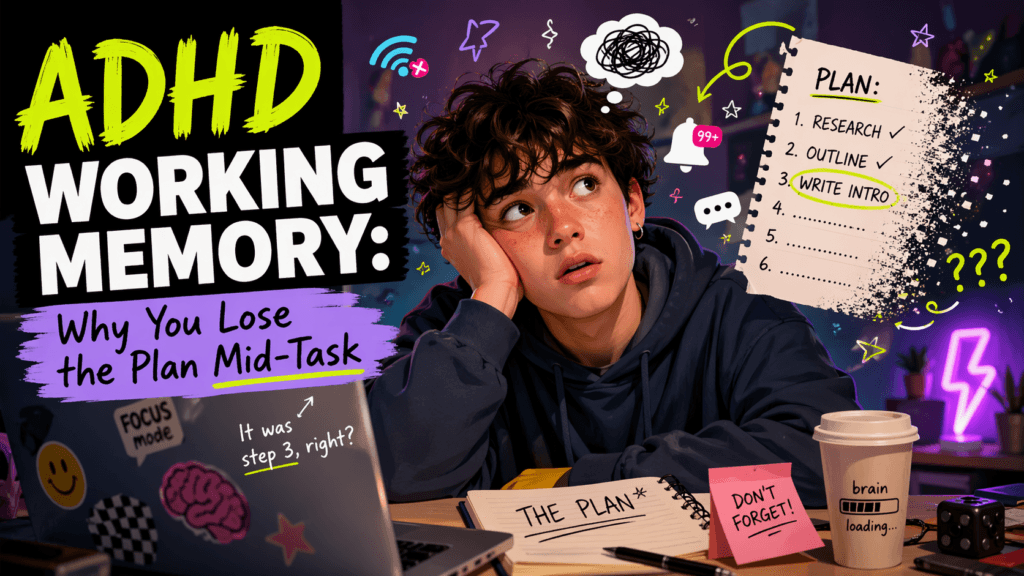
You have a clear plan. You sit down, open the document, and start working. Ten minutes later you surface and you have no idea what you were supposed to do next. You remember you had a list. You cannot remember what was on it. You spend the next four minutes reorienting, rebuilding context, and wondering whether this has been happening for years without you noticing.
It has. And it is not a memory problem in the traditional sense. It is an ADHD working memory problem, which is a different thing entirely, with different implications for how you structure your work.
Working Memory Is Not What You Think It Is
Most people use "memory" to mean long-term memory: the ability to recall facts, faces, events. Working memory is something else. It is the mental workspace where you hold information while actively using it. The cognitive scratch pad where the plan lives while you execute it.
Psychologist Alan Baddeley and Graham Hitch introduced the modern model of working memory in 1974. They described it as a multi-component system with a central executive (the director), a phonological loop (verbal and auditory information), a visuospatial sketchpad (spatial and visual information), and an episodic buffer that integrates them. This model has held up well across decades of research and is still the dominant framework today.
Working memory capacity is limited in everyone. We can hold roughly four chunks of information at once (the old "seven plus or minus two" figure has been revised downward in more recent work). What matters for ADHD is that working memory deficits are one of the most reliably documented features of the condition, more consistent across studies than any other cognitive marker.
What ADHD Does to Working Memory
Russell Barkley, one of the most cited ADHD researchers in the field, has argued for decades that ADHD is fundamentally a disorder of executive function, and that working memory sits at the center of that. His model frames ADHD not as an attention problem but as a problem with self-regulation across time: the ability to hold the future in mind while managing the present.
A 2005 meta-analysis by Willcutt and colleagues, reviewing 83 studies on executive function in ADHD, found that working memory showed the largest and most consistent effect sizes of any cognitive domain tested. This is not a small or disputed finding. Working memory impairment in ADHD is well-established in the research literature.
What this looks like practically: the verbal scratch pad that holds instructions gets overwritten faster. The plan you built in your head two minutes ago is gone. The thing you were going to say before the other person finished talking has evaporated. The reason you walked into this room has simply ceased to exist.
This is not forgetfulness. Forgetfulness implies information was stored and lost. Working memory failure means it was never consolidated. The information was never written down in a stable way. It existed briefly in working memory and was displaced before you could act on it or transfer it anywhere durable.
Why You Lose the Plan Mid-Task
Here is the specific mechanism. When you begin a complex task, your brain assembles a representation of the goal, the steps, and the current position in the sequence. This representation lives in working memory. Every interruption, every intrusive thought, every context switch risks overwriting it.
For a neurotypical person, this representation is reasonably stable. It takes a significant interruption to displace it. For an ADHD brain, the representation is fragile. A brief distraction, a single intrusive thought, or even the internal cognitive load of doing the actual work can be enough to knock the plan out of the scratch pad entirely.
This is why you can be doing well on a task, genuinely engaged, and then suddenly have no idea where you are. The work itself consumed the working memory that was holding the map of the work. You were navigating and someone folded the map mid-walk.
It also explains a specific and painful pattern: multi-step verbal instructions. Someone tells you four things to do. You hear them all. You nod. You go to do them. By the time you have done the first two, you have lost the third and fourth. You did not fail to listen. Your phonological loop simply could not hold four steps against the competing load of actually executing step one.
The Shame Layer That Gets Added On Top
Working memory failures are invisible. Nobody sees the scratch pad go blank. What they see is you asking the same question twice, forgetting what you were just told, losing track of a task you said you would handle, or walking out of a meeting with no idea what was agreed.
Over time, this accumulates a reputation: unreliable, not a good listener, disorganized. And over time, you internalize that reputation. By adulthood, many undiagnosed ADHD adults have built an elaborate set of beliefs around this pattern: "I have a bad memory," "I can't be trusted with important things," "I have to write everything down because I'm the kind of person who forgets."
That last one is actually true, but it is a strategy, not a flaw. The flaw framing is what causes the damage. Working memory impairment is neurological. You cannot will your phonological loop into holding more items. But you can build external systems that do what your working memory cannot.
Working memory is not fixed. While baseline capacity varies by brain, the effective capacity can be extended dramatically through externalization: offloading information from your head into reliable external systems. This is not a workaround. It is the correct solution.
What the Research Suggests About Intervention
There have been attempts to train working memory directly. The most well-known is Cogmed, a computerized training program that showed early promise. However, subsequent meta-analyses, including a 2015 review by Melby-Lervag and Hulme, found that while working memory training can improve performance on working memory tasks specifically, it does not generalize to broader cognitive outcomes or ADHD symptoms. Training the task does not train the capacity.
What does have good evidence is accommodation and externalization. A 2014 review in the Journal of Attention Disorders by Gathercole and colleagues summarized strategies that reduce the working memory load of complex tasks: breaking instructions into smaller segments, providing written materials, using visual supports, and encouraging note-taking at the point of instruction.
These are not accommodations for someone who is lazy. They are accommodations for a specific neurological difference that is well-documented and measurable. They work because they offload the storage function from working memory to an external system, freeing working memory to do what it is better at: holding the current active thought.
Practical Architecture for ADHD Working Memory
The goal is not to fix working memory. The goal is to build external systems that do the job working memory cannot reliably do, and to use those systems consistently enough that they become automatic.
Capture before you start, not when you forget. Before beginning any multi-step task, write out the steps. All of them, in order. Not as a reference document. As the active plan that replaces your working memory. You are not going to hold those steps in your head. Write them so you do not have to.
The two-minute re-entry protocol. Every time you surface from a work session, before you do anything else, write down exactly where you are. One sentence: "I just finished X. The next step is Y. The blocker is Z." This costs two minutes and saves the twenty minutes of reorientation you would otherwise spend next time you sit down.
Visible progress markers. The plan should be visible while you work, not buried in a notes app. A sticky note on the monitor. A text file open beside your work window. The point is to keep the map in your peripheral visual field so that when working memory drops it, your eyes find it again before you have to rebuild it from scratch.
Reduce the number of open contexts. Every open tab, unfinished conversation, and pending task is occupying a small piece of working memory. Reducing the number of open loops reduces the cognitive load competing for scratch pad space. This is why single-tasking, even if it feels slower, often produces better output in ADHD brains: the working memory is not split.
Verbal-to-written translation immediately. When someone gives you verbal instructions, write them down before you respond. Not after. Not later. Before you say anything back. The phonological loop starts decaying immediately. The only way to stop the decay is to translate to an external medium within seconds.
What Hyperfocus Does to This
There is a specific paradox for ADHD working memory in hyperfocus states. When you are deeply engaged in something genuinely interesting, working memory actually performs better in the context of that task. The interest creates a higher signal, which holds the relevant information in working memory more reliably.
But here is the catch. When you surface from hyperfocus, you have lost everything that was not related to the focus object. You may have no idea how long you were in there, what time it is, what you were supposed to be doing, or what obligations have passed during the session. Hyperfocus is not a working memory fix. It is a working memory redirect. The rest of life gets dropped while the focused task holds all available capacity.
This is why hyperfocus can be simultaneously the most productive state an ADHD brain enters and one of the most disruptive to overall function. Managing it requires external timers, commitments that pull you back, and the re-entry protocol above applied rigorously when you surface.
The Thread Between Now and Later
Working memory, in Barkley's framework, is ultimately what allows you to connect current behavior to future goals. The plan you hold in mind while working is a thread from the present task to the intended outcome. When working memory fails, that thread breaks. You are left doing something without quite knowing why or what comes next.
ADHD, from this perspective, is partly a problem with threading: maintaining the connection between now and the plan. Every strategy in this article is ultimately a way to keep that thread visible and intact even when your brain cannot hold it internally. Write it down. Keep it visible. Re-read it when you surface. Build systems that do not rely on your working memory to work.
This is not a workaround for a broken brain. It is the architecture that matches the brain you have. The difference matters, because one frame produces shame and the other produces strategy.
Rate this article
Was this a useful hit?