ADHD Task Switching: Why Changing Gears Costs Your Brain More Than It Should

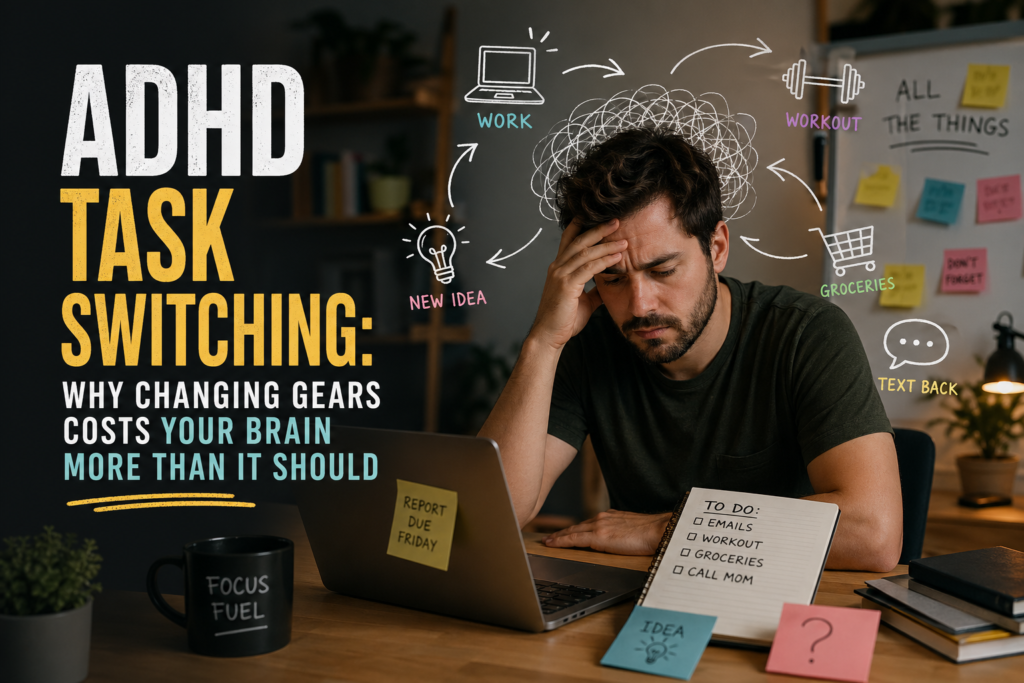
You are in the middle of something. It is going well, or at least it is going. Then something demands your attention, a meeting starting, a message you cannot ignore, a task you promised someone else. You close what you were doing and open the next thing. And then you sit there, blinking, feeling like you just crossed a time zone. The new task is in front of you, you know what it is, but something in your brain is still standing in the last room. This is ADHD task switching, and the reason it feels so costly is that it genuinely is, neurologically, measurably, and in ways that neurotypical productivity advice almost entirely ignores.
What Switching Cost Actually Means
Cognitive scientists have a name for what happens when you move between tasks: switching cost. It refers to the measurable drop in performance speed and accuracy that occurs immediately after a task switch, even when the person knows the switch is coming and has had time to prepare. The foundational research on this comes from Stephen Monsell, whose 2003 review in Trends in Cognitive Sciences laid out the basic architecture of the problem (Monsell, S., 2003, Trends in Cognitive Sciences). Monsell’s work showed that switching cost is not simply about re-reading instructions or figuring out what to do next. Much of the cost is generated by something deeper: the persistence of the previous task’s mental set, and the incomplete configuration of the new one.
Joshua Rubinstein and colleagues extended this framework in a landmark study examining how people switch between tasks of varying complexity, finding that the time lost to switching was not trivial, in some conditions, it added up to 40 percent performance loss (Rubinstein, J.S., Meyer, D.E., and Evans, J.E., 2001, Journal of Experimental Psychology: Human Perception and Performance). Forty percent. That is not a rounding error. That is nearly half your available cognitive capacity hemorrhaging into the space between tasks.
Switching cost is not about forgetting what you were doing. It is about the brain carrying the ghost of the last task into the next one, and struggling to let either one fully go.
For neurotypical adults, these costs are real but manageable. The prefrontal cortex handles the reconfiguration relatively efficiently, especially with practice. For ADHD brains, the same reconfiguration process is compromised at a structural level, and the costs compound in ways the research is only beginning to fully map.
Why the ADHD Brain Is Particularly Bad at This
ADHD is not a problem with attention in the simple sense of not having enough of it. It is a problem with regulating attention, directing it, shifting it, and most relevant here, releasing it from one target and reorienting it toward another. The neural systems responsible for this are centered in the prefrontal cortex and its connections to the basal ganglia and anterior cingulate cortex. These circuits handle what researchers call executive control of attention, and in ADHD they are underactivated and less efficiently connected (Barkley, R.A., 1997, Psychological Bulletin).
When a neurotypical person finishes a task or is interrupted mid-task, their brain relatively efficiently inhibits the active mental set, the configuration of rules, goals, and attentional filters associated with that task, and begins constructing the new one. In ADHD, inhibition is impaired (Barkley, R.A., 1997, Psychological Bulletin). The old mental set does not fully shut down. It lingers. Researchers sometimes call this perseveration, but in everyday ADHD life it looks like staring at a new document while mentally still solving the problem you just closed. It looks like arriving at a meeting and spending the first five minutes unable to track what anyone is saying because your brain is finishing a sentence from thirty minutes ago.
There is also a working memory dimension. Task switching requires you to hold the new task’s goal in working memory while simultaneously suppressing the old one. ADHD working memory is notoriously unreliable, which means the new task’s mental set is harder to load and easier to drop mid-construction. The result is that you can appear to switch, you are physically in the new place, you have opened the right file, while your cognitive system is still partially running the old process in the background.
The residual activation problem: After switching tasks, the brain continues processing the previous task involuntarily. This is called backward inhibition failure, and it is more pronounced in ADHD. It is not distraction in the colloquial sense, it is your attention system failing to fully disengage, even when you want it to.
The Transition Is Hard Even When You Want Both Tasks
Here is the part that confuses a lot of people, including ADHD adults themselves. It would make intuitive sense if switching cost was highest when you were being pulled from something enjoyable toward something boring. Hyperfocus to homework, for example. And yes, that transition is brutal. But switching cost is also substantial when you are moving between two things you actually want to do. Two projects you care about. A conversation you are enjoying and a creative task you have been looking forward to all day. The switch still costs, and the cost still derails you.
This matters because it dismantles the common assumption, including assumptions ADHD adults often internalize about themselves, that the difficulty is fundamentally motivational. If you cannot switch even when you are motivated to do both things, motivation is not the primary variable. The neural machinery is. The reconfiguration cost exists independently of whether you want to make the switch.
If the problem were simply motivation, you would be able to switch freely between two tasks you love. You cannot. That is not a character deficiency. That is an executive function deficit doing exactly what the research predicts.
This also explains something ADHD adults frequently describe in therapy and online communities: the paralysis that sets in during transitions that should feel low-stakes. Finishing lunch and starting work. Leaving a social event when you were having a good time. Closing a YouTube rabbit hole to return to something you genuinely care about completing. The switch is resisted not because you do not want the next thing, but because your brain’s switching machinery is sluggish, and the cost of transition is felt as a kind of cognitive pain.
Hyperfocus Makes It Worse, Not Better
ADHD hyperfocus is often framed as a superpower, and in some contexts the capacity for intense, sustained engagement does produce real results. But from a task-switching perspective, hyperfocus is the problem on steroids. When an ADHD brain locks into a hyperfocus state, the attentional filter that screens out everything irrelevant becomes extraordinarily tight. That is what makes the focus intense. But it also means the switching cost when you are pulled out of hyperfocus is dramatically higher than during ordinary engagement.
The transition out of hyperfocus often involves what feels like physical disorientation: not knowing what time it is, struggling to reorient to the environment, experiencing something close to emotional dysregulation as the intrusion disrupts the absorbed state. This is not metaphorical. The abrupt termination of a high-engagement state triggers the same inhibitory failure described above, but from a much deeper level of attentional commitment. The cost is not just cognitive, it is frequently experienced as frustration, irritability, or a kind of grief at losing the thread.
Research on attention and monotropism is relevant here, particularly in populations with both ADHD and autism. Murray and colleagues described how monotropic attention, the tendency to focus a narrow but intense attentional tunnel on a single thing, makes transitions inherently disruptive because so much attentional resource has been channeled into a single activity (Murray, D., Lesser, M., and Lawson, W., 2005, Autism). While this framework was developed for autistic experience, many ADHD adults, and particularly those who are AuDHD, report a recognizably similar pattern. The deeper the investment in the current task, the more the switch costs.
Transition Anxiety Is a Real Neurological Event
Something else happens in the ADHD brain during transitions that goes beyond the cognitive: the anticipation of switching, or the active experience of being interrupted, frequently triggers an emotional response that looks disproportionate from the outside. Someone asks you to stop what you are doing and come to dinner, and your reaction is out of scale with the request. Someone moves a meeting to right now, and you feel a flash of something close to panic.
This is not just being irritable or inflexible. It involves the emotional dysregulation mechanisms that are increasingly recognized as a core feature of ADHD rather than a comorbidity. Russell Barkley has argued that emotional impulsivity and poor self-regulation of emotion are among the most impairing aspects of ADHD, and that the neurological systems responsible for emotional regulation are the same ones that handle executive control of attention (Barkley, R.A., 2010, Attention Deficit Hyperactivity Disorder). When those systems are already taxed by the reconfiguration demands of switching, emotional responses to transitions become harder to modulate.
What this produces in daily life is a pattern where the ADHD adult learns, often unconsciously, to dread transitions. Not just difficult ones. All of them. Transition anxiety becomes its own layer on top of the cognitive cost, meaning that even before the switch happens, there is already a cortisol response in the way. You are not just switching tasks, you are switching tasks while managing the physiological residue of anticipating how bad the switch will feel.
Transition anxiety is not avoidance: When ADHD adults resist switching tasks, it is often labeled as avoidance behavior or rigidity. But there is a neurological basis for it. The anticipation of switching activates the same emotional dysregulation pathways that make ADHD so impairing day to day. Naming this accurately changes the intervention.
The Hidden Cost of Constant Context Switching at Work
Modern work environments are structured in a way that is genuinely hostile to ADHD brains when it comes to task switching. The open-plan office, the notification-saturated digital workspace, the expectation of near-instant message response, the back-to-back meeting culture, all of these impose a relentless schedule of forced context switches. For neurotypical workers these are costly, for ADHD workers they are often catastrophic to sustained output.
The research on interruptions in knowledge work is stark. Gloria Mark at the University of California, Irvine found that it takes an average of over 23 minutes to fully return to a task after an interruption (Mark, G., Gudith, D., and Klocke, U., 2008, ACM Conference on Human Factors in Computing Systems). That figure is for neurotypical workers. For someone whose switching cost baseline is already elevated by executive function deficits, and whose working memory makes reconstructing an interrupted task more effortful, the recovery time is likely considerably longer.
This dynamic is one reason ADHD adults in knowledge work often describe doing their best work very early in the morning, very late at night, or during periods when others are absent, any window where the environmental interruption rate drops. It is not that they work better in isolation as a personality preference. It is that fewer externally imposed switches means more of their cognitive budget stays in the task rather than burning off in reconfiguration overhead.
If you do your best work at 11pm, you are not nocturnal by preference. You are working during the only window the world stops switching you.
What Transition Rituals Actually Do to Your Brain
Knowing the mechanism suggests the intervention. If the problem is that the brain resists releasing the previous task’s mental set and struggles to fully load the new one, then useful transition rituals are ones that actively support both of those processes. They are not motivational tricks. They are cognitive scaffolding that compensates for what the prefrontal cortex is not doing efficiently on its own.
The first function a transition ritual can serve is closure on the departing task. The Zeigarnik effect describes the brain’s tendency to keep processing unfinished tasks, a sort of cognitive open loop that pulls attention back even after you have physically moved on (Zeigarnik, B., 1927, Psychologische Forschung). Writing a specific note about where you left off, what the next step is, and when you will return does something measurable: it gives the brain permission to close the loop temporarily. The task is not abandoned, it is parked with a return address. This is why a physical or written “stopping note” is not just organization theater, it directly reduces the residual processing that bleeds into your next task.
The second function is orienting toward the incoming task. This is not the same as reviewing what the task involves. It is about beginning to configure the mental set before you fully commit to working on it. A brief, explicit statement, spoken or written, of what you are about to do activates the relevant attentional filters before the cognitive load of the task itself lands. It is a warm-up for your attention system, not for the task content.
The third function is a physical or sensory buffer between tasks. Research on decision fatigue and cognitive load suggests that brief periods of genuine cognitive rest, not scrolling, not processing, but actual low-demand activity, partially restore executive function resources (Baumeister, R.F., Bratslavsky, E., Muraven, M., and Tice, D.M., 1998, Journal of Personality and Social Psychology). For ADHD brains, this buffer serves as a gear-shift rather than a gap. Two minutes of walking, looking out a window, or performing a simple physical routine signals to the nervous system that a context change is happening in a regulated way, rather than as a jarring intrusion.
Building a Transition Ritual That Actually Holds
The problem with most ADHD productivity advice on this topic is that it prescribes rituals without accounting for the fact that ADHD brains are also bad at maintaining rituals. A transition ritual that requires significant working memory to remember and implement will itself become another thing that falls apart under cognitive load. The ritual needs to be simple enough to survive a bad brain day.
The most durable version has three steps and takes under five minutes. First, close the current task explicitly, not just minimizing the window, but writing or saying one sentence about its status and your return plan. Second, take a short physical break that involves no screens and no information input. Third, state the next task out loud before opening it. That is it. Three steps. Each one is doing a specific neurological job, and none of them requires you to feel motivated, rested, or particularly functional to execute.
The other design principle is that the ritual should feel the same regardless of which direction the switch is going. One of the reasons ADHD transition management fails is that people build rituals for the specific transition they find hardest, usually from hyperfocus back to low-interest tasks, but abandon them in other contexts. When the ritual is context-agnostic, it becomes a reliable anchor rather than a situational workaround. The goal is to make the act of transitioning itself more predictable to your nervous system, so the physiological anticipation response starts to dampen over time.
It is also worth building in a visible signal that a transition is coming. Research on task preparation suggests that a brief warning period before a mandatory switch reduces switching cost compared to an abrupt transition (Monsell, S., 2003, Trends in Cognitive Sciences). In practice this means a five-minute alarm before a scheduled switch, not as a reminder that time is running out, but as a deliberate preparation prompt. The brain has five minutes to begin closing the current mental set rather than being yanked out of it cold.
The Deeper Thing Nobody Talks About
Under all of this is something worth naming directly. ADHD adults are often described, by others and by themselves, as inflexible, difficult, or selfish when transitions are hard. The person who cannot stop what they are doing to come to dinner. The employee who needs twenty minutes after a meeting before they can write again. The adult who snaps when interrupted during a task they were finally making progress on. The behavior looks like it is about the other person or about prioritization. It is not. It is a brain that is paying a tax that other brains do not pay, every single time the environment demands a switch.
That is not an excuse for impact on other people, naming the mechanism does not eliminate the responsibility to manage it. But understanding that the cost is real, measurable, and neurologically grounded changes the intervention from “try harder to be flexible” to “design your environment and transitions so the cost is lower.” Those are entirely different problems with entirely different solutions.
You are not resistant to change. You are paying a neural switching tax that most people around you cannot see and do not know to account for. Understanding that changes what you ask of yourself.
The switching cost research tells us something freeing, if you let it: the difficulty of ADHD task switching is not a motivational deficiency, not a character flaw, and not something that simply improves with willpower. It is a function of how the ADHD prefrontal cortex handles reconfiguration. That means it responds to structural interventions, not to trying harder. It responds to rituals, buffers, explicit closures, and environmental designs that reduce the frequency and abruptness of forced switches. It responds, in other words, to working with the brain rather than fighting it.
Quick Dopamine Hits:
- Before switching tasks, write one sentence completing this: ‘I am leaving [current task] at [specific stopping point], and I will return to it at [specific time].’ This closes the loop your brain refuses to release.
- Set a two-minute ‘buffer alarm’ between any two tasks. Do nothing purposeful during it. Stand up, breathe, look at something 10 feet away. This is not wasted time, it is the neural gear-shift your prefrontal cortex needs.
- Name the new task out loud before you start it: ‘I am now doing [task name].’ Saying it activates a different attention set than just drifting into it, and reduces the residual distraction that trails you from the previous task.
Rate this article
Was this a useful hit?