Your ADHD Brain Doesn’t Run on Willpower. It Runs on These Four Neurological Fuels.

You have probably spent years trying to figure out why your motivation behaves like a light switch with a broken circuit. You can sit down to work on something that genuinely excites you and lose four hours without noticing. Then a different task, one that objectively matters more, sits untouched for days while you watch yourself not do it and feel the shame compound. This is the central paradox of the ADHD interest-based nervous system, and it has a name, a mechanism, and a much better explanation than laziness or lack of willpower. Psychiatrist William Dodson, writing in ADDitude and presenting extensively through CHADD, proposed that ADHD brains do not operate on an importance-based motivation system like neurotypical brains. They operate on an interest-based nervous system, one that requires specific neurological inputs to generate the dopamine necessary for task engagement. Understanding those inputs doesn’t just explain your behavior. It gives you a completely different design brief for your life.
The Myth of “Just Try Harder”: Why Willpower Cannot Move an Interest-Based Nervous System
Standard productivity advice is built on a foundational assumption: that humans can choose to engage with any task if they care enough about the outcome. The whole structure of goals, deadlines, accountability systems, and motivational frameworks assumes that importance is sufficient to generate action. For the majority of people with neurotypical dopamine regulation, this is roughly true. They can recognize that filing their taxes matters, feel some mild aversion, and then push through it with what we loosely call willpower. The importance of the outcome is enough to activate the prefrontal cortex and get movement.
For ADHD brains, this mechanism is structurally different. Research on dopamine pathways in ADHD consistently shows reduced dopamine transporter density and altered D2 receptor binding, particularly in the striatum and prefrontal cortex (Volkow et al., 2009, Journal of Clinical Investigation). The practical result is that the importance of a task, even a task the person genuinely values, is often insufficient to generate the neurochemical signal needed for initiation, because your ADHD brain is running on the wrong fuel. Importance is processed cognitively. Activation requires dopamine. And in the ADHD nervous system, dopamine does not reliably show up just because the stakes are high.
Willpower is not a character trait. For ADHD brains, it is a neurochemical state that cannot be summoned on command. The fuel is real. The tank is just wired differently.
This is why the “just try harder”, prescription is not only ineffective but genuinely harmful. It misdiagnoses a dopamine-availability problem as a motivation-values problem, which means every failure to start becomes evidence of a moral failing rather than a neurological one. The person with ADHD knows the task matters. They want to do it. That knowledge is doing exactly nothing for their prefrontal cortex without the right activation signal.
What William Dodson’s Four Activators Actually Are
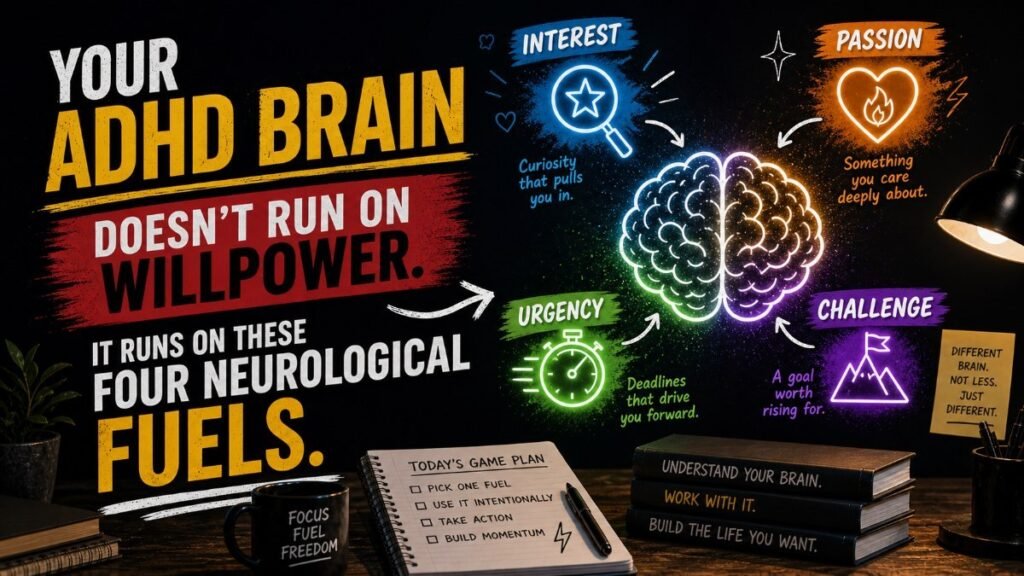
Dodson’s model identifies four specific inputs that can reliably generate sufficient dopamine in the ADHD nervous system to activate engagement. These are not personality traits or preferences in the casual sense. They are neurological triggers: interest, challenge, urgency, and passion. Each one works through a slightly different pathway, but all four share a common function. They create an internal state of sufficient arousal that the prefrontal cortex receives enough signal to initiate and sustain focus.
Interest is the most immediate activator. When a topic, task, or project genuinely engages the brain’s curiosity circuits, dopamine release follows almost automatically. This is not about liking something in a mild, pleasant way. It is about a topic that captures attention involuntarily, the way a fascinating conversation holds you without effort. For many ADHD adults, interest is their most reliable access point to sustained focus, and also the one most misunderstood by employers and educators who interpret interest-dependent performance as inconsistency rather than neurology.
Challenge activates the brain through the engagement of problem-solving circuitry. A task that sits at the right level of difficulty, hard enough to require real cognitive engagement but not so hard that it triggers avoidance, generates norepinephrine and dopamine in a way that routine tasks cannot. This is why many ADHD adults perform remarkably well in crisis situations, competitive environments, or complex technical roles while struggling to complete simple administrative tasks. The difficulty is the fuel.
Urgency is the time-pressure activator, and it is the one most ADHD adults know best from the inside. The impending deadline triggers the stress-response system, releasing adrenaline, which in turn elevates norepinephrine and provides a substitute for the dopamine that was insufficient before. This is why the night before a deadline produces a focus that felt impossible a week earlier. The urgency created the neurochemical state the brain needed. It is not procrastination in the lazy sense. It is the nervous system waiting for its fuel.
Passion is the deepest activator, operating more like a sustained background signal than an acute trigger. When work or a project connects to something the person genuinely cares about at a values level, it can provide ongoing motivation that the other three activators cannot always sustain over the long term. But as Dodson notes, passion alone is rarely sufficient without at least one of the other three activators present in the immediate task context.
Key neurological point: None of the four activators are choices. Interest, challenge, urgency, and passion either generate sufficient dopamine or they don’t. You cannot decide to find something interesting any more than you can decide to feel full when you’re hungry. The activation is automatic or it is absent.
Why You Can Hyperfocus on One Thing and Procrastinate on Everything Else
The behavior that confuses most people around ADHD adults, and often confuses the adults themselves, is the radical inconsistency. The same person who spent twelve hours last weekend building an elaborate spreadsheet tracking their favorite obscure statistics cannot spend twenty minutes responding to emails that have been sitting in their inbox for two weeks. Partners, managers, and parents observe this and draw the obvious conclusion: this is about motivation, not capacity. If you can focus for twelve hours, you can focus for twenty minutes. You are choosing not to.
This conclusion is logical within a neurotypical framework and completely wrong within the ADHD framework. The twelve-hour spreadsheet session happened because the task was interesting enough, complex enough, and personally meaningful enough to generate continuous activation. The emails have none of those properties. They are not interesting. They are not challenging. There is no urgency unless an external deadline creates one. And they don’t connect to any deep sense of passion or purpose. The ADHD nervous system looks at the email inbox and finds nothing to run on. The car is in the driveway. There is simply no fuel in the tank for that particular destination.
What looks like inconsistency from the outside is actually completely predictable from the inside, once you map the activation profile of each task. Hyperfocus states are not achievements of willpower. They are automatic activations triggered by sufficient interest or challenge. Research on monotropic attention, which describes the tendency to focus deeply on a narrow range of interests, suggests that this kind of absorbed focus is a feature of how certain ADHD and Autistic brains allocate cognitive resources, not an anomaly (Murray et al., 2005, Autism). The hyperfocus is not the ADHD brain working properly despite itself. It is the ADHD brain working exactly as it does, when the conditions for activation are met.
Procrastination on everything and hyperfocus on one thing are not contradictions. They are the same nervous system responding differently to different levels of neurological fuel.
Interest as the Primary Activator: Designing Work Around What Actually Compels You
For most ADHD adults, interest is the most accessible and most consistent activator. It also happens to be the one the professional world is least likely to accommodate, because the standard assumption is that adults should be able to perform required tasks regardless of interest level. This assumption works for many people. It catastrophically fails for ADHD brains.
The practical implication is not “only do things you find interesting,”, which is neither realistic nor the point. It is: when you are designing your work structure, your career trajectory, or even how you arrange your day, the question of interest needs to be treated as a neurological requirement, not a luxury preference. A role that contains sustained engagement with genuinely interesting problems is not a nice-to-have for an ADHD adult. It is closer to a medical accommodation.
This extends to how you approach tasks that are not inherently interesting. The question changes from “why can’t I just do this”, to “what would make this task carry enough activation signal?”, Sometimes that means connecting the task to a larger problem you care about. Sometimes it means making the task itself more complex in a way that engages your challenge circuitry. Sometimes it means finding a human element in it, a person it will help, a relationship it will strengthen, because social interest can activate the ADHD nervous system in ways that abstract importance cannot.
At the career level, this is an argument for radical honesty about fit. ADHD adults who spend decades forcing themselves through roles that never activate them are not failing at discipline. They are running a high-performance engine on the wrong fuel, and the engine will eventually stop. The design question is not “how do I become someone who can sustain motivation in any job”, but “what kind of work structure generates the activation I need to function?”
Challenge and the Goldilocks Zone: Too Easy Kills Engagement, Too Hard Kills Starting
Challenge is a more nuanced activator than interest because it has a narrower effective range. A task that is too easy provides no activation signal at all: the brain registers it as routine, dopamine doesn’t respond, and the result is boredom-driven avoidance. A task that is too hard triggers a different problem: the gap between current state and required output is so large that the brain’s threat-detection circuitry activates instead of its problem-solving circuitry, and the result is freeze and avoidance from the opposite direction.
The activation sweet spot is a task that requires genuine cognitive effort but feels technically within reach. Csikszentmihalyi’s flow research describes this same zone as the precondition for optimal experience (Csikszentmihalyi, 1990, Flow: The Psychology of Optimal Experience), and while his research was not ADHD-specific, the neurological logic aligns. ADHD brains that are in the challenge sweet spot show the same kind of absorbed, time-distorted engagement that neurotypical people experience in flow states, because the dopamine generation is sufficient.
The practical consequence is that if you want to activate your ADHD brain through challenge, you need to calibrate task difficulty intentionally. Breaking a large project into the smallest possible next step is standard productivity advice. For ADHD brains, it also serves a specific neurological function: it reduces the task to something that feels appropriately challenging rather than overwhelming, which moves it from the threat category back into the engagement category. Similarly, artificial complexity can help. Turning a straightforward task into a game, a puzzle, or a timed challenge can inject enough difficulty to generate activation where the base task had none.
The calibration problem: Routine kills the ADHD nervous system slowly. If you have been in the same role for three years and the work has become fully automatic, your activation deficit is not laziness. It is that the challenge activator has been completely removed from your daily environment.
Urgency as a Double-Edged Activator: Why Deadlines Work and Why They’re Unsustainable
Most ADHD adults have an intimate and conflicted relationship with urgency. They know from years of experience that the approach of a deadline unlocks a quality of focus that no amount of earlier intention-setting could produce. The night before submission, the hour before the meeting, the last possible moment before something becomes a real problem: this is when the ADHD brain finally fires. And it often fires brilliantly, producing work that impresses people who didn’t observe the agonizing inaction that preceded it.
Urgency works because it activates the sympathetic nervous system. The approaching deadline triggers a stress response, adrenaline is released, and norepinephrine levels rise. Norepinephrine plays a significant role in prefrontal cortex function, and elevated norepinephrine is part of why stimulant medications help ADHD: they increase both dopamine and norepinephrine availability (Arnsten, 2006, Biological Psychiatry). The last-minute sprint is not a character flaw. It is the ADHD nervous system finally receiving an adequate neurochemical signal, just through the adrenaline pathway rather than the dopamine one.
Living in chronic urgency is the ADHD equivalent of running your car engine at redline all day, every day. It works, until it doesn’t, and the breakdown is rarely minor.
The problem is the cost. Urgency as a primary activation strategy requires living in a sustained low-grade stress state. The nervous system is constantly scanning for the next deadline, the next crisis, the next external pressure that will finally generate enough signal to move. Over months and years, this pattern contributes to anxiety, emotional dysregulation, and burnout. The urgency activator is reliable in the short term and erosive in the long term, which is why it needs to be one tool in a larger set rather than the default operating mode.
This is also where strategic urgency creation becomes important. Creating artificial deadlines, social commitments with real stakes, or external accountability structures can generate urgency without waiting for a real crisis. The neurological effect is similar even when the urgency is self-constructed, because the brain’s arousal response doesn’t much care whether the stakes are real or manufactured. What matters is the subjective sense that something has to happen now.
Passion and Purpose: Why “Find Your Why”, Fails Without the Other Three Activators
The self-help world places enormous emphasis on passion and purpose as the foundations of sustained motivation. Find your why. Connect to your deeper mission. Build a life aligned with your values. This advice is not wrong, exactly. It just treats passion as sufficient to override everything else, which is where it fails for ADHD brains.
Passion operates as a long-term directional signal rather than an immediate activation trigger. It can sustain commitment over months and years, providing a reason to return to something after the other activators have faded. But on a Tuesday morning when you need to write the report that serves your passionate mission, passion alone cannot bridge the gap between intention and initiation. The task still needs to be interesting, appropriately challenging, or sufficiently urgent in the immediate moment. Passion doesn’t generate the acute dopamine signal required for task initiation. It sets the direction. The other activators get you off the starting block.
This matters because many ADHD adults have spent enormous energy trying to find their passion, as if discovering the right passion would solve the activation problem. They change careers, pursue new interests, and invest in purpose-finding exercises. Then they discover that even work they genuinely love has tasks that don’t activate them, that passion does not make administrative work interesting, and that they can care deeply about something and still not start the related task for three days. This is not failure of passion. It is passion operating exactly as it should, as a background orientation, while the immediate task still lacks a sufficient activator.
Redesigning Your Environment, Not Yourself: Structures That Actually Activate
The shift from understanding this model intellectually to using it practically requires moving from self-improvement thinking to systems thinking. The question is not “how do I become better at motivation”, but “what environmental structures can reliably supply the activation signals my nervous system needs?”
External accountability is one of the most consistently effective structures for ADHD adults because it generates social urgency. When another person is expecting your output, expecting to work alongside you, or has committed their own time to showing up, the social stakes create neurological urgency even when the task itself has none. This is why body-doubling works so reliably: the presence of another person raises the activation floor without requiring the task to be inherently interesting (Jurecska et al., 2012, Journal of Attention Disorders, describes related findings on social facilitation in ADHD contexts).
Task pairing involves intentionally coupling a low-activation task with a high-interest sensory input: a specific playlist, a particular environment, a physical ritual that signals to the brain that this task and this pleasurable input belong together. Over time, the pairing creates a conditioned response where the sensory input carries some of the activation load. This is not a hack. It is basic associative learning applied to the problem of dopamine availability.
Role-crafting is a longer-term strategy that involves deliberately shaping your job description, your responsibilities, or your career path to maximize contact with activating work. This might mean negotiating to hand off certain types of tasks, seeking out roles that involve novelty and problem-solving rather than maintenance and routine, or building a freelance practice that allows selective project choice. It requires self-knowledge, negotiating skill, and sometimes privilege, but the alternative is spending a career fighting your own neurology for forty hours a week, which is not a sustainable position.
Environmental design addresses the physical and digital context of work. A novel environment can provide the interest and challenge activation that a familiar one cannot. Removing friction from activating tasks and adding friction to avoidance behaviors changes the activation calculus without requiring willpower. Setting up your workspace to default to the next meaningful task, rather than to the path of least resistance, externalizes the initiation decision.
When Your Work or Life Doesn’t Activate: Permission to Stop Fighting and Start Choosing
Here is the part that most ADHD content avoids because it is uncomfortable: not every job can be made activating. Not every relationship context can be redesigned. Not every commitment can be retrofitted with interest, challenge, urgency, or passion. Sometimes the honest conclusion of understanding the interest-based nervous system model is that a particular role, environment, or life structure is genuinely incompatible with how your brain works, and the answer is not more strategies but a different choice.
This is a harder message than “here are five hacks to make boring tasks more interesting.”, It requires acknowledging that ADHD adults often stay in deeply activating-incompatible situations for years because leaving feels like giving up, because the shame of not being able to make it work has become entangled with their identity, or because they genuinely don’t know that the mismatch is neurological rather than personal. The interest-based nervous system model offers an exit from that shame spiral: the problem was never that you lacked discipline. The problem was a structural mismatch between what your nervous system requires and what your environment was providing.
That reframe doesn’t make practical decisions easier. Changing careers, restructuring finances, or renegotiating relationships to accommodate neurological realities involves real costs and real risks. But it changes the decision-making framework from “how do I become capable of sustaining this”, to “is this situation capable of meeting my neurological needs?”, The first question has no good answer for a genuinely incompatible situation. The second at least points toward an honest evaluation.
The goal is not to become someone whose nervous system runs on importance and obligation. It is to build a life where interest, challenge, urgency, and passion show up often enough that your brain has what it actually needs to function.
The ADHD interest-based nervous system is not a limitation to overcome through sufficient effort. It is a neurological operating system with specific requirements. People who thrive with ADHD long-term are not people who finally mastered willpower. They are people who stopped trying to run on the wrong fuel and built environments that supply the right kind. That is an engineering problem, not a character problem, and engineering problems have solutions that don’t require you to be a different person.
Quick Dopamine Hits:
- Before starting a task you’ve been avoiding, write down one genuine reason it’s interesting, challenging, or urgent to you specifically. Not why it ‘should’, matter. Why it actually might. Give yourself 90 seconds and don’t skip this step.
- Pair your lowest-activation task with a high-interest sensory input: a specific playlist, a particular drink, a physical environment that you only use for that task. The pairing creates a conditioned activation cue over time.
- Set a fake deadline. Tell someone specific that you’ll send them your output by a time that is earlier than the real deadline. Write their name on a sticky note next to your screen. The social urgency is neurologically real.
Rate this article
Was this a useful hit?