Your Brain Isn’t Ignoring the Clock. It Literally Cannot See Time.

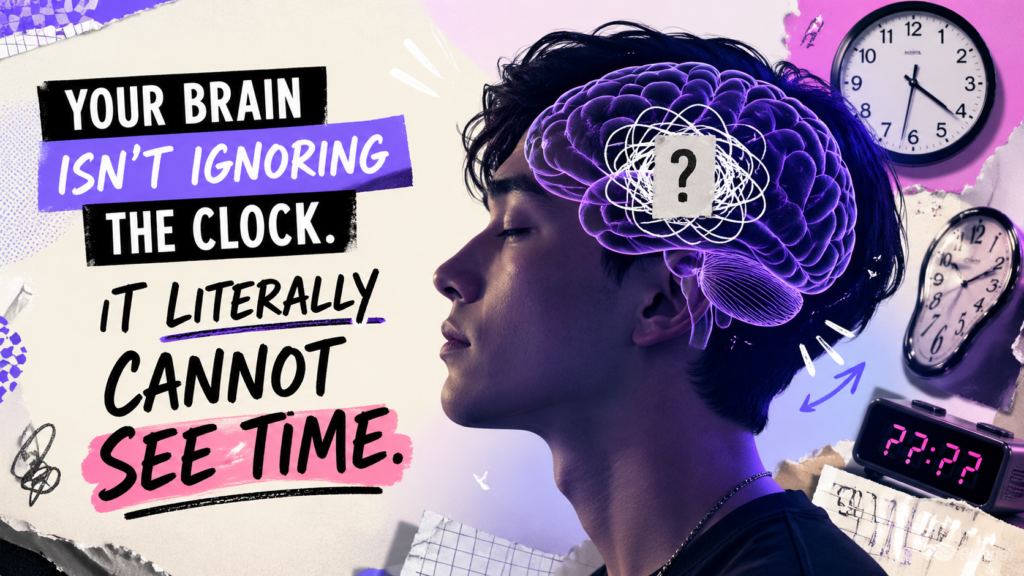
If you have ADHD, time probably does not feel like a river moving steadily forward. It feels more like two modes: now and not now. Something is either happening or it isn’t. An hour from now and a week from now occupy the same vague territory. Deadlines feel abstract until they are suddenly, terrifyingly real. This is time blindness, and it is not a metaphor. It is a measurable neurological difference in how the ADHD brain perceives and tracks duration, and it is one of the most underaddressed aspects of the condition. The good news is that the brain does not need to fix itself to work better with time. It needs external scaffolding: environmental design and cues that live outside your head, because the internal ones are unreliable.
What Time Blindness Actually Is (and Is Not)
Time blindness is not a failure to care about punctuality. It is not disrespect for other people’s schedules. It is a deficit in prospective time estimation and duration monitoring that is directly tied to the executive function impairments of ADHD. Russell Barkley, one of the most cited researchers in ADHD science, has described ADHD as fundamentally a disorder of self-regulation across time, arguing that the core problem is not attention per se but the inability to use time as a guide for behavior (Barkley, 2011, ADHD and the Nature of Self-Control).
Research supports this framing. A study by Ptacek et al. (2019, Medical Science Monitor) found that adults with ADHD showed significantly impaired time estimation accuracy compared to controls, underestimating durations and losing track of elapsed time at rates that could not be explained by inattention alone. The problem is not that ADHD brains forget to check the clock. The problem is that between clock-checks, the brain is not maintaining any internal sense of time passing.
The ADHD brain is not bad at managing time. It is bad at sensing time in the first place, and that is a fundamentally different problem with fundamentally different solutions.
This distinction matters enormously for how you approach the problem. If time blindness were about motivation or caring, the solution would be to care more. But because it is a perceptual gap, the solution is external perception: tools that make time visible, audible, or physically felt, because your internal clock is simply not transmitting a reliable signal.
Why “Just Check Your Phone” Doesn’t Work
The default advice is to check the time more often. The problem is that checking your phone requires initiating a behavior, which requires the very executive function that is already impaired. And even when you do check, you get a number, 2:47, that your brain has to convert into a meaningful sense of “how much time is left” and “how long that actually feels.” For an ADHD brain, that conversion fails constantly.
Your phone also competes with approximately 200 other things that want your attention the moment you pick it up. Looking at the clock becomes looking at a notification becomes reading a thread becomes forgetting what time it was when you started. External time tools work better when they are passive, ambient, and don’t require you to initiate anything to receive information about time.
The passivity principle: The most effective time tools for ADHD brains require zero initiation. Time information should come to you, visually, audibly, or physically, without you having to seek it out. The moment a tool requires you to remember to use it, it has already failed half the ADHD population.
This is why analog and physical tools often outperform digital ones for time management in ADHD, even though neurotypical productivity culture has largely moved past them. The best tool for your brain is the one that makes time impossible to ignore.
Visual Timers: Making Duration Visible
The Time Timer is probably the single most evidence-adjacent tool in this space. It is a physical clock with a red disk that shrinks visually as time passes, so you can see how much time remains without reading any numbers. Research on working memory and visual-spatial processing suggests that converting duration into spatial representation is far more compatible with ADHD cognition than tracking abstract numerical time (Zakay & Block, 1997, Prospective and Retrospective Duration Judgments).
The key insight is that the shrinking disk creates a continuous, passive signal. You do not need to initiate anything. You glance at it and you see time leaving the frame. That visual urgency is something the ADHD brain can actually register and respond to, where a digital countdown number often cannot break through.
There are digital versions of visual timers as well, including apps like Time Timer on tablet or the Focusmate interface, but the physical desk version wins for one simple reason: it does not share a screen with anything else competing for your attention. Put it in your direct line of sight. Not on a shelf. Not behind your monitor. Directly visible when you look up from your work.
Time Blocking With Physical Anchors
Time blocking as a productivity concept has been around for decades, but most people implement it as a calendar on their phone that they never look at. For ADHD, time blocking needs physical anchors to work. A physical anchor is something in your environment that tells your body what time-zone of the day you are in, without requiring you to check anything.
Concrete examples include a specific scent (a candle or diffuser you only use during focused work), a specific desk setup or physical arrangement you only use in the morning, or a particular playlist that you have trained yourself to associate with a specific time block. The brain learns to use these environmental signals as time markers the same way it uses light and temperature as circadian cues.
Research on context-dependent memory and state-dependent cognition supports this approach. The brain is remarkably good at using environmental context to organize behavior, even when explicit time-tracking fails (Smith, 1994, Psychological Bulletin). If “morning focus block” has a consistent smell, sound, and physical setup, your nervous system starts to recognize what time it is through the environment rather than through an internal clock that isn’t working.
The goal is not to track time better. The goal is to make time legible to your nervous system through your senses, because that channel is open even when the executive function channel is jammed.
Auditory Cues: Using Sound to Punctuate Time
Chime apps and hourly alert systems are simple and devastatingly effective for ADHD. An app that plays a soft chime every 30 or 60 minutes does something precise: it interrupts time blindness at regular intervals and forces a micro-orientation to reality. You hear the chime and your brain briefly registers “oh, time is passing.” That is the entire goal.
Pomofocus, Focusmate, and basic phone alarms can all serve this function. The trick is specificity: different sounds for different transitions. A soft tone for “check in with where you are,” a different alert for “transition in five minutes,” and a distinct third sound for “stop now.” Training your auditory system to distinguish these signals takes about a week of consistent use, and after that, the sounds do a significant portion of the time-management work for you without any conscious effort.
Music with a known runtime is an underused version of this. A playlist you know runs exactly 45 minutes becomes a body-based timer. You know when the last three songs start that you are in the final stretch. Your brain does not have to track minutes, it tracks where you are in the music, which is far more intuitive and far less likely to fail.
Body-Based Time: Ultradian Rhythms and Physical Cues
The brain operates on ultradian rhythms, cycles of roughly 90 to 120 minutes that correspond to natural peaks and troughs in alertness and cognitive function (Kleitman, 1982, Sleep). Most people experience these as a natural shift in energy, but ADHD brains often either hyperfocus through them entirely or crash hard when they hit the trough without warning.
Building body-based time cues means learning to read your own physical state as a time signal. Hunger, eye strain, back tension, restlessness, these are your body’s version of a clock telling you a cycle has ended. The problem is that ADHD brains are notoriously poor at interoception, the perception of internal body states. A study by Schauder et al. (2015, Autism Research) documented significant interoceptive differences in ADHD and neurodivergent populations, which partly explains why physical time cues get missed.
The workaround is to pair body awareness training with a scheduled check-in. Every time a chime sounds, you add a quick body scan: am I hungry, stiff, or zoning out? That physical check forces the interoceptive data into conscious awareness rather than waiting for your body to signal loudly enough to break through. Over time, you start catching these signals earlier, before they have escalated into a crash.
Interoception gap: Many ADHD adults don’t notice hunger, fatigue, or physical tension until these signals are extreme, which means the body’s natural time cues get missed entirely. Scheduled body-scan check-ins paired with auditory alerts are a direct workaround for this perceptual gap.
Transition Warnings: The Five-Minute Rule
Transitions are where time blindness causes the most visible damage. You are deep in a task and someone says “we need to leave in five minutes” and your brain treats that as meaningless information because it cannot feel five minutes. You stay in the task for what feels like thirty seconds, and it has been eight minutes, and now everyone is frustrated and you are confused and defensive.
Transition warnings need to be built into your environment, not delivered by other people expecting you to respond to verbal time estimates. A five-minute visual timer placed next to whatever you are working on before a transition is one approach. A specific song that runs exactly five minutes, started when you need to begin wrapping up, is another. Some ADHD adults use a smart light that changes color ten minutes before a required transition, providing a passive ambient signal that does not require reading, listening, or responding to another person.
The principle is the same across all of these: time warnings need to be multi-sensory, passive, and impossible to miss without requiring any executive function to receive them. If the warning requires you to be already paying attention to work, it is not a warning system. It is a test you are about to fail.
Deadline Staging: Breaking Future Into Now
The classic ADHD deadline experience involves a project that is due in three weeks, which exists entirely in the “not now” zone until about 36 hours before submission. The project was not ignored on purpose. It simply did not exist in any felt sense until urgency made it real.
Deadline staging is the practice of manufacturing intermediate deadlines that force future tasks into the present. This works not by creating fake urgency (your brain usually sees through that) but by creating concrete, specific, near-future deliverables that feel real because they have an immediate consequence or observer.
Accountability partners serve this function, which is partly why body-doubling and co-working arrangements are so effective for ADHD. When another person will see your progress at a specific time, that time becomes real in a way that an internal deadline cannot. Focusmate, a co-working platform where you book 50-minute sessions with a stranger who watches you work on video, leverages this mechanism. Research on accountability and self-regulation suggests that external observers significantly improve task initiation and follow-through in populations with executive function deficits (Gollwitzer & Sheeran, 2006, Advances in Experimental Social Psychology).
Manufactured urgency rarely works on ADHD brains. Manufactured social reality does. The distinction is whether someone else will actually see the output at a specific moment, because that is the only kind of future that feels real enough to act on.
The Analog Clock Advantage
Digital clocks display a number. Analog clocks display a position in space. For ADHD brains, which frequently process spatial information more reliably than numerical information, this is not a small distinction. The position of clock hands on a face gives you an immediate visual gestalt of where you are in the hour, you can see that the minute hand is almost at the bottom without having to compute what “48 minutes past” means relative to anything.
Multiple ADHD coaches and occupational therapists recommend placing a large analog clock in every room where you spend significant time, not as decoration, but as a continuous ambient signal about where you are in the day. The size matters: a clock you have to squint at is a clock you will not use. A clock that fills a significant portion of your peripheral vision is a clock that can actually compete with whatever has your hyperfocus.
Color-coded clock faces, available through specialty ADHD supply vendors and some educational supply stores, add an additional layer by color-coding segments of the hour. The “first 15 minutes” is one color, the “second 15 minutes” another. This makes elapsed time even more visually immediate, closer to the spatial-visual format of the Time Timer but in a permanent wall-mounted format for rooms where you need ongoing time awareness.
Phone-Free Zones and Environmental Design
One of the most counterintuitive time blindness interventions is removing your primary device from the equation entirely during focused blocks. The phone is simultaneously the most common time-checking tool and the most reliable destroyer of time awareness. The moment you pick it up to check the time, you have already introduced the conditions for losing the next twenty minutes.
Designing phone-free or phone-distant zones for specific work periods forces you to rely on analog and environmental time cues instead. A physical timer, a wall clock, an ambient chime, these provide time information without the dopamine trap of the device. For ADHD brains that struggle with impulse control around screens, the spatial separation matters: if the phone is in another room, the friction of retrieving it creates enough pause to interrupt the automatic reach.
Research on smartphone use and executive function is still developing, but existing work on task-switching costs suggests that even the presence of a phone on a desk reduces available cognitive resources, even when the phone is not being used (Ward et al., 2017, Journal of the Association for Consumer Research). Removing the device from the workspace is not about willpower. It is about reducing the cognitive load that competes with time awareness.
Building Your Personal Time Blindness Stack
No single tool from this list is going to fix time blindness. The brain needs redundancy, because one signal is easy to miss and one tool is easy to forget. The goal is to build a stack, a set of overlapping cues across different sensory channels and different timescales, so that time information is reaching you continuously through multiple pathways simultaneously.
A basic working stack might look like this: a large analog clock on the wall for ambient hour-level awareness, a visual timer on the desk for task-level duration, an hourly chime on a watch or phone for macro time orientation, a specific playlist for the work block you are in, and a five-minute transition alarm before any required departure. That is five separate signals, none of which require the others to work, all of which feed you time information through different senses.
The other piece is calibration. Most ADHD adults have badly miscalibrated time estimation, not because they are incapable of estimating duration, but because they have rarely practiced it with feedback. The practice of estimating before timing, saying out loud “I think this will take 20 minutes” and then checking your accuracy with a timer, builds the feedback loop that the internal clock never got. Ptacek et al. (2019) noted that time estimation in ADHD is trainable with repeated practice and feedback, which means the internal clock is not broken permanently. It is undertrained. External tools compensate immediately while that training happens over months.
Try Spark: If time blindness is derailing your task initiation, Spark is built to help you break the gap between “I know I need to start” and actually starting, with structured prompts that make the next five minutes concrete and actionable, not abstract.
Time blindness is one of those ADHD symptoms that gets framed as a character flaw long before anyone suggests it might have a neurological basis. Adults who are chronically late, who miss deadlines, who underestimate how long anything takes, these people are not failing to try hard enough. They are navigating a world built around an internal time sense they do not have reliable access to. External tools are not a workaround or a crutch. They are the correct solution to a perceptual gap, the same way glasses are the correct solution to impaired vision. Build your stack, layer your cues, and stop expecting an internal clock that was never built to carry the whole load.
Quick Dopamine Hits:
- Set a visual timer for exactly 25 minutes right now and place it where you can see it without looking away from your work, not on your phone, somewhere physical in your direct sightline.
- Pick one recurring transition in your day (waking up, leaving for work, starting dinner) and attach a specific song with a known run time to it as your personal ‘time is passing’ signal.
- Before you start any task today, say out loud how long you think it will take, then set a timer to check your accuracy, do this three times and notice the pattern.
Rate this article
Was this a useful hit?