These 7 Executive Function Breakdowns Are Why Work Feels Impossible

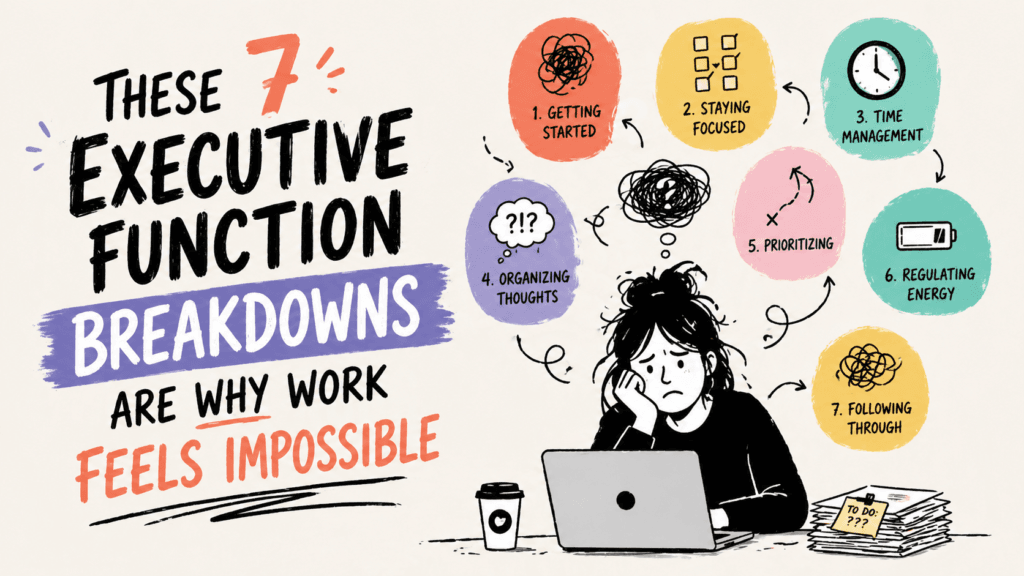
Executive function challenges at work are the reason a smart, capable adult can stare at an open email for 45 minutes without typing a single word. They are why you miss deadlines you care about, why you lose track of conversations mid-sentence, why transitioning from one task to another feels like dragging yourself through wet concrete. This is not a character flaw. It is not laziness. It is a specific, neurologically grounded breakdown in the brain systems that neurotypical workplaces are built around, and understanding exactly which systems are failing, and why, is the first step toward actually doing something about it.
What Executive Function Actually Is (And Why ADHD Hits It So Hard)
Executive function is an umbrella term for the cognitive processes that allow you to plan, initiate, regulate, and complete goal-directed behavior. It lives primarily in the prefrontal cortex, a region that develops slowly and relies heavily on dopamine and norepinephrine signaling. In ADHD brains, those neurotransmitter systems work differently. Dopamine availability and dopamine transporter activity are both affected, which means the prefrontal cortex is chronically underactivated during tasks that don’t generate immediate interest or urgency.
Russell Barkley, one of the leading researchers in ADHD, has argued for decades that ADHD is fundamentally a disorder of executive functioning rather than attention per se. His model frames ADHD as a deficit in self-regulation across time, affecting working memory, inhibition, emotional regulation, planning, and verbal self-direction (Barkley, 2012, Executive Functions: What They Are, How They Work, and Why They Evolved). This framing matters because it reframes the problem. You are not failing to pay attention. You are failing to regulate your behavior across time in a system that was never built for how your brain actually works.
ADHD is not a problem of knowing what to do. It is a problem of doing what you know, when you know you need to do it, in the context where it matters.
What follows are the seven most disruptive executive function challenges for ADHD adults in workplace settings, grounded in the research, and paired with concrete interventions for each.
1. Task Initiation: The Start Signal That Never Fires
Task initiation is the ability to begin a task without procrastinating or requiring external pressure. For ADHD brains, the internal start signal is unreliable. The brain needs a dopamine spike to cross the activation threshold, and for tasks that feel routine, unclear, or emotionally neutral, that spike simply doesn’t arrive.
Research using neuroimaging has shown that ADHD adults show reduced activation in the anterior cingulate cortex during task initiation, a region responsible for signaling effort and transitioning from rest to engagement (Bush et al., 2005, Biological Psychiatry). This is not metaphorical. There is literally less neural firing when the task begins, which is why sitting down and “just starting” feels like a physical impossibility rather than a simple choice.
What helps: externalize the start signal. Use verbal commitment, a physical trigger, or a body double. The 10-minute rule, committing to start for only 10 minutes with explicit permission to stop, lowers the activation cost enough that the brain can engage. Implementation intentions, specific “if-then” plans like “When I sit down after lunch, I will open the spreadsheet first,” have been shown to significantly improve follow-through in people with high task-avoidance tendencies (Gollwitzer &, Sheeran, 2006, Advances in Experimental Social Psychology).
The activation threshold problem: ADHD brains don’t lack motivation. They lack a reliable bridge between intention and action. Any strategy that lowers the perceived cost of starting, rather than trying to increase willpower, is working with your neurology instead of against it.
2. Working Memory: The Mental Whiteboard That Keeps Getting Erased
Working memory is your brain’s ability to hold information in mind while using it. It is what lets you keep track of what you were saying mid-sentence, remember the three things you needed to do before the meeting, and hold the context of a problem while you solve it. In ADHD, working memory capacity is consistently lower than in neurotypical controls, and this gap widens under stress or cognitive load.
A meta-analysis by Kasper et al. (2012, Neuropsychology Review) found that both children and adults with ADHD show significant deficits in verbal and visuospatial working memory compared to control groups. The effect sizes are substantial, meaning this is not a mild inconvenience but a core functional difference that shows up constantly in work contexts.
In practice, this looks like losing your train of thought in meetings, forgetting what you just read the moment you finish a paragraph, or walking into a room and having no idea why you’re there. It looks like needing to re-read emails three times and still missing the action item. It looks like promising something in a conversation and genuinely having no memory of it two hours later.
What helps: externalize everything. Working memory is a bottleneck, and the only way around a bottleneck is to route information outside of it. Write it down immediately. Use a voice memo while walking. Repeat back action items in meetings. Build a system where nothing important lives only in your head, not because you’re disorganized, but because you are working with a brain that does not retain information in the same way.
3. Cognitive Flexibility: Getting Stuck in a Mental Gear
Cognitive flexibility is the ability to shift mental frameworks when circumstances change. It is what lets you adapt when a meeting runs long, pivot when a project requirement changes, or move between different types of tasks without losing momentum. ADHD adults often show reduced cognitive flexibility, meaning the mental gear-shift is slower, more effortful, or sometimes impossible under certain conditions.
This shows up at work as extreme difficulty context-switching, frustration disproportionate to the situation when plans change, and getting stuck in a particular way of thinking about a problem even when it isn’t working. It is related to perseveration, the tendency to keep returning to the same thought or approach, which is driven partly by the same dopaminergic disruption that underlies task initiation problems.
The gap between knowing a plan changed and emotionally accepting that it changed can be hours wide for an ADHD brain. That lag is neurological, not dramatic.
What helps: build transition buffers into your schedule. If you know you have back-to-back meetings, the cognitive load of switching contexts without a gap is genuinely taxing. Even five minutes between tasks reduces the error rate and emotional cost of transitions. For unexpected changes, the practice of naming what just changed out loud (“okay, the brief has shifted, here is what that means”) activates the verbal regulation system and helps the brain update its mental model faster.
4. Inhibition: The Brain’s Broken Brake Pedal
Inhibition is the ability to stop a prepotent response, meaning the ability to not say the thing that just came to mind, not click away from the task, not interrupt the person speaking, not react immediately to an irritating email. Inhibitory control is one of the most consistently impaired functions in ADHD across the lifespan, and it has cascading consequences in professional settings.
Nigg (2001, Psychological Bulletin) conducted a comprehensive review establishing that response inhibition is a core deficit in ADHD, distinct from general attentional problems. The brain’s ability to suppress automatic, immediate responses in favor of deliberate, goal-directed ones is genuinely weaker in ADHD, and this is not resolved by trying harder. Effort alone cannot override an underpowered inhibitory system.
At work, poor inhibition looks like blurting out ideas in meetings before others finish, sending emails in frustration that you immediately regret, jumping to a new task the moment something more interesting appears, or saying yes to requests impulsively and then having no capacity to follow through. Each of these has real professional consequences, and many ADHD adults carry significant shame about the pattern without understanding its source.
What helps: create friction between impulse and action. A rule like “draft but don’t send for 10 minutes” adds enough delay that the inhibitory system has time to catch up. For interruptions in meetings, keeping a notepad to write down your thought, knowing you can share it later, satisfies the urgency without the social cost. The goal is not to eliminate the impulse but to insert a gap between the impulse and the behavior.
5. Emotional Regulation: When the Feelings Are Louder Than the Work
Emotional regulation is technically an executive function, though it is often left out of workplace conversations about ADHD because it doesn’t look like a “productivity” problem. But it is. The ability to modulate emotional responses, tolerate frustration, recover from setbacks, and stay regulated under criticism or pressure is essential for sustained work performance, and it is significantly impaired in ADHD.
Shaw et al. (2014, American Journal of Psychiatry) found that emotional dysregulation is present in approximately 70% of adults with ADHD, and that it predicts functional impairment independently of inattention and hyperactivity. This means you can be medicated, strategies in place, and still find that a critical comment in a meeting derails the rest of your afternoon. The emotional response is not the problem. The inability to regulate it back down quickly is.
From the community: “I watch brilliant developers, designers, and PMs get labeled as ‘inconsistent’ or ‘unreliable’ because their productivity doesn’t look like a flat line. Meanwhile, their bursts of hyperfocus often produce the team’s best work.”, r/neurodiversity thread
Rejection Sensitive Dysphoria, the intense emotional pain triggered by perceived criticism or rejection, is closely linked to this regulatory impairment. It is not weakness or oversensitivity. It is a rapid, intense emotional flood that the prefrontal cortex does not have the resources to modulate in real time. What helps: predictability and low-stakes processing windows. Knowing you have time after the meeting to decompress before your next obligation reduces the compounding load. Naming the emotion verbally, not to express it to others but to label it internally, engages the prefrontal cortex and begins to reduce amygdala activation (Lieberman et al., 2007, Psychological Science).
6. Planning and Prioritization: When Everything Feels Equally Urgent or Equally Invisible
Planning involves breaking a goal into steps, sequencing those steps logically, and estimating the time and resources each will require. Prioritization means being able to distinguish what matters most right now from what feels most urgent in the moment. For ADHD adults, both processes are impaired in a very specific way: the future feels abstract and low-salience, while the present feels overwhelming and high-salience.
This is sometimes called temporal discounting, the tendency to overvalue immediate rewards and undervalue future consequences. ADHD brains discount the future more steeply than neurotypical brains, which is partly why deadlines feel fake until they are imminent, why a task due in two weeks doesn’t register as real until 48 hours before, and why starting early feels neurologically impossible even when you know intellectually that it would help (Sonuga-Barke, 2003, Neuroscience and Biobehavioral Reviews).
The problem isn’t that ADHD adults don’t understand priorities. It’s that the brain assigns emotional salience to tasks based on interest and urgency, not importance. A boring task due in three weeks is essentially invisible to the threat-detection system that drives action.
What helps: make the future concrete and visible. Time-blocking works better than to-do lists because it anchors tasks to a specific moment rather than a floating obligation. Weekly reviews, where you physically look at what is coming in the next 7 days and assign tasks to specific days, reduce the cognitive load of re-prioritizing in the moment. External deadlines, accountability partners, or check-ins with a manager can substitute for the internal urgency signal the brain is not generating naturally.
7. Time Blindness: Living in a Permanent Present Tense
Time blindness is arguably the most pervasive and least discussed executive function challenge for ADHD adults in professional settings. It refers to impaired awareness of time passing, difficulty estimating how long tasks will take, and the inability to feel the future approaching in a way that motivates preparation. Barkley describes it as living in a “now” and “not now” world, where the only time that feels real is the immediate present.
Research on time perception in ADHD consistently shows that adults with ADHD underestimate elapsed time and are less accurate at reproducing time intervals compared to neurotypical controls (Ptacek et al., 2019, Neuropsychiatric Disease and Treatment). This is not a perception problem in the casual sense. It is a genuine deficit in the internal clock mechanism that typically guides behavior across time.
At work, this produces a specific cluster of problems: chronic lateness to meetings, tasks that were supposed to take 20 minutes consuming two hours, the sudden panic when you realize a deadline is today and not tomorrow, and the inability to pace yourself across a project. None of this is because you don’t care. The time simply does not feel real until it has almost run out.
What helps: make time visible. Analog clocks, time timers that show elapsed time visually rather than as a number, and time-tracking apps all externalize the internal clock. Building in “time checkpoints,” moments where you explicitly ask yourself how much time has passed and how much remains, trains a habit of time monitoring that the brain is not doing automatically. Overestimating task duration deliberately, assuming everything will take twice as long as you think, corrects for the systematic underestimation bias.
The consistent productivity myth: Workplaces are built around a neurotypical model that assumes flat, predictable output from 9 to 5. ADHD brains produce output in bursts, peaks, and valleys shaped by interest, energy, and dopamine availability. The goal is not to manufacture flatness. It is to build systems that capture output when it flows and protect capacity when it doesn’t.
Working With the Grain of Your Brain, Not Against It
There is a critical distinction between accommodation and compensation. Compensation means trying harder to perform within a system that was not built for you, burning executive resources you don’t have to appear neurotypical, and cycling through shame when you fail. Accommodation means structuring your environment so that you need to rely less on executive functions that are genuinely impaired, and more on external systems, routines, and tools that do the regulatory work your brain cannot do automatically.
The research on what actually helps ADHD adults in workplace settings consistently points in the same direction: externalize, structure, and reduce activation cost. External reminders replace working memory. Written implementation intentions replace spontaneous planning. Timers and time-tracking replace the internal clock. Accountability partners replace the inhibitory control that keeps long-term consequences salient. None of these are crutches. They are adaptive tools that align your work structure with how your brain actually processes information.
Understanding which specific executive function is failing in a given situation also changes how you troubleshoot. If you’re stuck at the start of a task, the problem is initiation, and the fix is lowering activation cost. If you keep losing track of what you were doing, the problem is working memory, and the fix is externalizing information. If you blow up at a critical email, the problem is emotional regulation, and the fix is a processing buffer and a labeling practice. The diagnosis tells you what category of challenge you’re in. The breakdown tells you exactly where to intervene.
You are not failing at work because you are not trying hard enough. You are failing at the specific points where your brain’s regulatory systems are under-resourced. That is a targeting problem, not a character problem.
The seven challenges covered here, task initiation, working memory, cognitive flexibility, inhibition, emotional regulation, planning and prioritization, and time blindness, are not a complete taxonomy of everything that can go wrong. But they account for the vast majority of the professional derailments that ADHD adults experience repeatedly and blame themselves for relentlessly. Each one has a biological basis, a predictable presentation, and a set of evidence-informed workarounds. You don’t need to solve your brain. You need to build the right scaffolding around it.
Quick Dopamine Hits:
- Before your next task, say out loud what you are about to do and why it matters today. Verbal declaration activates the prefrontal cortex and can substitute for the internal start signal your brain isn’t generating on its own.
- Set a physical timer for 10 minutes and commit only to starting, not finishing. When the timer goes off, you can stop. The goal is to lower the activation threshold, not power through it.
- At the end of each workday, write down exactly three things you will do first tomorrow, in order. Put that list somewhere visible before you close your laptop. Decision fatigue compounds executive dysfunction, so remove the morning choice entirely.
Rate this article
Was this a useful hit?