Overwhelmed and Stuck: What's Actually Happening and One Way Out

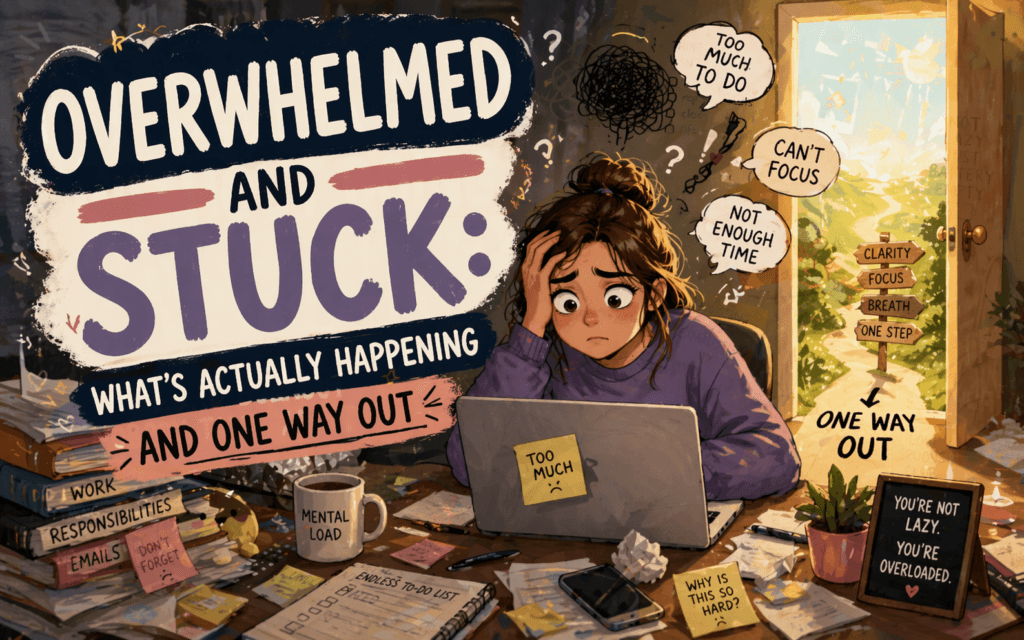
Everything needs doing and nothing is getting done. You're aware of the whole pile, and you can't move. This is not a productivity problem. This is a neurological state, and it has a name: overwhelm.
For ADHD brains, overwhelm hits differently and more often than average. Understanding what's happening when you're in it is the first step toward getting out.
What Overwhelm Actually Is
Overwhelm isn't a personality weakness or a sign of poor time management. It's what happens when the brain's executive function system gets overloaded and starts to fail.
The prefrontal cortex, which handles prioritization, decision-making, and task sequencing, can only process so much at once. When the volume of demands exceeds its capacity, the system doesn't gracefully queue things up. It freezes.
In ADHD, this threshold is lower. The prefrontal cortex is already working harder than average to perform basic executive functions. When input spikes, it hits the limit faster.
The freeze that follows isn't avoidance. It's the system doing what it can, which, at that moment, isn't much.
Why "Just Pick One Thing" Doesn't Work
The standard advice for overwhelm is to choose the most important thing and start there. Simple in theory. For an overwhelmed ADHD brain, nearly impossible in practice.
Here's why: prioritization requires executive function. The same executive function that just went offline is the one you need to decide what to prioritize. The advice assumes the tool that's broken is still available.
Telling an overwhelmed ADHD brain to just pick one thing is like asking someone with a sprained wrist to fix it by doing a push-up. The instrument required for the task is the thing that's compromised.
This creates a loop: you need to prioritize to act, you can't prioritize because you're overwhelmed, and you can't fix the overwhelm without acting. You're stuck.
Overwhelm activates the amygdala (the brain's threat-detection system), which can suppress prefrontal cortex activity further. The more overwhelmed you feel, the harder it becomes to think clearly. This is not a failure of discipline. It's the threat response doing its job in the wrong context.
The Spiral You're Probably In
Overwhelm tends to spiral because the awareness of being stuck becomes its own source of stress. You're overwhelmed by the tasks. Then by the fact that you're overwhelmed. Then by the time you've spent being overwhelmed. Each layer adds weight.
Breaking out doesn't happen through thinking your way out. It happens through interruption: changing the state of the system so it can reboot.
Four Steps That Actually Break It
This is the Steady protocol, and it works in four stages:
Step 1: Name it. Say or write what you're feeling. Not what you need to do. What you're actually feeling right now. "I'm overwhelmed. I feel frozen and stressed." Research on affect labeling shows that naming an emotional state measurably reduces its intensity. You're not venting. You're downregulating your nervous system.
Step 2: Distance the thought. Take whatever spiraling thought is loudest ("I'll never get this done," "I'm failing") and create some space from it. You don't have to fight it or dismiss it. Just observe it. "I notice I'm having the thought that I'll never get this done." This is a technique from Acceptance and Commitment Therapy. It works because you're no longer inside the thought. You're looking at it from the outside.
Step 3: Postpone the worry. This is not suppression. It's scheduling. Tell yourself: "I'll think about all of this at 4pm." Actively choosing when to engage with a worry removes it from the background loop that's chewing through your processing power. You're not ignoring it. You're filing it.
Step 4: Move your body. Physical movement does something that thinking can't: it changes your neurological state. Even two minutes of movement, a walk, jumping jacks, stepping outside, shifts the physiological markers of stress. This isn't metaphorical. It's chemical.
After the Freeze: Re-Entry
Once you've interrupted the overwhelm state, you're not back to full capacity. But you're out of the freeze. Now you need a single, low-friction re-entry point into action.
Not the most important task. Not the fastest task. The task with the lowest initiation cost that is also genuinely on the list. Open something. Touch something. The goal is to establish that you're moving again, not to clear the backlog in one session.
The pile will still be there. But you'll be in a different relationship to it.
Preventing the Next One
Overwhelm in ADHD usually builds before it's visible. It's rarely one big demand. It's a slow accumulation of open loops, unfinished things, promises you've made to yourself, and ambient anxiety about the gap between where you are and where you think you should be.
Regular small clearing sessions help more than occasional major efforts. Closing loops as they open reduces the pile that overwhelm feeds on.
But in the moment, the priority is getting out of the freeze. Understanding how you got there can wait.
Rate this article
Was this a useful hit?