ADHD and Sleep: Why Your Brain Refuses to Shut Off at Night

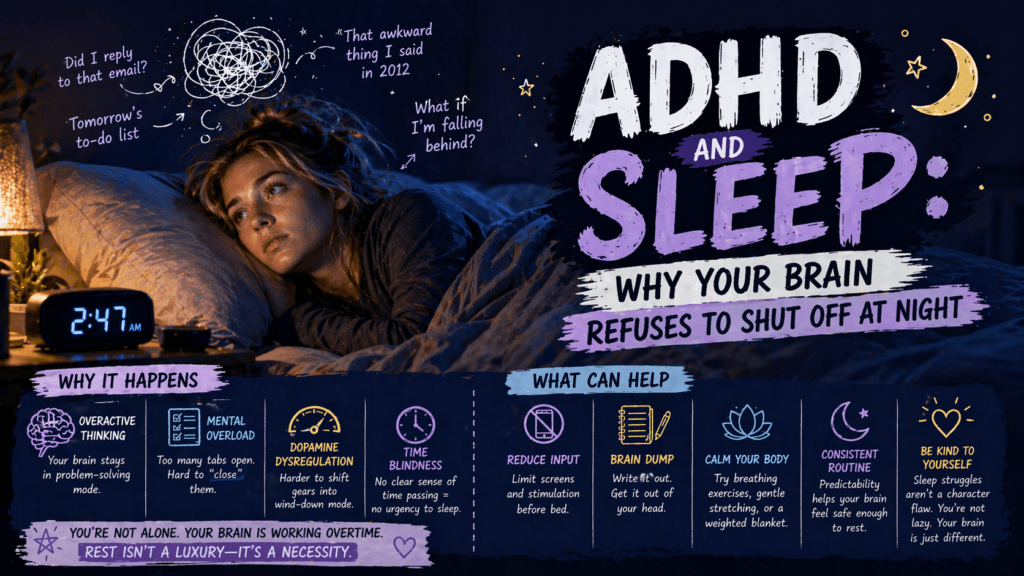
It's 2:47 AM and your body is exhausted. Your eyes burn. You have an important meeting in six hours. And yet your brain is running a highlight reel of every awkward conversation from the past decade while simultaneously solving problems you won't face until next quarter. This is not a failure of willpower. This is ADHD sleep problems in their most frustrating form: a neurological pattern that affects up to 75% of adults with ADHD.
The conventional sleep advice you've heard a thousand times: put away screens, drink chamomile tea, keep your bedroom cool. You've tried it. It doesn't work. Or rather, it works for neurotypical brains that don't have the same fundamental differences in circadian regulation, arousal systems, and executive function that characterize ADHD.
The Delayed Clock: ADHD and Circadian Phase Disorder
Research has consistently identified a strong link between ADHD and delayed sleep phase disorder, a condition where the internal biological clock runs on a later schedule than the external world demands. A landmark study by Bijlenga and colleagues (2019, Journal of Attention Disorders) found that adults with ADHD showed significantly delayed circadian rhythm markers, including later melatonin onset and later core body temperature minimums. Your brain isn't misbehaving at midnight. It's following its own biological schedule, which happens to be shifted several hours later than society expects.
The ADHD brain doesn't lack the ability to sleep. It lacks the ability to sleep on society's schedule.
This means forcing yourself into bed at 10 PM when your body believes it's only 7 PM creates a mismatch between your internal state and external behavior. You lie awake not because you're doing something wrong, but because your biology hasn't yet shifted into sleep-ready mode.
Racing Thoughts: The Default Mode Network Problem
Beyond circadian delays, ADHD brains struggle with a specific neural network issue at bedtime. The default mode network, the brain system that activates during rest and self-reflection, shows atypical patterns in ADHD. Research published in Biological Psychiatry by Castellanos and colleagues (2008) demonstrated that the ADHD brain has difficulty suppressing default mode network activity during tasks requiring focused attention.
When you lie down to sleep, your brain should gradually shift into a quieter state. The ADHD brain often does the opposite. The absence of external stimulation removes the scaffolding that kept attention directed outward during the day. Without that structure, the mind begins to wander aggressively, jumping between unfinished tasks, past embarrassments, future worries, and random creative tangents.
The Quiet Room Effect: Many people with ADHD report that racing thoughts intensify specifically in quiet, dark environments. The understimulated ADHD brain generates its own stimulation through mental activity, making the ideal sleep environment paradoxically the worst environment for the ADHD mind trying to settle.
Sleep Procrastination: The Revenge Bedtime Phenomenon
A particularly common ADHD sleep problem doesn't involve difficulty falling asleep once in bed. It involves never getting to bed in the first place. Research by Kroese and colleagues (2014, Frontiers in Psychology) identified sleep procrastination as a self-regulation failure, and subsequent studies have linked it strongly to ADHD traits.
There's another layer specific to ADHD adults. After a day of masking, accommodating neurotypical expectations, and managing symptoms, nighttime often represents the only unstructured, unsupervised period available. The resistance to ending that freedom is not laziness. It's a predictable response to lives structured around others' needs and schedules.
Sleep procrastination is not about hating sleep. It's about loving the only hours that feel truly yours.
Why Standard Sleep Hygiene Fails for ADHD
Sleep hygiene recommendations were developed primarily through research on neurotypical populations. Telling someone with ADHD to maintain a consistent bedtime ignores the time blindness that makes tracking schedules inherently difficult. Recommending a relaxing bedtime routine assumes the ability to stop engaging activities and transition smoothly, which is precisely what executive dysfunction prevents.
The failure of standard advice creates a secondary problem: shame and self-blame. When you've tried everything that supposedly works and still can't sleep properly, the conclusion seems obvious — something must be wrong with you specifically. This misses the fundamental point: ADHD is a neurological condition that affects the very brain systems required to implement sleep hygiene recommendations.
Practical Strategies That Account for ADHD Neurology
Light exposure represents one of the most powerful tools for shifting circadian rhythm. Bright light in the morning, ideally within 30 minutes of waking, advances the circadian clock and helps establish earlier sleep onset. For adults with delayed sleep phase, a light therapy lamp (10,000 lux for 20-30 minutes) may be necessary. Equally important is reducing light exposure in the evening, particularly blue-wavelength light.
For racing thoughts, the strategy is not suppression but redirection. Attempting to force your mind to stop thinking typically backfires. Instead, providing the brain with low-stimulation engagement occupies cognitive resources enough to prevent runaway thinking. Audio content — podcasts, audiobooks, ambient soundscapes — works well because it requires some attention without visual stimulation. Many ADHD adults find familiar, previously consumed content works best.
External structure compensates for internal self-regulation deficits. A specific alarm that signals the start of wind-down time. Automatic dimming of smart lights. A physical location change that separates evening activity space from sleep preparation space. The more you can externalize the executive function required for sleep transitions, the less you depend on compromised internal systems.
The Social Jet Lag Problem: Many adults with ADHD experience a mismatch between their biological sleep timing and the schedule demanded by work. This chronic misalignment is associated with worse health outcomes and increased ADHD symptom severity. Where possible, structuring work and life to accommodate your natural rhythm may be more effective than endlessly fighting it.
The Emotional Regulation Connection
Sleep deprivation worsens ADHD symptoms across the board, creating a vicious cycle. Poor sleep increases emotional reactivity, reduces impulse control, impairs attention, and depletes the cognitive resources needed for effective self-management. These worsened symptoms then make healthy sleep practices harder to implement, leading to more sleep deprivation.
Breaking this cycle often requires addressing the emotional regulation component directly. The frustration of lying awake, the shame of another late night, the anxiety about tomorrow's consequences: these emotional responses add arousal that further prevents sleep. Developing distress tolerance specifically for the bedtime period can reduce the secondary arousal that compounds primary sleep difficulties.
Your brain's refusal to shut off at night is not a personal failing. It is a predictable output of neurological differences in circadian regulation, default mode network function, and executive control. Understanding these mechanisms shifts the response from self-blame to strategic intervention. The 2:47 AM racing thoughts may not disappear entirely, but they can become less frequent and less destructive when you stop fighting your brain and start working with its actual architecture.
Rate this article
Was this a useful hit?