The ADHD Dopamine Menu: How to Stop Waiting for Motivation and Build It Instead

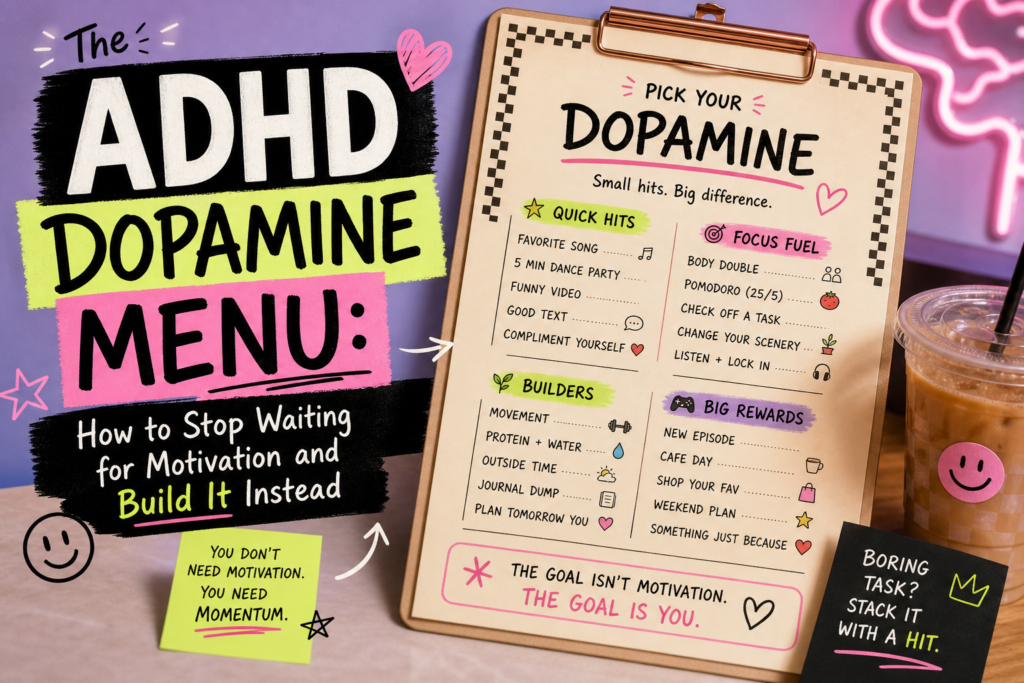
If you have ADHD, you already know that motivation doesn’t work the way everyone tells you it should. You can’t just decide to start something. You can’t just “want it enough.”, The gap between knowing what you need to do and actually doing it isn’t a character flaw, it is a neurological reality. The ADHD dopamine menu is a concept that has been circulating in ADHD communities for a few years now, and it is one of the most practically useful frameworks to come out of those spaces. But most explanations stop at the listicle level: “here are some fun things you can do!”, That’s not enough. To use this tool well, you need to understand what your brain is actually doing when it refuses to start, why certain activities work when others don’t, and how to build a menu calibrated to your specific nervous system rather than someone else’s.
Why the ADHD Brain Can’t Just “Get Motivated”
Motivation in a neurotypical brain is driven partly by the anticipation of reward. The dopaminergic system releases dopamine not just when you receive a reward, but when you predict one is coming. That anticipatory signal is what creates the pull toward action. For people with ADHD, this system is structurally underactive. Research by Volkow et al. (2009, Journal of the American Medical Association) found that adults with ADHD had significantly fewer dopamine receptors and transporters in reward-related brain regions, including the nucleus accumbens and the caudate nucleus. Less receptor density means weaker reward signals, which means the brain doesn’t register future rewards as sufficiently motivating to initiate action in the present.
This is why deadlines feel fake until they are terrifyingly real. The future reward of “finishing the report”, doesn’t generate enough dopamine signal to compete with the immediate stimulation of anything else. It’s not that you don’t care. Your brain literally cannot generate the neurochemical signal that would make starting feel worthwhile. Russell Barkley, a clinical psychologist who has spent decades researching ADHD, has described this as a disorder of motivation rather than attention, the core problem is that the ADHD brain cannot be motivated by things that are important but not immediately stimulating, a dopamine timing problem rather than a motivation one.
The ADHD brain is not lazy. It is dopamine-starved. And a starved brain will not work on promises alone, it needs a signal it can feel right now.
This is where the dopamine menu comes in. Rather than waiting for motivation to arrive on its own, or trying to convince yourself that you “should”, want to do something, you deliberately prime your dopamine system with a targeted input. You give the brain a real, felt signal. Then you redirect that momentum toward the thing you actually need to do. It’s a bridge, not a bypass.
What the Dopamine Menu Actually Is
A dopamine menu is a personalized list of activities that reliably generate a dopamine response in your specific brain. The word “menu”, is intentional. Menus have categories. Menus have options for different appetites and different amounts of time. You don’t order the same thing every day, and you don’t order a full meal when you only have 10 minutes. The menu structure matters because the ADHD brain’s dopamine needs vary significantly depending on the time of day, stress load, sleep quality, and whether medication has worn off. One activation strategy rarely fits all circumstances.
The most useful way to organize a dopamine menu is along two axes: speed and domain. On the speed axis, you have fast-acting inputs (under 10 minutes, high-intensity stimulation) and slow-burning inputs (20 minutes or more, lower-intensity but more sustained). On the domain axis, you have body-based inputs, mind-based inputs, and social inputs. These categories matter because different people with ADHD have different dopamine-response profiles. Some people’s brains light up for physical movement, others barely feel it and need intellectual stimulation instead. Building a menu without knowing your own profile means you’ll end up with a list that works for someone else’s ADHD, not yours.
Key distinction: A dopamine menu is not a self-care list or a fun-activities list. Every item on it must pass one test: does it reliably produce a felt shift in your alertness, engagement, or mood within a short window? If it doesn’t, it’s not on the menu.
Fast vs. Slow: Matching the Input to the Moment
Fast-acting dopamine inputs are high-novelty, high-intensity, and short-duration. They work by rapidly spiking the dopaminergic signal. Examples include cold water on your face or a cold shower, a 3-minute dance to one specific song you love, 10 minutes of a genuinely funny video from a creator you follow, a quick competitive game on your phone, or a few minutes of intense physical exertion like sprinting up stairs or doing jumping jacks to the point of breathlessness. The key property these share is that they are immediately engaging. Your brain doesn’t have to be convinced to pay attention, attention is grabbed automatically.
Slow-burning dopamine inputs work differently. They don’t spike as fast, but they sustain the signal for longer and tend to produce less of the crash that comes after a rapid spike. Examples include a 20-minute walk without headphones (letting your mind drift), cooking something you find genuinely enjoyable, working on a hobby project with no particular goal, listening to a long-form podcast while doing something physical, or spending time with a pet. These are particularly useful for longer work sessions because they build a more stable neurochemical baseline rather than a sharp peak followed by a trough.
The mistake most people make is relying exclusively on fast-acting inputs. If every activation strategy you use is high-novelty and high-intensity, you will burn through the signal quickly, find that your threshold keeps rising, and eventually reach for increasingly extreme inputs just to feel anything. This is a pattern that research suggests is associated with higher impulsivity and risk-taking behavior in ADHD populations. Volkow and colleagues have noted that the ADHD brain’s blunted reward circuitry can drive escalating sensation-seeking in the absence of adequate baseline stimulation. A well-structured dopamine menu includes both fast and slow inputs, used intentionally depending on what the moment requires.
Body-Based Inputs: The Most Underused Category
Movement is the most reliably documented dopamine driver for the ADHD brain. John Ratey, a clinical associate professor of psychiatry at Harvard Medical School, has extensively documented in his work that aerobic exercise increases dopamine, norepinephrine, and serotonin in ways that functionally overlap with stimulant medication. A study by Piepmeier et al. (2015, Journal of Sport and Health Science) found that a single bout of aerobic exercise improved executive function and working memory in children with ADHD. Similar effects have been found in adult populations. The mechanism is not complicated: exercise drives dopamine synthesis and release, and it upregulates receptor sensitivity over time.
But body-based dopamine inputs extend beyond conventional exercise. Temperature changes are powerful activators. A cold shower or even cold water on the face triggers a norepinephrine spike that functions as a rapid alertness signal. Rhythmic physical activity, including drumming, dancing, bouncing on a trampoline, or even tapping to music, appears to engage the dopaminergic system through its overlap with reward processing and motor coordination. Eating something with strong flavor, particularly sour, spicy, or highly savory, can function as a sensory activation input for some people. The point is to think broadly about what your body can do to shift your nervous system state, not just whether you did your 30 minutes on the treadmill.
Exercise isn’t a lifestyle recommendation for ADHD brains. It is a neurochemical tool. The distinction matters because it changes how you use it.
Mind-Based Inputs: Using Novelty and Curiosity Deliberately
The ADHD brain is a novelty-seeking system. What registers as novel gets dopamine. What is already familiar does not. This is both the source of hyperfocus and the reason that tasks stop feeling engaging the moment they become routine. For mind-based dopamine inputs, you are deliberately feeding the novelty drive in a controlled way.
Reading something genuinely interesting, not something you “should”, read, but something you actually find fascinating, is one of the most accessible mind-based inputs. Watching a documentary or video essay on a topic you’ve never explored. Listening to a podcast episode on something slightly outside your usual domains. Solving a puzzle, playing a word game, or working through a problem that has no stakes but requires real thinking. The criteria are simple: it must feel genuinely engaging, not obligatory, and it must require active cognitive attention rather than passive consumption.
One category that belongs here but rarely gets recognized as a dopamine tool is creative output. Writing something for no audience, drawing, building something in a game, composing anything, rearranging furniture, any act of making that gives you immediate visible feedback on your effort tends to generate sustained dopamine signaling. The reason is that creative output combines novelty (you are making something that didn’t exist before) with reward prediction (each small completion step produces a mini-reward signal). This is also why hyperfocus so often lands on creative or constructive activities: the dopamine feedback loop is particularly dense.
From the community: “Monday: Hyperfocus superhero mode. Tuesday: Executive function offline. Wednesday: Average capacity. Thursday: Deep work for 12 hours. Friday: Can’t even email.”, r/neurodiversity thread
This is the variability that a static productivity system can never account for. Your dopamine menu has to be dynamic enough to meet your brain wherever it is on a given day, not where you wish it were.
Social Inputs: The Ones People Forget to Put on the Menu
Social connection is one of the fastest and most powerful dopamine drivers available, and it is systematically underrepresented in most discussions of ADHD activation strategies. Oxytocin, released during positive social contact, has direct interactions with the dopaminergic reward system. Laughter, genuine conversation, feeling seen or understood, these are neurochemical events, not just nice experiences. For many ADHD adults, the body double effect (working alongside another person, even silently) is sufficient to dramatically reduce task initiation difficulty. Research on this phenomenon, while limited in formal studies, is robust in self-report data from ADHD communities, and the mechanism likely involves the ambient social signal providing enough dopamine-adjacent arousal to shift the brain out of avoidance mode.
Social inputs for a dopamine menu might include a 5-minute voice message exchange with a friend, joining a body doubling session (several apps now facilitate this), texting someone a genuinely funny observation, watching a live streamer you enjoy (the parasocial real-time element matters more than recorded content), or calling someone while doing a physical task. The key is reciprocal or quasi-reciprocal engagement. Passive social media scrolling does not qualify, the stimulation is too low-density and the dopamine hits are too brief and disconnected to build momentum.
How to Build Your Specific Menu
Generic dopamine menu examples are a starting point, not a destination. The actual work is identifying which inputs produce a reliable, felt response in your nervous system specifically. Here is how to do that systematically.
Start by thinking about the last three to five times you went from genuinely stuck to genuinely moving. Not times when you forced yourself through willpower, times when something shifted and you actually felt like doing things. What happened immediately before that shift? What were you doing in the 20 minutes before you started working? That activity is a candidate for your menu. Write it down without judgment, even if it seems trivial or embarrassing. The brain doesn’t care about your feelings about what activates it.
Then categorize each candidate by speed (fast or slow) and domain (body, mind, social). Look for gaps. If your entire list is fast-acting mind-based inputs, you are going to burn out on novelty quickly and have nothing to fall back on when your medication wears off in the evening or when you’ve already used your high-intensity inputs earlier in the day. Aim for at least two entries in each domain category, with a mix of fast and slow across the whole menu.
The goal is not to have a long list. The goal is to have a reliable list. Five items that actually work beat twenty items that sound like they should work.
Test each item deliberately over a two-week period. Use one, then try to start the task you have been avoiding, and note whether it helped. If an item consistently fails to produce a felt shift, remove it. Your menu is a living document. It will change as your life changes, as medication changes, as seasons change. Some people find their summer and winter menus look completely different because their baseline arousal levels shift with daylight and temperature.
Common mistake: Building a dopamine menu during a good brain day and then finding it useless on a bad one. Write your menu when you’re struggling slightly, not when you’re already activated. That’s when you’ll identify what actually bridges the gap.
The Transition Problem: Getting from the Menu Back to the Task
Here is the part that almost every explanation of dopamine menus skips. The activation strategy only works if you can successfully transfer the momentum from the menu item to the actual task. This transition is its own executive function challenge, and for many ADHD brains, it’s where the whole system breaks down. You do your 5-minute dance, feel good, and then somehow end up watching three more videos instead of starting work.
The solution is structural, not motivational. Before you start your menu item, you set up the task environment so that the next step requires almost zero decision-making. Your document is already open. Your first action is already written down as a single, concrete sentence. Your timer for the first work block is already loaded on your phone. The menu item ends, and the environment pulls you into the task rather than requiring you to make a new decision. Decision-making is a dopamine cost. If you have just spent your fresh dopamine signal on the activation activity, you don’t want to spend more of it figuring out what you’re doing next.
This is also why the categories matter so much. A fast-acting input produces a sharper spike and a shorter window of usable momentum. You have maybe 5 to 10 minutes after a cold shower before the signal starts to fade. A slow-burning input gives you a broader plateau. If your task is a 20-minute focused writing session, a fast input is probably sufficient. If you are trying to get through a 3-hour project block, you will need a slow-burning input, possibly supplemented by a fast one at the start, and built-in re-activation points throughout.
When the Menu Stops Working
Every ADHD adult who has tried a dopamine menu eventually hits a wall where it stops being effective. The inputs feel flat. Nothing on the list sounds appealing. The strategies you built feel like obligations. This is not a failure of the concept, it is a signal that your baseline is depleted rather than your menu being wrong. The ADHD literature on burnout, and particularly the parallel work on AuDHD burnout recovery, describes this pattern precisely: when the nervous system is running a chronic deficit, even legitimate dopamine inputs fail to register adequately. Research on autistic burnout notes that individuals describe going “dimmer,”, where previously enjoyable activities feel effortful and flat rather than restorative.
If your menu stops working across the board, the problem is not the menu. The problem is the load. The research context here is clear: for depleted brains, the pairing of genuine rest with very small pleasures works better than trying to force activation through higher-intensity inputs. This means stepping back from the menu approach temporarily, reducing demands, and focusing on what writer and researcher Devon Price and others in the burnout recovery space have described as “small bits of aliveness”, not full activation, just enough to remind your nervous system that engagement is still possible.
When you return to the menu after a genuine rest period, it often works better than before. That is not a coincidence. Dopamine receptor sensitivity appears to improve with reduced overstimulation during rest periods, which is part of why ADHD adults often report feeling “reset”, after a proper vacation or a genuinely low-demand week. The menu is a tool for a brain with adequate baseline capacity. Rebuilding that capacity is a prerequisite when the baseline has collapsed.
Making It a System, Not a Ritual
A dopamine menu is most powerful when it stops being something you have to remember to use and becomes a designed feature of your environment. The menu lives somewhere visible, not buried in an app. Your fast-acting items are set up in advance: the playlist is already made, the cold water setting is already in your shower, the game is already on your home screen. Your slow-burning items are scheduled into your week as non-negotiable blocks, not as rewards to earn but as infrastructure for everything else you want to do.
The neurological basis here is straightforward. Barkley’s model of ADHD as a deficit in self-regulation toward the future means that anything requiring you to plan, initiate, and execute a new sequence in the moment of need will fail under cognitive load. The dopamine menu only works reliably when most of the friction has been removed before the moment of need arrives. You build the system when you’re regulated so it works when you’re not.
The ADHD brain is not waiting for motivation to appear from nowhere. It is waiting for a signal it can actually feel. The dopamine menu is how you deliver that signal on purpose, in a form that your specific brain responds to, at the right time and in the right dosage to bridge the gap between stuck and started. That’s not a hack. That’s working with your neurology instead of against it.
Quick Dopamine Hits:
- Pick one item from your fast-body category right now and do it for exactly 5 minutes before returning to whatever you’re avoiding. Set a visible timer so your brain believes it ends.
- Write your dopamine menu on a physical index card and tape it somewhere you can see it from your desk. Digital lists don’t count, your brain needs to see it in the environment, not buried in an app.
- When you’re stuck, say out loud: ‘I need a dopamine bridge, not a pep talk.’, Then open your menu and choose the lowest-friction item, not the most appealing one.
Rate this article
Was this a useful hit?