Your Executive Function Isn’t Broken. It’s Just Starving for the Right Input.

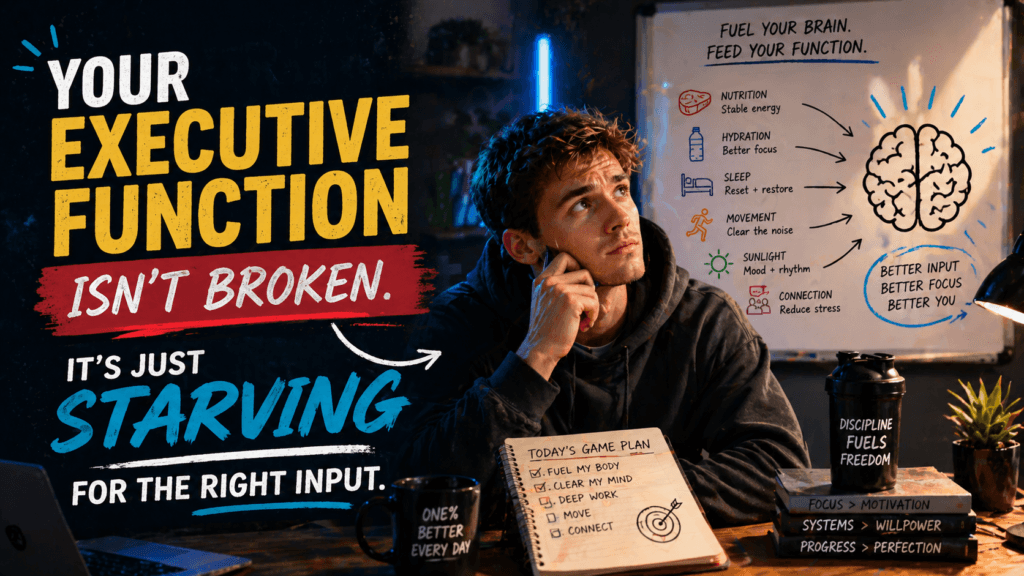
Executive function is the term clinicians use to describe the brain’s management system: planning, initiating, sustaining attention, regulating emotion, and following through on intentions. For adults with ADHD, these processes don’t fail because of laziness or lack of intelligence. They fail because the prefrontal cortex, the region most responsible for executive control, operates with a different neurochemical profile. Specifically, dopamine and norepinephrine signaling in the PFC is less efficient, and that inefficiency cascades into every area of life that requires deliberate, self-directed action. If you want to improve executive functioning in ADHD adults, you need activities that actually engage and strengthen these systems, not generic productivity advice dressed up in clinical language.
The good news is that executive function is not a fixed trait. Neuroplasticity research has consistently shown that the PFC can be shaped by repeated, targeted experience. The eight activities below are grounded in that research. They are not tips to try once and forget. They are practices to build into the architecture of your week, because repetition is how neural circuits get reinforced.
Why Standard Productivity Advice Misses the Mark
Most executive function advice for ADHD adults reads like it was written for someone whose brain already works. Use a planner. Set a reminder. Prioritize your tasks. The problem is not that this advice is wrong exactly. It’s that it skips the layer underneath: the biological mechanisms that make planning feel impossible before you even open the planner.
Barkley (2012, in Executive Functions: What They Are, How They Work, and Why They Evolved) describes ADHD as fundamentally a disorder of executive functioning rather than attention per se. The core deficit is in self-regulation across time: the ability to hold future goals in mind and let them influence present behavior. That framing matters because it means interventions need to externalize what the brain can’t reliably do internally. The environment has to carry the cognitive load that the PFC keeps dropping.
Executive dysfunction in ADHD is not a character flaw or a skill gap. It is a neurobiological timing problem. The brain’s ability to make the future feel real enough to compete with the present is impaired.
With that in mind, the activities that follow work not because they teach discipline, but because they either directly stimulate dopaminergic pathways, build PFC circuit strength through repetition, or create external scaffolding that compensates for what the brain can’t yet do internally.
Activity One: Cardiovascular Exercise Done Consistently
This is not here because exercise is good for everyone. It’s here because the evidence for aerobic exercise specifically improving executive function in ADHD populations is unusually strong. John Ratey’s work, summarized in Spark: The Revolutionary New Science of Exercise and the Brain (2008), documented how aerobic activity acutely increases dopamine and norepinephrine availability in the prefrontal cortex, producing a window of improved executive function that can last two to four hours post-exercise.
A 2013 study by Pontifex et al., published in the Journal of Pediatrics, found that a single 20-minute bout of aerobic exercise improved inhibitory control and cognitive flexibility in children with ADHD, but research in adults shows similar mechanisms. Consistent cardio, meaning three to five sessions per week at moderate to vigorous intensity, is not a supplement to treatment. For many ADHD adults, it is a cornerstone of it.
The practical barrier is initiation, which is exactly where ADHD creates friction. The key is removing the decision from the morning. Lay out clothes the night before. Schedule it like a meeting. Use body doubling if needed. The activity itself requires minimal executive function once you’re moving. Getting started is the entire challenge.
Activity Two: Working Memory Training Through Dual N-Back
Working memory is the mental workspace where you hold information long enough to act on it. ADHD consistently shows working memory deficits, and those deficits ripple through planning, reading comprehension, and task sequencing. Dual N-back training, a cognitive exercise where you track a sequence of stimuli and identify matches from N steps back, is one of the few cognitive training paradigms with credible evidence for transferring gains to real-world function.
Klingberg et al. (2005, Journal of the American Academy of Child and Adolescent Psychiatry) found that computerized working memory training in children with ADHD produced measurable improvements in working memory, response inhibition, and reduced inattention, with effects holding at a three-month follow-up. Subsequent research in adults has been more mixed, with some studies showing transfer to fluid intelligence and others showing more limited effects.
Key distinction: Dual N-back is not a magic brain game. It is a targeted working memory stressor. To get benefit, you need to train at your difficulty threshold, meaning the task should feel genuinely hard. Easy repetitions produce minimal adaptation. Aim for 20-minute sessions, five days a week, for at least four to six weeks before evaluating impact.
Free versions of dual N-back are available through apps like Dual N-Back by Mikael Nordenfelt. The interface is ugly and the task is frustrating. That’s the point.
Activity Three: Deliberate Planning Rituals With External Capture
Planning for ADHD adults has to be externalized. The brain that forgets a task the moment a notification arrives cannot be the sole repository of the plan. But there’s an additional layer here that standard advice ignores: planning itself is an executive function skill that gets stronger with deliberate practice.
Spending ten minutes every morning writing out your three most important tasks, in order of priority, on paper, is not just organizational hygiene. It is a prefrontal workout. You are practicing holding future states in mind, evaluating relative importance, and translating abstract goals into concrete steps. Done daily, this builds the habit of prospective memory, which research consistently identifies as one of the most impaired functions in ADHD adults (Kerns et al., 2010, Journal of Attention Disorders).
The medium matters. Research on handwriting versus typing suggests handwriting recruits more neural processing, including areas associated with encoding and retrieval. For ADHD brains, the slower, more deliberate nature of handwriting may actually work in your favor by reducing the rate at which thoughts can be captured, forcing prioritization in real time.
Activity Four: Mindfulness Practice Targeted at Attention Control
Mindfulness for ADHD has an awkward reputation. It sounds like the kind of thing a neurotypical wellness coach recommends when they’ve run out of ideas. But the neuroimaging evidence is more interesting than the reputation suggests.
Zylowska et al. (2008, Journal of Attention Disorders) conducted an eight-week mindfulness training program specifically adapted for adults and adolescents with ADHD and found significant improvements in self-reported ADHD symptoms, with neuropsychological testing showing improvements in attention and inhibitory control. Structural MRI studies have linked consistent mindfulness practice to increased cortical thickness in regions including the prefrontal cortex and anterior cingulate cortex, both central to executive function.
Mindfulness for ADHD is not about achieving calm. It is about training the attention system to notice where it has wandered and redirect it. That redirection is exactly the muscle that executive function requires.
The catch is that standard mindfulness instructions are not always ADHD-compatible. Sitting still for 20 minutes produces more frustration than focus for many ADHD adults, especially early in practice. Start with three to five minute sessions using guided breath awareness. Apps like Waking Up or Insight Timer have shorter-form options. Walking mindfulness, where attention is focused on physical sensation while moving, is often more sustainable for ADHD adults who experience hyperactivity or restlessness.
Activity Five: Body Doubling as Scaffolded Initiation
Body doubling is the practice of working in the presence of another person, not for collaboration, but for presence. Something about having another human nearby activates task engagement in ADHD brains in a way that sitting alone does not. The mechanism is not fully understood, but dopaminergic arousal and social accountability circuits are both plausible explanations.
From the community: “Monday: Hyperfocus superhero mode. Tuesday: Executive function offline. Wednesday: Average capacity. Thursday: Deep work for 12 hours. Friday: Can’t even email.”, r/neurodiversity thread
This variability is exactly why body doubling works as an executive function support rather than just a productivity trick. On the days when executive function is offline, external presence can bridge the gap between intention and action. Virtual body doubling through platforms like Focusmate, or simply working in a coffee shop or library, provides this benefit without requiring a specific partner or scheduled accountability. The important thing is consistency: using body doubling regularly, not just on crisis days, builds the behavioral habit of sitting down to work in a structured way.
Activity Six: Structured Physical Activities That Require Cognitive Engagement
Not all movement is equally useful for executive function. Activities that combine physical demand with cognitive coordination, including martial arts, rock climbing, dance, and racquet sports, appear to produce stronger executive function benefits than steady-state cardio alone. The dual demand forces the PFC to manage movement planning, sequencing, and real-time adaptation simultaneously.
A 2015 study by Chang et al., published in Perceptual and Motor Skills, found that coordinative exercise involving cognitive and motor elements produced greater improvements in executive function compared to aerobic exercise alone in children with ADHD. Research in adults with ADHD specifically is more limited, but the mechanism, increased PFC engagement through coordinated motor planning, is consistent with broader neuroplasticity literature.
Martial arts deserve specific mention. A 2020 review by Zeng et al. in the International Journal of Environmental Research and Public Health found that martial arts training across multiple studies was associated with improved attention, inhibitory control, and working memory, including in populations with ADHD diagnoses. The combination of rule-following, motor sequencing, breath control, and focus on present-moment physical cues makes it an unusually complete executive function workout.
Activity Seven: Implementation Intentions and If-Then Planning
This is one of the most underused and evidence-backed tools in the ADHD executive function toolkit. Implementation intentions are specific plans of the form: “If situation X occurs, then I will do behavior Y.” They work because they delegate the decision-making to a plan made in advance, reducing the demand on in-the-moment executive function when it is most likely to fail.
Gollwitzer and Sheeran (2006, Advances in Experimental Social Psychology) conducted a meta-analysis across 94 studies and found that implementation intentions significantly increased goal achievement across populations, with particularly strong effects when executive function was compromised, as in depleted or distracted states. For ADHD adults, who chronically operate in conditions of executive depletion, the logic is compelling.
An implementation intention removes the need for a decision in the moment. The ADHD brain doesn’t have to generate the plan under pressure. The plan is already there, waiting to be triggered.
Practical application: instead of “I’ll work out three times this week,” write “If it is Monday, Wednesday, or Friday at 7am, then I will put on my running shoes and step outside.” Instead of “I’ll respond to emails more promptly,” write “If I finish lunch, then I will open my inbox and respond to two emails before doing anything else.” The specificity is the mechanism. Vague intentions are easy to override. Concrete situational triggers are harder to ignore.
Research note: Gollwitzer and Sheeran’s meta-analysis (2006) found a medium-to-large effect size (d = 0.65) for implementation intentions on goal achievement. This is not trivial. For ADHD adults specifically, pre-committing the decision is one of the highest-leverage moves available.
Activity Eight: Reflective Journaling Focused on Pattern Recognition
Journaling appears on every wellness list ever written, which has made it feel generic. What makes it a legitimate executive function tool is not the act of writing feelings down. It is the deliberate use of retrospective reflection to build what researchers call metacognitive awareness: the ability to observe your own thinking patterns, identify where and why they break down, and adjust accordingly.
ADHD adults often have poor metacognitive accuracy. They underestimate how long tasks take, overestimate how much they’ll be able to do under pressure, and miss the patterns in their own performance variability. Journaling, when structured around specific reflective prompts, trains the brain to look back at behavior with enough objectivity to notice these patterns.
Effective prompts include: What was my executive function capacity today and what seems to have driven it? Where did I lose track of my intention today and what was happening at that moment? What made initiating difficult or easy today? Over weeks and months, answers to these questions reveal patterns that are invisible in the moment. Sleep deprivation tanks initiation. Certain social interactions drain cognitive bandwidth for hours. Post-lunch energy dips reliably derail the most planned afternoon. This knowledge is actionable in a way that vague self-awareness is not.
Keep journal sessions short, five to ten minutes, and time-bound. Long, open-ended journaling creates its own executive function demand. A structured template you return to daily is more sustainable than a blank page requiring you to generate structure each time.
Building a Stack, Not a List
The error most ADHD adults make with executive function strategies is treating them as a checklist to complete rather than a stack to build. No single activity here will transform your planning, initiation, or follow-through on its own. The power comes from combining them in ways that reinforce each other: morning planning practice followed by a run, body doubling for tasks that require initiation, implementation intentions for the specific situations where executive function reliably collapses.
Research on neuroplasticity is consistent on one point: change requires repetition over time, and repetition requires removing friction from the practice itself. That means your job, before anything else, is to design your environment so that these activities are the path of least resistance. Lay out the running shoes. Have the journal on the desk, open. Schedule the Focusmate session before you need it. The executive function that would normally handle those decisions in the moment is the same one you’re trying to develop. You cannot bootstrap it from scratch every day.
The goal is not to become a person who uses willpower to override executive dysfunction. The goal is to build a life where the right actions require the least possible executive function to initiate.
Executive function in ADHD adults is not a fixed ceiling. But strengthening it takes more than downloading another app or reading another article. It takes activities that directly engage the neural systems involved, repeated consistently enough and long enough to create structural change. These eight activities are not the only options. They are the ones with the clearest evidence behind them and the most direct path to the systems that matter. Start with one. Build the stack from there.
Quick Dopamine Hits:
- Right now, pick one task you’ve been avoiding and break it into exactly three micro-steps. Write them on paper, not your phone. Do only step one in the next ten minutes.
- Set a timer for 20 minutes and do a single-focus body double session: open a video of someone working silently on YouTube, sit with your task, and match their presence.
- After your next meal, take a 10-minute walk outside without headphones. No agenda. Let your brain idle. This is not wasted time, it’s active consolidation.
Rate this article
Was this a useful hit?