Why Your Brain Won’t Let You Start (Even When You Really Want To)

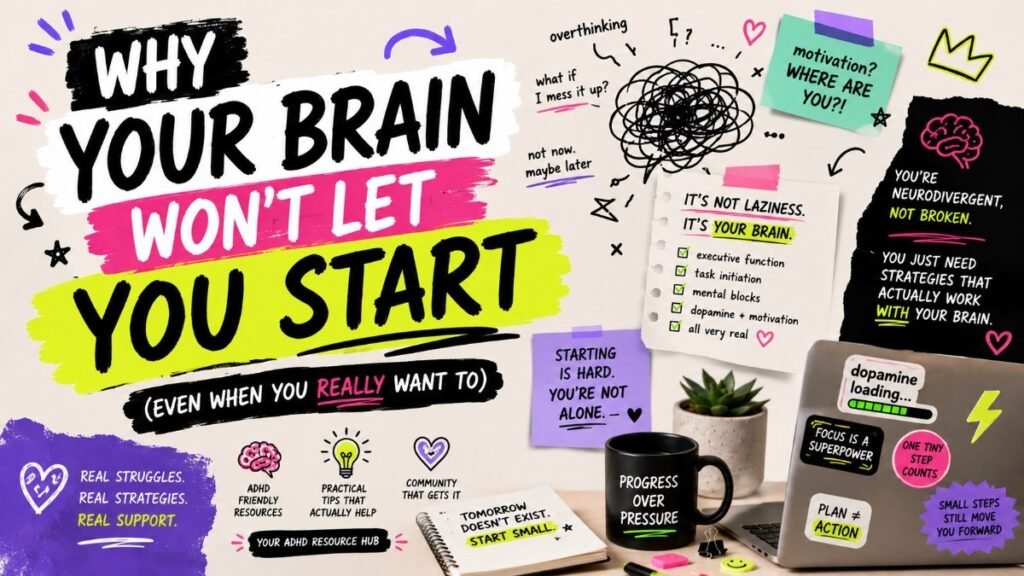
You know exactly what you need to do. You’ve known for hours. Maybe days. You’re not confused about the task. You’re not missing information. You actually want to get it done, and part of you is genuinely ready.
And yet you’re sitting there, completely stuck, watching the time disappear while a version of you inside your head is screaming “JUST START.”
This is one of the most disorienting experiences of having ADHD. Not the forgetfulness. Not even the distraction. This: the gap between knowing what to do and being able to do it. The wanting without the starting.
It’s not that you don’t care. It’s that caring isn’t enough, and nobody warned you that could happen.
Here’s what’s actually going on.
The Car With a Broken Starter
Picture a car sitting in a driveway. The engine is perfectly healthy. The fuel tank is full. The driver is sitting behind the wheel, ready to go, with somewhere important to be.
But when they turn the key, nothing happens. Not because the engine is broken. Because the starter motor, the small mechanism whose only job is to get the engine going in the first place, is faulty. The engine never catches. The car goes nowhere.
To anyone walking past, it just looks like the car isn’t moving. They have no idea there’s a mechanical problem. They might even assume the driver doesn’t really want to go.
That car is your brain.
The part of your brain responsible for launching you into action, for flipping the switch between “thinking about doing” and “actually doing,” works differently in ADHD brains. Researchers have found that the chemical your brain uses to signal “this is worth starting” is in shorter supply, and the circuits that are supposed to carry that signal from intention to action are, frankly, unreliable.
Your engine is fine. Your starter is the problem. And no amount of wanting to drive will fix a broken starter.
Why “Just Start” Is Genuinely Terrible Advice
The most common piece of advice for procrastination is some version of “stop overthinking and just begin.” And for people without ADHD, honestly, that advice works fine. Their starter motor fires. The engine catches. Off they go.
But for you, something else is happening first.
Researchers who study procrastination, including a team who published work in 2023, have found that for people with ADHD, intense emotions get in the way of starting before you’ve even had a chance to try. We’re talking about feelings like boredom, low-level anxiety, or that vague sense of dread that a task brings up. These aren’t dramatic emotions. You might barely notice them consciously. But your brain notices them.
And when those feelings get loud enough, they effectively hijack the part of your brain that’s supposed to be your gas pedal and brake. Starting the task feels impossible, not because you lack discipline, but because the emotional signal is drowning out everything else.
Quick note: This isn’t about being emotionally fragile. It’s about wiring. Your brain’s emotional responses are faster and louder than average, and they physically interfere with the circuits responsible for getting things going. That’s a neurological thing, not a character flaw.
So when someone tells you to “just start,” they’re essentially telling a driver with a broken starter to “just turn the key harder.” It’s not wrong, exactly. It’s just not the problem.
Your Brain Is Literally Different Every Day
Here’s something that might make a lot of your life suddenly make sense.
Some days you’re unstoppable. You get into a flow and knock out three hours of work before lunch. You feel competent, capable, like the person you keep trying to be. You wonder why it’s ever hard.
Other days, the same task feels like moving through wet concrete. You sit down. You stare. You open a tab. You close it. You check your phone. An hour passes and you haven’t done anything. You know what you’re supposed to do. Your body just won’t cooperate.
It’s not motivation. It’s not discipline. It’s like your “capacity” changes day to day and you never know which version of your brain you’re getting.
That’s not a quote from a research paper. That’s how someone in an ADHD community forum described it, and thousands of people recognized themselves immediately.
The science backs this up. The brain chemical involved in making starting feel possible doesn’t stay at a steady level. It fluctuates based on sleep, stress, hormones, what you’ve eaten, how much stimulation you’ve had, and factors that researchers are still working out. On good days, the signal gets through clearly. On bad days, it barely registers.
This is why every productivity system you’ve tried has eventually failed you. They all assume you have the same brain on Monday as you do on Thursday. You don’t. Nobody with ADHD does.
The Chain Reaction Nobody Talks About
There’s a specific flavor of this experience that’s worth naming, because it’s deeply strange and almost impossible to explain to someone who hasn’t felt it.
You sit down to start. Something small pulls your attention away. Maybe a notification, maybe a random thought, maybe you notice the cup on your desk needs to go to the kitchen. You follow that pull for just a second. Then that leads to something else. Then something else. And suddenly you’re twenty minutes deep into reorganizing your bookshelf, or reading about the history of something completely unrelated to what you were supposed to do, and the original task is so far away it feels like it belongs to a different day.
From the community: “I was putting on my shoes, noticed a loose thread, pulled it, saw a stain, went to grab cleaner, noticed dishes in the sink, started washing them, forgot about the shoes, checked the time, panicked.”, r/ADHD thread
That’s not scattered thinking as a personality trait. That’s your brain’s braking system failing to do its job. The part of your brain that’s supposed to say “not now, stay on task” isn’t firing reliably. So one small distraction triggers the next, which triggers the next, in a chain reaction that you’re not really in control of until suddenly you surface and realize what happened.
And then the shame kicks in. Which makes everything worse.
Why Shame Makes the Whole Thing Harder
Here’s the cruelest part of this whole situation.
When you can’t start, you feel bad about yourself. That bad feeling makes it harder to start next time. Which makes you feel worse about yourself. Which makes it harder still.
Researchers who study procrastination have actually mapped this loop: the emotional spiral from “I can’t start this task” leads to lower self-confidence, which leads to more avoidance, which leads to more shame. It feeds itself. And in ADHD brains, where those emotional signals are already running loud and fast, the shame spiral can escalate in minutes.
The really insidious part is the story the shame tells you. It says: “You should be able to just start. Other people can start. If you can’t start, something is wrong with you, not your brain.” That story sounds reasonable. It is not reasonable. But it’s very convincing when you’re in the middle of it.
Your brain is an organ. If someone had a lung disorder, you wouldn’t tell them to just breathe harder. Your brain controls thinking and acting the same way lungs control breathing. All three are equally capable of having a disorder. And all three deserve the same basic understanding.
Shame doesn’t fix broken starter motors. It just makes you feel worse while you’re stuck in the driveway.
What Actually Helps (Hint: It’s Not Willpower)
The strategies that actually work for ADHD task initiation have one thing in common: they don’t ask your broken starter to work harder. They find a way around it.
External triggers are one of the most reliable tools. Your internal signal system, the one that’s supposed to tell you “now is the time to start,” isn’t dependable. So you borrow a signal from outside: a loud timer, an accountability partner, a specific song you only play when starting work. Your brain responds to outside input when it can’t generate the right inside input on its own.
Reducing friction at the start matters more than you’d expect. The task itself might not feel impossible, but the setup for the task does. Opening the laptop, finding the document, clearing a space. Each tiny step is another ignition attempt that might not fire. So you remove as many of those steps as possible in advance: laptop open, document already loaded, everything ready. You’re trying to make the very first action as small and frictionless as possible.
Working with your emotional weather instead of against it is probably the most important shift. If the feeling that makes starting hard is boredom, you add stimulation: music, a change of environment, a timer that makes it feel like a game. If the feeling is anxiety, you make the first step so small it can’t feel threatening. You’re not fighting your emotions. You’re giving your brain what it needs to get the signal through.
Quick note: None of this is about tricking yourself into being neurotypical. It’s about building a starter motor out of the materials you actually have. External triggers, tiny first steps, and emotional awareness are your jumper cables.
None of this is a permanent fix, and none of it works every single time. Bad brain days happen. The chemistry fluctuates. Some days the car just won’t start no matter what you do, and the most useful thing you can do is notice that, be honest with yourself about it, and not spend six hours in shame about it.
The Thing Worth Knowing
If you’ve spent years believing you were lazy, or undisciplined, or that you just didn’t want things badly enough, this is the part where it’s worth sitting with the alternative explanation for a moment.
You were not failing to try. You were trying with a broken starter. Those are genuinely different things, and one of them is not your fault.
The gap between wanting to do something and being able to start it is real. It has a neurological explanation. It is not a measure of your character or your ambition or how much you care about your life.
Understanding why the starter is broken doesn’t fix it instantly. But it does mean you stop blaming the driver.
And from that place, the right tools actually start to make sense. Not because you’ve fixed yourself, but because you finally know what you’re working with.
Quick Dopamine Hits:
- Pick the smallest possible first move, not ‘start the project,’ but ‘open the document.’ One action. That’s it.
- Set a loud external trigger: a timer, an alarm, a friend texting you ‘go.’ Your brain responds to outside signals when inside ones fail.
- Say out loud what you’re about to do before you do it. Hearing yourself name the task can break the freeze, your brain registers it differently when it’s spoken.
Rate this article
Was this a useful hit?