Why Small Tasks Feel Impossible With ADHD

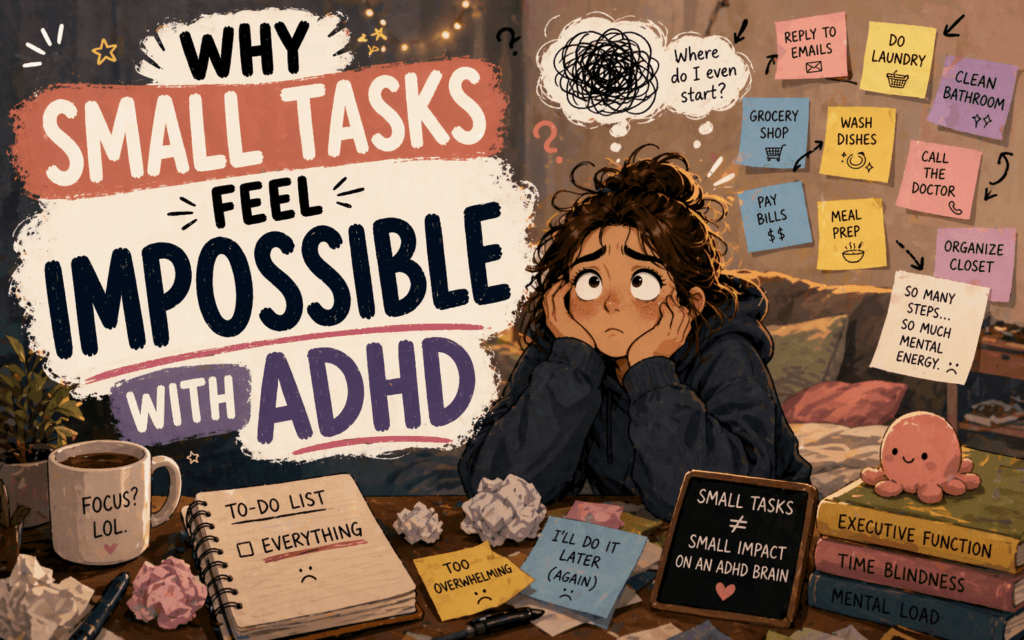
Replying to a text. Sending one email. Rinsing a mug. On paper, these take two minutes. In reality, they sit on the list for days, sometimes weeks, silently multiplying the background stress.
If you've ever felt genuinely confused about why something so small feels so hard, you're not imagining it and you're not being dramatic.
It's Not the Size of the Task
The conventional assumption is that difficulty scales with size. Hard tasks are big. Small tasks are easy. If a small task is hard for you, there must be something wrong with your effort or your attitude.
For ADHD brains, this isn't how it works.
The size of a task has very little to do with how difficult it is to start. What matters is the type of executive function required, the transition cost to get there, and the number of invisible micro-steps involved (even when each step is tiny).
A two-minute phone call to make an appointment requires: remembering you need to do it, deciding to do it now, finding the number, preparing what you'll say, managing the unpredictability of the call, and handling any follow-up. For someone without ADHD, most of this is automatic background processing. For an ADHD brain, each piece is a small conscious executive function task.
The task was never small. It just looked that way from the outside.
Transition Cost Is Real
ADHD makes switching tasks harder than average. The brain has to disengage from whatever it's currently doing, shift cognitive modes, locate the relevant context for the new task, and begin. This is a genuine neurological process that takes effort.
This transition cost is relatively fixed. Whether the task you're switching to takes two minutes or two hours, you still pay the same switching cost. This is partly why "just do the small thing first" doesn't always compute: the cost of switching to it can be higher than the value of completing it quickly.
Stacking several small tasks doesn't solve this. It increases the number of transitions you have to make.
Working Memory Overhead
Every task, no matter how simple it looks, requires holding information in working memory while executing. What to say on the call. Which cupboard the mug goes in. What the email is actually supposed to say.
ADHD is associated with weaker working memory capacity. This means the overhead of "simple" tasks is genuinely higher, because you're working harder to keep the relevant context active while doing the task. Things that are automatic for most people require conscious, effortful management for ADHD brains.
This is one reason that small tasks feel more exhausting than their apparent size justifies. The cognitive overhead is much higher than it looks.
ADHD working memory is sometimes described as having a smaller RAM. You can run the program. But when too many processes are open, the whole system slows down or crashes. Small tasks compete for the same limited resource as large ones.
Phone Calls, Texts, and "Just Reply"
Phone calls deserve a specific mention. "Just call them" is advice that lands very differently on an ADHD brain.
Phone calls are unpredictable. You can't control how long they'll take, what will be asked, or how they'll go. The ADHD brain, which already struggles with transitions and working memory, also tends to be more sensitive to uncertainty. An unscripted interaction carries a higher activation cost than a predictable one.
Texts accumulate for a similar reason. Each unreplied message is an open loop, something your brain knows it needs to return to. Returning to it requires a context switch. And the accumulated weight of having not replied already adds to the emotional barrier around doing it now.
The message doesn't get answered because you don't care. It doesn't get answered because the initiation cost, combined with the guilt of waiting, has made it genuinely hard to start.
What Helps
Make the first action physically visible. Don't tell yourself to "reply to that text." Put your phone in your hand, open the message, and type one word. One word is your only stated commitment. You can stop there. Usually you won't.
Reduce unpredictability before you start. For phone calls, write down three bullet points of what you need to say before you dial. The script reduces working memory load and makes the call feel less like a leap into the unknown.
Batch similar small tasks. Instead of paying the transition cost for each one individually, set a specific short window and handle all the small things at once. One transition, multiple completions.
Don't judge the task by its listed size. If it's hard, it's hard. The size on the to-do list is not an accurate indicator of the actual cognitive load it carries for your brain.
The Permission You Might Need
If you've been treating the difficulty of small tasks as evidence of personal failure, it's worth reconsidering what the evidence actually shows.
It shows that your brain processes task initiation and transition differently. That executive function is a finite resource. That working memory load is real. None of that is laziness. None of that is a choice you're making.
The task is genuinely hard for your brain. Taking that seriously, rather than adding shame to it, is the first step toward finding approaches that actually work.
Rate this article
Was this a useful hit?