ADHD Object Permanence: Out of Sight Really Is Out of Mind (and Out of Priority)

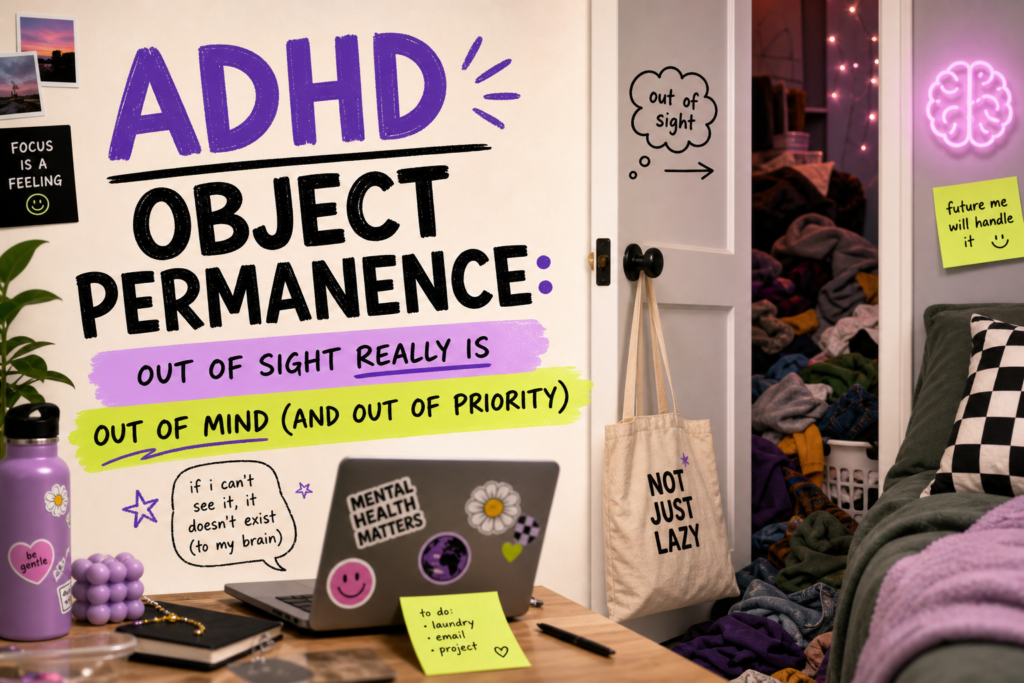
If you have ADHD, there is a decent chance you have lost track of a bill that was sitting inside a folder, forgotten about a friend you genuinely love because they did not text you first, or discovered a task you swore you would do “later”, three weeks after it was due. This is not carelessness. It is not a character flaw. It is a direct consequence of how the ADHD brain handles object permanence, and once you understand the neuroscience behind it, a lot of your life suddenly makes a different kind of sense.
What Object Permanence Actually Means in an ADHD Context
In developmental psychology, object permanence refers to an infant’s ability to understand that an object continues to exist even when it cannot be seen. Most children develop this capacity by around eight to twelve months. But when the term migrates into ADHD conversations, it describes something related but distinct: the functional inability to keep things actively represented in working memory when those things are not currently in your sensory field.
This is not about knowing, intellectually, that the thing exists. You know the bill is in the folder. You know your friend is alive and that you care about them. The problem is that the ADHD brain does not maintain a live, motivationally relevant signal for things that are out of view. The object exists in declarative memory, but it has lost its emotional salience, its urgency, its pull on your attention. It has become inert.
Knowing something exists and having your brain treat it as real and present are two completely different cognitive events. For people with ADHD, that gap can be enormous.
The underlying mechanism connects directly to working memory deficits, which are among the most consistently documented features of ADHD. Barkley et al. (1997, Journal of Abnormal Psychology) described working memory impairment as central to ADHD, not peripheral to it, noting that the ADHD brain struggles to hold information in an active, actionable state across time. When something leaves your immediate environment, it does not just fade gradually. For many people with ADHD, it drops almost immediately from the brain’s active queue.
The Neuroscience Behind “I Forgot It Existed”
The prefrontal cortex is responsible for maintaining representations of things that are not currently present in your environment. It is what allows you to hold a plan in mind while walking across the house to execute it, or to remember that you have an appointment next Tuesday even when it is currently Monday morning. In ADHD, prefrontal cortex functioning is disrupted, particularly in the circuits involving dopamine and norepinephrine signaling.
Research by Arnsten et al. (2009, Neuron) established that dopamine and norepinephrine modulate the signal-to-noise ratio in prefrontal networks. Without adequate modulation, the network that should be holding a background representation of “the thing I need to do later”, gets overwhelmed by whatever is happening right now. The present moment wins, not because you prefer it, but because your brain’s architecture gives it an unfair structural advantage.
This is also why ADHD object permanence failures are not consistent. If something is emotionally charged, urgently deadline-bound, or tied to a strong reward signal, it can break through. The brain is not equally blind to everything out of sight. It is specifically bad at maintaining low-to-medium salience representations over time. Which, unfortunately, describes most of adult life: medium-importance tasks, slowly deepening relationships, recurring obligations that never feel urgent until they are overdue.
Why this is not laziness: The ADHD brain’s working memory deficits are structural and neurobiological. Forgetting something exists when it leaves your field of view is a predictable output of a dopamine-modulated prefrontal system under strain, not a reflection of how much you care about it.
Objects and Tasks: Why Your Junk Drawer Is a Graveyard
The most immediately visible consequence of ADHD object permanence is what happens to physical things. Objects placed inside drawers, cabinets, folders, or boxes cease to exist in any functional sense. You will buy a third pair of scissors because you cannot see the first two. You will miss a deadline because the paper it was written on is under another paper. You will forget to take a medication that is in the medicine cabinet instead of on the counter.
This is the exact reason why open shelving, pegboards, clear bins, and visible storage systems are not just aesthetic choices for people with ADHD. They are cognitive prosthetics. If your brain cannot maintain a reliable internal representation of something absent from view, then the solution is to keep as few things absent from view as possible. Your environment has to do the memory work that your prefrontal cortex cannot do reliably on its own, which is why building a visual system for an out-of-sight-out-of-mind brain is essential..
The same logic applies to digital objects. An email that gets archived is functionally gone. A task that lives inside an app you have to navigate to is at serious risk. A reminder set for a specific time helps only if you are in the right mental state to act on it when it fires. None of these systems work well if the object itself is hidden from your primary visual field. The ADHD workspace, physical or digital, needs to be aggressively legible. Everything you need to act on this week should be visible at the moment you are most likely to act on it, without requiring you to remember to look for it.
Your environment is not just where you live and work. For an ADHD brain, your environment is your external working memory. Design it accordingly.
Tasks and Commitments: The Future Is a Foreign Country
ADHD also distorts time perception in ways that compound the object permanence problem. Researchers including Barkley (2011, Journal of Attention Disorders) have described ADHD as involving a fundamentally impaired sense of future time, a condition sometimes called “temporal blindness.”, The future does not feel real in the same way the present does. This means that a commitment you made for next week exists with approximately the same cognitive weight as something that might never happen at all.
The interaction between temporal blindness and object permanence creates a specific trap. You agree to do something. The conversation ends. The other person, the task, and the deadline all leave your immediate perceptual field. At that moment, the commitment does not go into some reliable mental filing system. It goes somewhere closer to nothing. Not forgotten in the sense that you consciously deleted it, but no longer actively present in any way that generates planning, anticipation, or preparation.
This is why the conventional advice of “just write it down”, is inadequate on its own. Writing it down in a notebook that lives in a bag that sits in a corner creates the same problem: the written record becomes invisible, which means it becomes inert. The externalization of the commitment has to be paired with visibility and environmental cues that will bring it back into your perceptual field at the right moment. Sticky notes on the bathroom mirror. A whiteboard at eye level in your primary working area. A recurring alarm with the actual words of the commitment in the notification text. The medium matters less than the principle: keep the thing visible, and keep it visible in the right place at the right time.
The visibility principle: A commitment that is written down but stored out of sight is nearly as cognitively inaccessible as a commitment that was never recorded. Externalization only works when the external cue lands in front of your eyes at the moment it needs to generate action.
The Relationship Cost No One Talks About
This is the part that tends to carry the most pain. ADHD object permanence does not only affect tasks and physical objects. It affects people. When someone is not in front of you, your ADHD brain can fail to maintain the same kind of warm, active, motivationally present representation of them that neurotypical brains seem to sustain more automatically. The relationship continues to exist in your long-term memory. You love them. But without regular sensory contact, the felt sense of their presence, the urge to reach out, the background awareness that they are a person you are in relationship with can all go quiet.
For friends, this means months passing without contact even when you genuinely miss them. For romantic partners, it can mean a partner feeling emotionally abandoned during a period of low interaction, even when nothing has gone wrong relationally. For family members, it can look like neglect. For colleagues, it can erode professional trust. None of this is because the ADHD person stopped caring. But caring in the abstract, while failing to generate any concrete relational behavior, does not sustain relationships. Relationships require showing up, and showing up requires that the other person remain present enough in your cognitive and emotional field to prompt action.
From the community: “I genuinely forget my friends exist when I don’t see them regularly. Not in a cruel way, just…, they disappear from my brain. And then I feel so guilty when I resurface that I avoid reaching out even more. It’s a whole cycle.”, r/ADHD thread
The guilt spiral described above is almost universal among adults with ADHD once they become aware of this pattern. The longer the gap, the more the guilt accumulates, and the more the guilt makes reaching out feel like an event that requires explanation, apology, and emotional labor. So the gap widens further. Understanding that the original disappearance was neurological rather than intentional does not automatically dissolve the guilt, but it does offer a more accurate framework for repairing the pattern, and for explaining it to the people in your life who deserve an honest account of what is actually happening.
Why Partners and Close Friends Often Take It Personally
When you tell someone who does not have ADHD that you forgot they existed for a month, their nervous system processes this through the lens of what that would mean if they did it. For most neurotypical people, failing to contact someone they love for weeks would require active avoidance. It would mean something was wrong. So when they hear this from an ADHD partner or friend, the natural inference is that something is wrong, that the relationship has lower priority than it appears, or that the forgetting is a form of passive withdrawal.
This mismatch in interpretation creates significant relational strain. The ADHD person is often confused about why the other person is hurt, because from the inside, the absence of contact did not feel like a choice or a signal. It felt like nothing at all. The problem was precisely the absence of felt experience around the gap, not the presence of a decision to pull away. Research on ADHD and relationship quality, including work by Eakin et al. (2004, Journal of Attention Disorders), has documented higher rates of relationship dissatisfaction in couples where one partner has ADHD, with communication breakdown and perceived unreliability among the most commonly cited issues.
The ADHD person did not experience a month of distance. They experienced a conversation, and then the next conversation. The gap in between had no felt texture. This is genuinely hard to explain to someone for whom absence from a loved one has emotional weight.
Being explicit about this dynamic is one of the most useful things you can do for your relationships. Not as an excuse, but as information that allows the other person to reinterpret past events and to participate in building systems that work better going forward. Agreeing on a regular check-in cadence, for example, removes the burden of remembering to initiate and reframes the relationship as something that has structure rather than something that depends entirely on spontaneous impulse from someone whose impulses are unreliable in this domain.
Visible Systems That Actually Work
The practical solutions to ADHD object permanence are not complicated in principle, but they do require a fundamental shift in how you think about your environment. The goal is to design your physical and digital spaces so that the things requiring your attention are inescapably present in the places and moments where you are most likely to act on them.
Open shelving is not just trendy. For an ADHD brain, it is functionally superior to cabinets because it eliminates the retrieval step that makes out-of-sight storage so cognitively costly. The same logic applies to clear storage containers over opaque ones, whiteboards over notebooks, and physical sticky notes over digital reminders buried in an app. The principle is that visual accessibility is cognitive accessibility.
For tasks and commitments specifically, a daily visible reset is more reliable than a weekly review. Many productivity systems built for neurotypical brains rely on periodic review sessions where you consult a master list and redistribute your attention. For ADHD brains, the gap between reviews is enough time for everything on the list to lose its salience completely. A better model is a small number of visible, non-negotiable anchors in your daily environment. A whiteboard in your eye line with no more than three things on it. A sticky note on your phone case. A specific spot on your desk that is reserved for things requiring action, kept empty of everything else.
For relationships, analog solutions tend to outperform digital ones because they remove the friction of navigating to an app. A corkboard with photos of the people you want to stay connected to makes them visually present in your space. A recurring calendar event titled with a person’s name, not “call friend,”, carries more cognitive specificity and is more likely to generate action. Some people find it helpful to keep a short physical list of their closest relationships somewhere visible, as a prompt to ask themselves when they last made contact. None of this is romantic. But relationships with ADHD involved often need scaffolding that neurotypical relationships do not, and there is no nobility in refusing the scaffold.
Accepting the Architecture Without Surrendering to It
There is a version of learning about ADHD object permanence that ends in fatalism. The brain works this way, therefore nothing can be done, therefore the losses are inevitable. This is the wrong conclusion, and it is worth being direct about why. The neuroscience explains the mechanism. It does not determine the outcome. Working memory deficits are real and persistent, but they interact with environment, habit, and external structure in ways that are genuinely modifiable.
The brain does not need to change for your life to change. Your environment needs to become a better external scaffold for the cognitive functions your brain handles inconsistently. That is a design problem, not a self-improvement problem, and design problems have solutions that do not depend on willpower, motivation, or character. You are not going to remember things better by trying harder to remember them. You are going to remember things better by ensuring they remain visible.
The same is true for relationships. You are not going to become someone who naturally maintains a warm, active, internal representation of every important person in your life. That is not how this brain works. But you can build external systems that prompt the relational behavior that demonstrates care, even when the internal felt sense of urgency is absent. And over time, consistent external behavior rebuilds trust and intimacy in ways that intentions alone never can.
You do not have to feel the urgency to act on it. You just have to build the system that acts on your behalf when the urgency is absent. That is what accommodation actually looks like.
Starting Where You Are
If you have read this far and are sitting with a mix of recognition and grief, that is a normal response. Understanding ADHD object permanence for the first time often means reviewing a significant portion of your adult life through a different lens: the friendships that quietly dissolved, the commitments that fell through without explanation, the objects replaced because the originals vanished into a drawer. None of that was inevitable, but none of it was a moral failing either.
The useful move now is not to audit the past for evidence of how broken you are. It is to pick one domain, objects, tasks, or relationships, and design one visible system for it this week. A single whiteboard. One recurring alarm with a real person’s name in it. One open shelf where previously there was a closed cabinet. The scope is less important than the principle: make the invisible visible, and then make that visibility automatic.
ADHD object permanence is not a character flaw you can fix with enough willpower. It is a structural feature of how your brain maintains information across time and space. But structural features of the brain interact with structural features of the environment. Change the environment, and you change what the brain has to work with. That is not a workaround. That is neuroscience-informed design. And it is available to you right now, starting with whatever is in front of you.
Quick Dopamine Hits:
- Right now, pick one recurring task that keeps falling off your radar and place a physical object related to it somewhere you cannot avoid seeing it, on your keyboard, your pillow, or directly in front of your coffee maker.
- Set a ‘relationship ping’, alarm on your phone for one friend or family member you haven’t contacted in a while. When it fires, send one sentence, no need to explain the gap.
- Do a five-minute visual audit of your space: move anything you need to act on this week out of drawers or cabinets and onto an open surface where your eyes will land on it naturally.
Rate this article
Was this a useful hit?