Is It an ADHD Thing That Social Situations Leave You Completely Wiped Out for Days After?

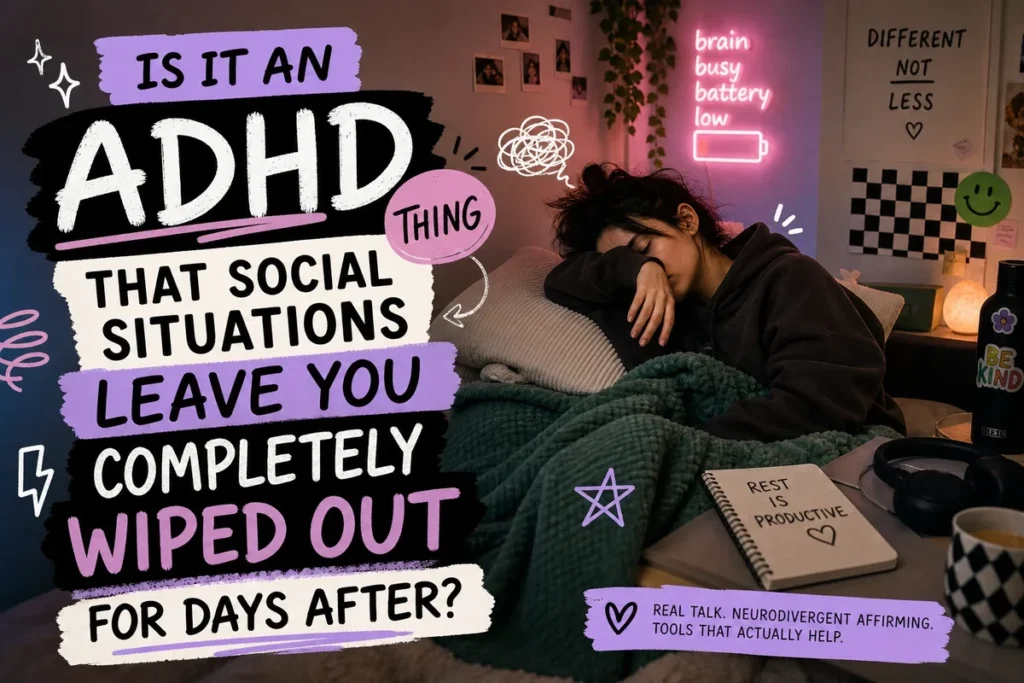
You went to your friend's birthday. Four hours. You liked being there, mostly. You laughed at the right moments, tracked three overlapping conversations, remembered to ask about someone's new job, noticed when the energy shifted and someone needed reassurance. You navigated the goodbye logistics, the "we should do this again soon" exchange, the car park small talk that somehow lasted another twenty minutes. You drove home feeling okay. Maybe even good. And then you woke up the next day and could not move. Not tired in the normal way. Emptied. You spent the entire day in bed, curtains drawn, watching something you've already seen because following a new plot felt impossible. And somewhere in the background, you felt a low hum of shame: it was only four hours. Why does everyone else bounce back while you need days to recover?
Yes, this is an ADHD thing. It's called ADHD social exhaustion, and it happens because your brain runs at significantly higher processing power during social interactions than neurotypical brains do. Every conversation requires more working memory, more impulse monitoring, more real-time translation between your internal experience and socially expected behaviour. The crash you feel afterwards is proportional to that invisible cognitive effort. You're not antisocial. You're not broken. You're experiencing the legitimate neurological cost of sustained masking and hypervigilance.
Why ADHD Brains Work Harder in Social Settings
Social interaction is not a passive activity for anyone, but for the ADHD brain, it's closer to running multiple demanding programs simultaneously while pretending your laptop isn't overheating. Research on ADHD and social functioning shows that 50 to 60 percent of people with ADHD experience significant difficulties with peer relationships, often due to the constant cognitive effort required to track unspoken social rules that others seem to process automatically.
Here's what's actually happening during a conversation for you: you're listening to words while also monitoring the speaker's facial expressions, adjusting your own expression to match the expected response, suppressing the three tangential thoughts that just sparked, remembering that you wanted to mention something but knowing now isn't the right moment, noticing background noise that keeps pulling your attention, fighting the urge to interrupt with something relevant, and simultaneously trying to predict where the conversation is heading so you can prepare an appropriate response. All while appearing relaxed and present.
Neurotypical brains automate much of this. The ADHD brain does not. You're manually running processes that should be background tasks. That's not a character flaw. That's executive function working overtime.
The Hidden Cost of Masking
Masking is the practice of suppressing or compensating for ADHD traits to appear neurotypical. In social situations, this means constantly monitoring yourself: Am I talking too much? Did I interrupt? Is my energy appropriate? Did I miss something important? Am I being weird? This self-surveillance is exhausting because it never stops. You're not just in the conversation. You're watching yourself be in the conversation, judging your performance in real-time.
Social exhaustion isn't about disliking people. It's about the cognitive load of performing "normal" while your brain is wired differently.
The longer you mask, the deeper the fatigue. A four-hour event after a week of "people-heavy" work can feel like running a marathon without ever lacing up your shoes visibly. Nobody saw you run. But your body knows.
People who received a late discovery of their ADHD often have decades of ingrained masking patterns. You've been doing this so long, you might not even recognise it as effortful. It just feels like "how socialising is." But then you watch friends leave the same event and go out for drinks afterwards, and you wonder what's wrong with you. Nothing is wrong with you. You've just been spending energy they didn't have to spend.
ADHD Social Exhaustion Is Not the Same as Introversion
You might have explained this to yourself as "I'm just introverted." And maybe you are. But ADHD social exhaustion operates differently from introversion, and understanding this distinction matters for how you manage it.
Introversion describes where you get energy: introverts recharge alone and expend energy socially. This is a preference, not a deficit. ADHD social exhaustion is about cognitive load, not preference. You might genuinely want to be social, enjoy the event while you're there, and still crash catastrophically afterwards. It's not that people drain you because you're introverted. It's that the processing demands drain you because your brain can't run those tasks efficiently.
The key difference: An introvert might feel tired after socialising but recover with a quiet evening. ADHD social exhaustion often requires multiple days, involves physical symptoms like headaches or inability to focus, and can trigger emotional dysregulation if you don't get adequate recovery.
This is why advice like "just be yourself" or "relax and enjoy it" doesn't work. You can't simply opt out of the processing demands. The only variables you can control are how often you expose yourself to high-demand situations and how you recover between them.
Why Standard Advice Fails for ADHD Social Exhaustion
Most advice about social fatigue assumes you can "pace yourself" during the event. Take breaks. Step outside. Find a quiet corner. This advice isn't wrong, but it misunderstands the nature of the problem. For ADHD brains, the exhaustion isn't primarily from sensory overload during the event. It's from the cumulative cognitive load that doesn't become apparent until later.
You might feel fine during the party. The crash comes after. This delayed reaction makes it difficult to calibrate in the moment. By the time you realise you've overdone it, the damage is already done.
The other standard advice is "say no to events you don't want to attend." Again, not wrong. But if you're exhausted after events you genuinely wanted to attend, saying no isn't the solution. The issue isn't desire. It's capacity.
The truth nobody tells you: managing ADHD social exhaustion isn't about attending fewer events. It's about protecting recovery time with the same seriousness you'd give to the event itself.
If you wouldn't cancel the dinner, don't cancel the recovery day that makes the dinner possible.
The Rage Response: Why New Commitments Feel Like Threats
Here's a pattern that might sound familiar: you're recovering from one social event, and someone mentions another commitment. Maybe your partner says dinner with the in-laws is happening this week. Maybe a friend texts about plans this weekend. Your immediate response isn't disappointment. It's rage. White-hot, disproportionate frustration that surprises even you. These are people you love. Why does the news feel like an attack?
This happens because your nervous system is already in a depleted state, and another demand registers as a genuine threat to your capacity. Your brain is running low on the resources needed to mask, perform, and regulate. A new commitment isn't just an addition to your calendar. It's a withdrawal from an already overdrawn account.
Research on rejection sensitivity and emotional dysregulation in ADHD helps explain this. When you're cognitively depleted, your ability to regulate emotional responses is compromised. The anger isn't about the event itself. It's about your nervous system recognising that you don't have what this will cost you.
This response often comes with shame. You feel guilty for resenting people you care about, for dreading events that should be enjoyable, for needing so much more recovery than seems reasonable. The shame compounds the exhaustion. Now you're tired and feeling bad about being tired.
What Actually Helps with ADHD Social Exhaustion
Managing ADHD social exhaustion requires working with your neurology instead of against it. Here's what that looks like in practice:
Protect recovery time structurally, not emotionally. Don't wait until you're depleted to decide you need rest. Block recovery days in your calendar the same way you'd block the social event. If Saturday is a birthday party, Sunday is a recovery day. Non-negotiable. This isn't self-indulgence. It's energy management based on your actual capacity.
Reduce masking where possible. This is difficult and requires safety, but even small reductions in self-monitoring help. If you're with close friends who know you have ADHD, practice not performing. Let yourself fidget. Let pauses be awkward. Don't manufacture the "appropriate" expression when you don't feel it. Every moment you're not masking is a moment you're conserving energy.
Front-load regulation. The day of a social event, do things that fill your tank before you arrive. This might be exercise, time in nature, a special interest deep-dive, or quiet solitude. Arrive less depleted and you'll crash less hard afterwards.
Recovery isn't laziness: The day in bed watching TV in the dark isn't a failure. It's your nervous system doing exactly what it needs to do. The shame you feel is learned, not accurate. You're not broken for needing this. You're responding correctly to a real demand.
Communicate capacity, not preference. When you need to decline or limit commitments, frame it as capacity rather than desire. "I can't do dinner this week" is different from "I don't want to." The first is a fact about your current state. The second invites negotiation. You're not being antisocial. You're managing a limited resource.
The Week-by-Week Reality
One of the clearest signs of ADHD social exhaustion is how multiple commitments in a single week compound. One event might be manageable. Two events with adequate recovery between them, still okay. But stack three or four commitments without recovery days, and you'll feel yourself becoming a worse version of yourself. Shorter temper. Lower frustration tolerance. Difficulty concentrating. Physical exhaustion that sleep doesn't fix.
This compounding effect means that planning matters more than willpower. You cannot push through this with determination. You cannot "try harder" to recover faster. The only leverage point is how you structure your weeks.
Some people find it helpful to designate certain days as permanently off-limits for social commitments. No plans on Mondays, ever. Or no more than one social event per weekend. These rules feel restrictive until you experience the difference they make. Suddenly you have capacity. Suddenly you can enjoy the events you do attend instead of resenting them before they start.
Reframing the Crash
The exhaustion you feel after socialising isn't a sign that you're doing life wrong. It's accurate feedback about how much energy your brain actually spent. The ADHD social hangover is real, and it's proportional to the invisible work you did while appearing effortless.
You're not too sensitive. You're not antisocial. You're not weak or broken or bad at being a person. You're running a brain that has to manually process what others automate. The cost is real. The recovery is necessary. And the only failure would be continuing to pretend that cost doesn't exist while burning out trying to keep up with people whose brains work differently.
Protect your recovery the way you'd protect any other essential need. Block the day after. Lower the lights. Let your brain do the quiet repair work it needs. That's not selfishness. That's maintenance. And it's the only way this actually works long-term.
Rate this article
Was this a useful hit?