Is It an ADHD Thing That You Responded to a Stranger's Message Instantly but Your Close Friend's Text Has Been Sitting There Three Days?

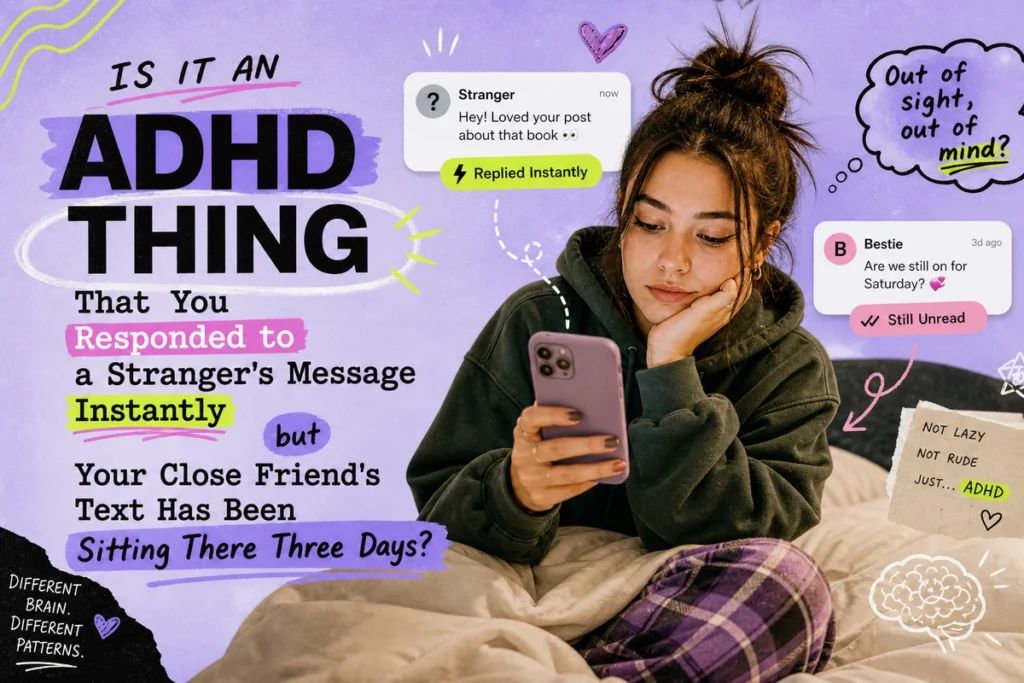
Your best friend texted you on Tuesday. It's Friday now. You've seen the message notification every time you've picked up your phone. You've thought about responding at least twelve times. You've even mentally composed three different replies. But the message sits there, unread or read but unanswered, while the guilt compounds with each passing hour. Meanwhile, yesterday a complete stranger DMed you asking about something in your bio, and you responded within ninety seconds. Effortlessly. Without thinking. Your thumbs moved before your brain even registered you were typing.
Yes, this is absolutely an ADHD thing. It's called novelty-driven dopamine response, and it explains why your brain treats unfamiliar people as more "urgent" than the people you actually care about most. This pattern is not a reflection of your priorities, your love, or your character. It's neurochemistry.
Why ADHD Texting Inconsistency Happens in the First Place
The ADHD brain operates on a dopamine deficit. Dopamine is the neurochemical that helps you initiate tasks, sustain attention, and feel motivated to complete things. When dopamine is low, even simple tasks feel like pushing through wet cement. When dopamine spikes, you can hyperfocus for hours without noticing time has passed.
Here's what matters for texting: novelty triggers dopamine release. A message from someone new, someone unpredictable, someone whose response pattern you haven't memorized yet, that message activates your brain's reward circuitry in a way that familiar messages simply cannot. The stranger represents an unknown variable. Your brain perks up because it doesn't know what comes next.
Your friend's message, on the other hand, exists in a known context. You know how they text. You know the general rhythm of your conversations. There's no neurochemical surprise waiting in that notification. So your brain, starving for stimulation, categorizes it as "safe to delay" while chasing whatever novel thing appeared in your peripheral vision.
The Paradox of Caring More but Responding Less
This is where the guilt gets brutal. You love your friend. You want to respond. You think about them often. But the very depth of that relationship becomes a barrier to response.
Close relationships carry emotional weight. Responding to your best friend isn't just typing words. It's considering their feelings, matching their energy, saying something meaningful, maintaining the connection that matters to you. That's a lot of invisible cognitive labor. Your ADHD brain, already running on empty dopamine, looks at that task and sees a mountain. Not because you don't care, but because you care too much to send a half-hearted "lol yeah."
The stranger? Zero emotional stakes. You can fire off whatever response comes to mind because it doesn't carry the weight of a relationship you're terrified of damaging. Low stakes equals low barrier. That's not coldness. That's your brain taking the path of least resistance while trying to survive the day.
The friend who matters most gets the worst response time because they deserve the best response, and you can't access "best" right now.
ADHD Novelty Social Response Is Not a Character Flaw
Research on ADHD and social behavior consistently shows that people with ADHD experience heightened response to novel stimuli across all domains, including social interactions. This isn't selective. This isn't you choosing strangers over friends. This is how your dopaminergic system processes information.
Studies examining attention and reward processing in ADHD demonstrate that the ADHD brain shows increased activation in response to unexpected or unpredictable stimuli. Meanwhile, predictable stimuli, even positive predictable stimuli like a message from someone you love, generate comparatively little neurochemical response.1
This same mechanism explains why you can spend three hours researching a random topic that popped into your head but can't spend three minutes responding to a straightforward question from your mother. Novelty hijacks the ADHD attention system. Familiarity does not.
Why Standard Advice Makes This Worse
The standard advice for "being a better friend" involves things like: set aside time to respond to messages, prioritize your relationships, remember that communication matters. This advice assumes you have equal access to task initiation regardless of the task. You do not.
Telling someone with ADHD to "just prioritize" responding to close friends ignores that prioritization itself requires dopamine. It requires the executive function to override your brain's novelty-seeking impulses. It requires you to generate internal motivation for a task that provides no immediate neurochemical reward.
The real problem: Your brain already knows your friend's message is important. Importance isn't the barrier. Activation is. You can't willpower your way into dopamine you don't have.
This is why shame spirals make the problem worse. Every day that passes without responding adds more emotional weight to the task. Now you don't just have to respond. You have to respond AND explain the delay AND manage the awkwardness AND repair any perceived damage. The activation cost keeps climbing while your dopamine reserves stay flat.
ADHD Communication Patterns Affect Real Relationships
Here's the part nobody talks about: this pattern damages relationships even when the other person understands ADHD. Your friend might know, intellectually, that your silence isn't personal. But after the fourth time they've texted you something important and received nothing back, the knowledge doesn't erase the feeling.
People with ADHD frequently report lower self-esteem related to their social difficulties and experience significant distress around relationship maintenance. The gap between intention and action creates a painful identity conflict: you know who you want to be as a friend, and you watch yourself fail to be that person over and over again.2
This isn't about being bad at relationships. It's about having a brain that makes relationship maintenance tasks, the boring consistent texting back part, disproportionately hard compared to the exciting parts of connection.
What Actually Helps with ADHD Texting Inconsistency
The goal isn't to eliminate the novelty response. You can't rewire your dopamine system through intention alone. The goal is to build systems that work with your brain instead of against it.
First: reduce the activation cost of responding to important people. This might mean giving yourself permission to send terrible responses. A "thinking of you" text with zero substance is infinitely better than perfect silence. Lower the bar until you can clear it.
Second: create artificial urgency or novelty around relationship maintenance. Some people set specific "respond to friends" times with a timer running. Others use apps that gamify communication. The point is to trick your brain into releasing dopamine for tasks it wouldn't otherwise prioritize.
Your friend doesn't need a perfect response. They need proof you're alive and still thinking of them. Send the bad text.
Third: tell the people who matter what's happening. Not as an excuse, but as information. "My brain makes it weirdly hard to respond to people I care about most. It's not about you. I'm working on it." Most people, when they understand the mechanism, can hold space for the pattern while you build better systems.
The Guilt Serves No One
You've probably beaten yourself up about this pattern already. You've probably called yourself a bad friend, a flake, someone who doesn't deserve the people in their life. That guilt feels like it should motivate change, but it doesn't. It just adds more emotional weight to an already heavy task.
The truth is simpler and less dramatic than your shame narrative: you have a brain that responds to novelty more than familiarity. That's a neutral fact about your neurology. What you do with that information matters more than how bad you feel about it.
Reframe: Responding to strangers quickly isn't evidence that you're capable of responding to everyone quickly. Different stimuli generate different neurochemical responses. You're not choosing. Your brain is reacting.
The people who love you have probably noticed this pattern. They've probably adjusted their expectations already. Your job isn't to become someone who responds instantly to everyone. Your job is to build enough scaffolding around your communication that the people who matter don't feel forgotten.
Moving Forward with ADHD Communication Patterns
Start where you are. If you have a friend whose text has been sitting for three days, respond today. Not with an apology tour, not with a lengthy explanation, just with a reply. Any reply. The relationship repair happens through resumed contact, not through perfect explanations of why contact lapsed.
Recognize that ADHD texting inconsistency will probably be a lifelong pattern. You're not going to wake up one day and suddenly find familiar messages as activating as novel ones. What you can do is build awareness, create systems, communicate openly, and forgive yourself faster when you fall back into the pattern.
Your brain chases novelty. That's not a moral failing. The stranger got a fast response because their message was unpredictable, not because they matter more. Now close this article and go respond to that friend. One sentence. That's all it takes to prove the connection still exists.
Rate this article
Was this a useful hit?