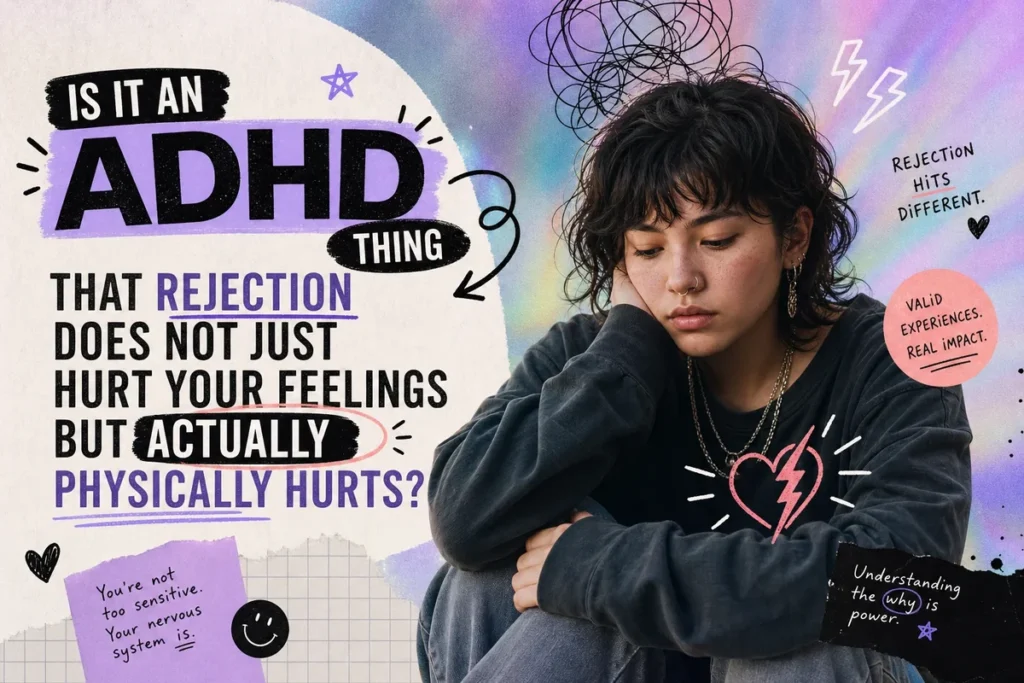
Is It an ADHD Thing That Rejection Does Not Just Hurt Your Feelings but Actually Physically Hurts?

Someone cancels plans with a vague excuse, and within seconds you feel it. Not just disappointment. Something sharper. A pinch in your chest, like someone reached in and squeezed. Your throat tightens. Your stomach drops the way it does on a rollercoaster, except you are standing still in your kitchen holding your phone. The message was three words long. The pain radiating through your body suggests something catastrophic just happened.
Yes, this is an ADHD thing. What you are experiencing has a name: Rejection Sensitive Dysphoria, or RSD. And the physical sensation is not imagined, exaggerated, or a sign that you are being dramatic. ADHD rejection sensitive dysphoria physical pain is a documented phenomenon where the brain processes social rejection through pathways that overlap significantly with physical pain processing. Your body is not lying to you. It genuinely hurts.
Why ADHD Rejection Sensitive Dysphoria Physical Pain Feels So Real
The ADHD brain handles emotional information differently than neurotypical brains. When rejection occurs, or even when rejection is merely anticipated, the emotional response bypasses the usual regulatory checkpoints. Where a neurotypical brain might register disappointment and move on, the ADHD brain escalates the signal to threat-level intensity.
Neuroscience research has established that social pain and physical pain share overlapping neural circuitry. The anterior cingulate cortex and the insula, brain regions involved in processing physical discomfort, also activate during experiences of social exclusion. For people with ADHD, this overlap appears to be more pronounced. The emotional dysregulation inherent to ADHD means the volume knob on this pain signal is turned higher, and the off switch is harder to reach.
Dr. James Kustow, a UK-based psychiatrist specialising in adult ADHD, has described RSD as "real, embodied, and deeply impairing." The formal science is still catching up to what people with ADHD have known in their bodies for years: this pain is not metaphorical. It is felt in the chest, the throat, the gut. It lands like a physical blow because, neurologically speaking, it is processed like one.
The Anticipation Is Often Worse Than the Rejection Itself
Here is something people rarely talk about: the expectation of rejection can cause more distress than actual rejection. Qualitative research on the lived experience of rejection sensitivity in ADHD found that participants described anticipatory rejection as particularly devastating. The rejection had not even happened yet, but the body was already responding as if it had.
This is why you might rehearse conversations obsessively before they happen. Why you might avoid asking for things you need because the possibility of no feels unbearable. Why you might interpret a delayed text response as evidence of abandonment. Your nervous system is not waiting for confirmation. It is already bracing for impact, and the bracing itself is painful.
The ADHD brain is wired for pattern recognition, and if you have a history of rejection, criticism, or social difficulty, your brain has catalogued those experiences efficiently. It uses them to predict future pain. The problem is that this prediction system is oversensitive. It fires on ambiguous signals, neutral expressions, and minor social friction. By the time you discover the cancellation was genuinely about the other person being sick, your body has already processed a full rejection event.
What the Physical Sensations Actually Feel Like
People with ADHD describe these sensations in strikingly consistent terms, yet the specific location and quality varies by individual. One person feels it as a pinch in the heart, swift and brief but sharp. Another describes it as something lodging in the throat, making it hard to swallow or speak. Some experience a sudden heaviness in the chest, as if someone placed a weight there without warning.
It is not just that my feelings are hurt. My actual body hurts. There is a physical quality to it that I cannot explain to people who have not felt it.
The stomach drop is common. So is a flushing sensation in the face and neck, sometimes followed by sudden fatigue, as if the body has spent enormous energy in seconds and now needs to collapse. Some people report their hands going cold or their jaw clenching involuntarily. These are not anxiety symptoms layered on top of emotional pain. They are the emotional pain expressing itself somatically, because for the ADHD brain, that distinction is blurred.
Why "Just Get Over It" Does Not Work
Standard advice for handling rejection assumes you are dealing with a purely cognitive event. Reframe your thinking. Remember that one rejection does not define you. Consider the other person's perspective. This advice is not wrong, exactly. It is just insufficient when your body is screaming that something terrible has happened.
You cannot think your way out of a physical sensation. Telling yourself the rejection was not that bad does not stop your chest from hurting. The ADHD brain processes emotional pain faster and more intensely than the prefrontal cortex can intervene. By the time the rational part of your brain starts composing reasonable counterarguments, the amygdala has already triggered a full stress response. Your cortisol is spiking. Your heart rate is elevated. You are in fight-or-flight mode over a cancelled coffee date.
Why standard coping fails: Cognitive reframing requires the prefrontal cortex to override the limbic system. In ADHD, the prefrontal cortex is already working at a disadvantage. The emotional signal arrives faster and louder, and the regulatory brake is slower to engage. This is not a willpower problem. It is architecture.
This is also why people with ADHD often develop elaborate avoidance strategies. If rejection is this painful, and if it cannot be easily reasoned away, then the logical move is to avoid situations where rejection might occur. The cost of this strategy is high. It leads to withdrawal from friendships, reluctance to pursue opportunities, and a shrinking life. But in the moment, avoidance feels like the only sensible option.
The Mask That Makes It Worse
Many people with ADHD develop a coping mechanism that researchers have termed masking. To protect themselves from rejection, they present a version of themselves that seems unbothered, easygoing, or emotionally unaffected. The logic is sound: if people do not see how much their words affect you, they cannot use that vulnerability against you.
The problem is that masking often backfires. Research on rejection sensitivity in ADHD has found that when others perceive someone as nonchalant or thick-skinned, they may become less careful with their words. Critiques increase. Careless comments land more frequently. The person behind the mask absorbs all of it, and because they have trained everyone to believe they are fine, no one checks in or offers support.
Participants in qualitative studies describe this as a vicious circle. The mask invites more rejection, which reinforces the need for the mask, which invites more rejection. Over time, the isolation deepens. The mask becomes harder to remove because removing it now, after years of presenting as unbothered, feels like admitting a lie.
ADHD Rejection Sensitive Dysphoria Physical Pain and Relationships
The physical intensity of RSD has particular implications for close relationships. When a partner makes an offhand comment, a friend forgets a detail you shared, or a family member sounds slightly irritated on the phone, the pain signal can be overwhelming. From the outside, your reaction may look disproportionate. From inside your body, you are responding to a genuine threat.
This creates a communication gap that many ADHD adults find difficult to bridge. Explaining that "you cancelled our lunch and now my chest physically hurts" sounds like hyperbole to someone who processes rejection as a mild emotional event. They may dismiss your reaction as oversensitivity or attention-seeking. This dismissal is itself a form of rejection, which compounds the original pain.
The hardest part is not the rejection itself. It is trying to explain to someone why their small action caused such a big response, and watching them decide you are being unreasonable.
Long-term, this dynamic can erode relationships. The person with ADHD may start withholding their reactions to avoid being seen as dramatic. They may withdraw preemptively to protect themselves from future hurt. Research suggests that ADHDers are more likely to experience loneliness than their neurotypical peers, and rejection sensitivity appears to be a significant contributing factor.1
What Actually Helps When the Pain Is Physical
If the pain is physical, the intervention needs to address the body, not just the mind. This does not mean cognitive strategies are useless. It means they work better when combined with somatic approaches that acknowledge what is happening in your nervous system.
Grounding techniques help. Place your hand on your chest and feel your heartbeat. Breathe slowly and deliberately. These actions engage the parasympathetic nervous system and begin to counteract the stress response. You are not thinking your way out of the pain. You are giving your body a different signal.
Movement helps. Walk around the block. Shake your hands vigorously. Do jumping jacks in your living room. Physical activity metabolises the stress hormones that rejection triggers. It does not make the pain disappear instantly, but it shortens the duration and intensity.
Naming the experience: Saying out loud "this is RSD, my brain is processing rejection as physical pain, this will pass" can create enough distance to interrupt the spiral. You are not denying the pain. You are contextualising it, which helps the prefrontal cortex re-engage.
Writing helps. Put the triggering event on paper in factual terms. Often there is a significant gap between what happened and what your brain interpreted. Seeing the actual words written down can reveal that the perceived catastrophe was, in objective terms, a minor social friction. This does not invalidate your pain. It helps you understand why your body responded the way it did.
Living With a Pain Signal You Cannot Turn Off
RSD does not go away with awareness. Understanding the mechanism does not stop the chest from tightening when someone criticises your work or the stomach from dropping when plans change. What changes is your relationship to the pain. You learn to recognise it faster. You develop a toolkit for riding it out. You stop adding shame on top of the hurt.
For people who discovered their ADHD late, there is often a reckoning period. Years of wondering why you were "too sensitive," why you could not handle what others seemed to manage easily, why rejection felt like a physical assault while everyone around you shrugged it off. The discovery that ADHD rejection sensitive dysphoria physical pain is a real, neurological phenomenon can be both validating and grief-inducing. You were not weak. Your brain was processing the signal differently the entire time.
The goal is not to stop feeling rejection. That would require rewiring fundamental aspects of your neurology. The goal is to reduce the collateral damage. To build relationships where your pain is understood, even if it cannot be fully shared. To develop body-based coping strategies that work faster than cognitive ones. To stop withdrawing from life in order to avoid pain that will find you anyway.
When rejection hits and your chest hurts, that sensation is information. Your brain is telling you something mattered. The pain is real, the mechanism is understood, and the experience is shared by millions of others whose bodies respond to social rejection the same way. The next time it happens, place your hand on your chest, name what is occurring, and give your nervous system time to come back down. The pain will pass. It always does. And now you know why it was there in the first place.
Rate this article
Was this a useful hit?