Is It an ADHD Thing That You Buy a Planner, Use It for Four Days, and Never Open It Again?

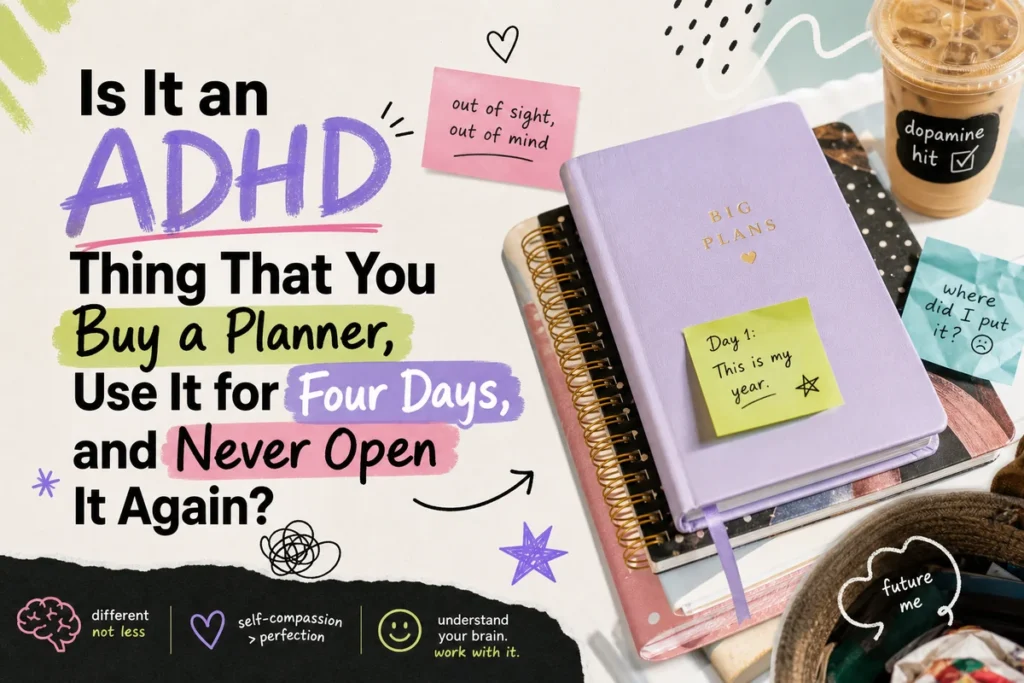
You bought the planner in January. The good one. The one with the thick paper and the layout that finally made sense. You spent an evening setting it up: colour-coded sections, stickers from the pack you'd been saving, your goals written in your best handwriting. For four days, you used it religiously. You felt organised. You felt like a person who has their life together. And then you stopped opening it. Now it sits in a drawer, or on a shelf, or buried under papers on your desk. You've walked past it a hundred times. You've felt a small pulse of guilt each time. You've also bought two more planners since then.
Yes, this is an ADHD thing. It has a name: novelty-dependent dopamine activation. Your brain doesn't run on obligation or routine the way neurotypical brains do. It runs on interest, urgency, novelty, and challenge. A new planner delivers novelty in concentrated form. The purchase, the unboxing, the setup: all of it floods your reward system with dopamine. That hit sustains engagement for a predictable window, usually three to seven days. When the novelty fades, the dopamine dries up. The planner becomes invisible to your motivation system. This is why your ADHD planner doesn't work after the first week, and why there is a drawer in your house that functions as a productivity tool graveyard.
Why Your Brain Loved the Planner (For Four Days)
The dopamine system in ADHD brains responds differently to reward and motivation than in neurotypical brains. Specifically, the prefrontal cortex and the nucleus accumbens, which regulate reward anticipation and task engagement, show altered dopamine signalling patterns. What this means in practical terms: your brain needs stronger, more novel stimuli to generate the same level of engagement that a neurotypical person gets from routine.
When you bought that planner, your brain received a dopamine hit from the anticipation of the organised life you were about to build. Setting it up delivered another hit: the creative task, the colour choices, the sense of possibility. Using it for the first few days delivered smaller but still noticeable hits: the satisfaction of crossing things off, the feeling of control. Each day the system becomes more familiar, the dopamine yield decreases. By day four or five, using the planner feels like any other obligation. And obligation without novelty is nearly impossible for an ADHD brain to sustain.
The ADHD Productivity System Graveyard
If this pattern sounds familiar, you probably have a collection. Paper planners. Digital apps. Bullet journals. Notion templates. Kanban boards. Pomodoro timers. Habit trackers. Each one worked for a week. Maybe two. Then they joined the pile.
Research on ADHD and cognitive offloading confirms that people with ADHD rely heavily on external systems: planners, reminders, physical cues in the environment. This compensation strategy makes sense given the working memory deficits that characterise ADHD. The problem is that the systems themselves require consistent engagement, and consistent engagement requires dopamine, and dopamine in an ADHD brain is chained to novelty.
The challenge isn't finding the right system. It's that every system eventually becomes the wrong system once it stops being new.
This creates a brutal loop. You need external systems to compensate for working memory issues. But your dopamine system sabotages long-term use of any single system. So you keep buying new ones, hoping the next one will be different. It never is. Not because the system was bad, but because your brain used it up.
Why the Standard Advice Fails for ADHD Brains
The standard productivity advice: pick a system and stick with it. Build the habit. Discipline yourself until it becomes automatic. This advice assumes a neurotypical dopamine system. It assumes that repetition leads to automaticity, and automaticity makes the task easier. For neurotypical brains, this is often true. The more you do something, the less mental energy it requires, and eventually it becomes effortless routine.
For ADHD brains, repetition without novelty leads to boredom, and boredom leads to complete task blindness. The planner doesn't become easier to use. It becomes invisible. Your brain stops registering it as something that exists. You can walk past it ten times in a morning and genuinely not see it. This is not a metaphor. ADHD affects visual attention and object permanence in practical, measurable ways. Out of sight, out of mind is a neurological reality, not a personal failing.
Why "just be consistent" doesn't work: Consistency requires routine. Routine kills novelty. Novelty is the fuel source for ADHD task engagement. Telling an ADHD person to just stick with a system is like telling them to drive a car without petrol.
The Novelty Cycle Is Predictable
Here's the part nobody tells you: the cycle has a rhythm. For most ADHD adults, the novelty window for a new system is roughly three to ten days. After that, engagement drops sharply. This isn't random. It's a predictable curve. Once you know the curve exists, you can work with it instead of against it.
The worst thing you can do is fight the drop. When you feel your engagement slipping, pushing harder usually accelerates the abandonment. You associate the system with effort, guilt, and failure. The next time you see the planner, those associations activate. Now the system is not just boring but aversive. This is how planners go from "I should use this" to "I can't even look at this."
The best thing you can do is expect the drop. Plan for it. Build rotation into your approach. Accept that you might need three different systems running in parallel, cycling through them as novelty dictates. This feels inefficient. It also actually works.
What Actually Helps When Your ADHD Planner Doesn't Work
First, stop trying to find the perfect system. The perfect system does not exist for you. Any system that works will work temporarily. Your job is to extend that window slightly and build in recovery mechanisms for when it closes.
Second, add artificial novelty. Change the pen you use every week. Move the planner to a different location. Add a new sticker section. Change the colour coding. These feel like trivial modifications, and they are. They also work because your brain is genuinely that responsive to small changes. The bar for novelty is lower than you think.
Third, use the planner for one thing only. Most planners fail because they become obligation repositories: everything you should do, in one place, staring at you. This triggers overwhelm, which triggers avoidance. Instead, give the planner a single, narrow function. Only appointments. Only the one most important task per day. Only meal planning. A planner that does one thing is easier for your brain to engage with than a planner that represents your entire life.
Your drawer full of abandoned planners is not evidence of failure. It's evidence that you keep trying to solve a real problem with the wrong diagnosis. The problem was never discipline. The problem was always dopamine.
The Rotation Strategy for ADHD Productivity Systems
Many ADHD adults find success with deliberate system rotation. This means having multiple tools that serve similar functions and cycling between them as novelty dictates. One week you use the paper planner. The next week you switch to a digital app. The week after that, maybe a whiteboard. When you feel engagement slipping with one tool, you switch to another. When you've cycled through all of them, the first one has had time to feel new again.
This strategy works because it stops treating system abandonment as failure. Instead, it treats novelty depletion as a predictable event that you can manage. You're not quitting the planner. You're rotating out of it temporarily. The language shift matters. It removes the guilt and shame that usually accompany abandonment, which makes it easier to return to the tool later.
Some people resist this approach because it feels chaotic or inefficient. They want one system that works forever. That desire is understandable, but it's also at odds with how your brain actually functions. Working with your neurology beats fighting it every time.
Try the touch rule: When you're struggling to use a planner, lower the bar to literally just touching it once a day. Open it, look at it for three seconds, close it. This maintains the neural pathway without requiring engagement. When novelty returns, you can scale back up.
Executive Function and the Organisation Paradox
Here's the deeper issue: planners are tools that require executive function to use. They require you to remember they exist, to initiate the task of using them, to sustain attention while writing, and to follow through on what you've written. Every one of those steps is an executive function skill. ADHD is fundamentally an executive function disorder.
This means planners ask you to use the exact cognitive skills that are most impaired by your condition. It's like asking someone with a broken leg to use a stair-climbing machine for rehabilitation. Technically possible. Also fundamentally mismatched to the reality of the injury.
The planners that work best for ADHD tend to be the simplest ones. Minimal pages. Minimal decisions. Minimal cognitive load at each step. The beautiful spreads and complex layouts that attract you at the store are often the first to fail because they require the most executive resources to maintain. Something ugly and boring with one line per day might actually serve you better, even though it's less exciting to buy.
Reframing the Pattern
You have likely been telling yourself a story: "I'm bad at being organised. I can never stick with anything. I always give up." This story is wrong, and it's also corrosive. It converts a neurological pattern into a character flaw, which makes you feel worse about yourself and less likely to try new approaches.
The accurate story: your brain has a different relationship with novelty than most brains. Systems that rely on routine and consistency are fundamentally mismatched to how you work. When a planner stops working, it's not because you failed. It's because the tool ran out of the fuel your brain requires. This is a design problem, not a you problem.
The drawer full of abandoned planners is not a shrine to your failures. It's evidence that you keep trying to solve a real executive function gap with tools built for different brains. The solution is not to try harder with the same tools. The solution is to find tools and strategies that account for novelty dependence from the start.
Start with what's in the drawer. Pick one planner. Open it to today's date. Write one thing. Just one. Do not set up an elaborate system. Do not commit to using it forever. Use it until novelty fades, then rotate to something else. The goal is not permanent consistency. The goal is functional engagement, however you can get it, for as long as you can sustain it.
Rate this article
Was this a useful hit?