Is It an ADHD Thing That You Were a Perfect Employee for Three Weeks and Then Completely Lost Interest?

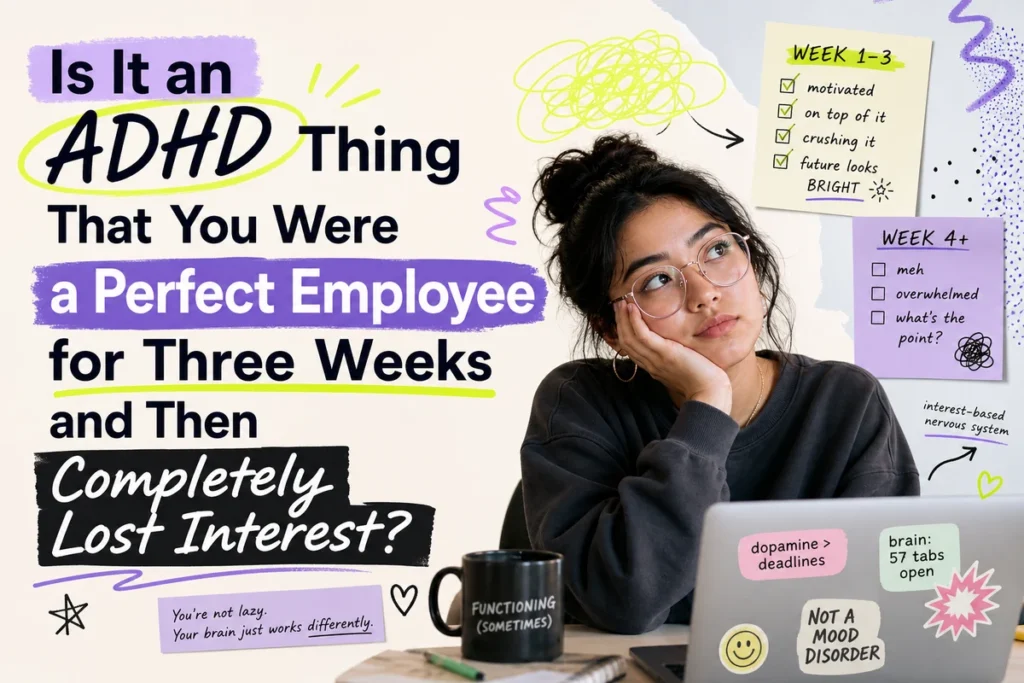
You remember those first three weeks. You arrived early. You took detailed notes in meetings and actually read them afterwards. You responded to emails within the hour. Your manager mentioned how impressed they were with your onboarding. You thought: maybe this time. Maybe this is the job where I finally become the person I know I can be. You bought a new planner. You colour-coded your task list. You felt, for the first time in years, like you had figured something out.
Then week four hit. The alarm felt heavier. The inbox felt like a wall. That task list you colour-coded sat untouched because opening it required energy you no longer had. You started arriving exactly on time, then five minutes late, then logging in remotely just to avoid the commute. The work itself hadn't changed. Nothing external had shifted. But something inside you had simply... turned off. And now you're Googling "ADHD job performance inconsistent" at 2am, wondering if this is a pattern or just proof that you're fundamentally unreliable.
Yes, This Is an ADHD Thing: Novelty-Dependent Dopamine Engagement
What you experienced has a name: novelty-dependent dopamine engagement. The ADHD brain doesn't produce dopamine in response to importance, deadlines, or professional consequences. It produces dopamine in response to newness, interest, urgency, and challenge. Those first three weeks weren't a fluke or a trick you played on your employer. That engagement was real. Your brain was genuinely lit up because everything was new: new systems to learn, new people to impress, new problems to solve, new environments to navigate.
The cruel part is that novelty has a half-life. Once the systems become familiar, the people become predictable, and the problems become repetitive, your brain stops releasing the dopamine it needs to engage. This isn't laziness. This isn't a lack of willpower. This is your neurological reward system functioning exactly as it was built to function, in an environment that wasn't designed for it.
Why ADHD Job Performance Is Inconsistent: The Neuroscience
The dopamine system in ADHD brains is structurally different. Research has consistently shown reduced dopamine receptor availability in the striatum and prefrontal cortex in people with ADHD, particularly in areas responsible for motivation and reward processing.1 What this means in practice is that the ADHD brain requires more intense stimulation to achieve the same level of engagement that neurotypical brains get from ordinary tasks.
Novelty provides that intense stimulation automatically. When something is new, the brain treats it as potentially important information worth attending to. Every new colleague could be a threat or an ally. Every new system could be a puzzle worth solving. Every new routine could be the one that finally works. This uncertainty keeps the dopamine flowing because the brain hasn't yet determined what's safe to ignore.
But brains are efficiency machines. They're designed to habituate: to learn what's predictable and stop wasting energy on it. For neurotypical brains, this habituation happens alongside a stable baseline of motivation. For ADHD brains, habituation means the dopamine supply gets cut off entirely. The task doesn't become easier to do automatically; it becomes nearly impossible to start.
The employee who was perfect for three weeks and then "lost interest" didn't lose interest. Their brain lost access to the neurochemical it needed to convert intention into action.
The Three-Week Cliff: Why That Timeline Keeps Repeating
You may have noticed this isn't the first time. Different jobs, different industries, different managers, but the same timeline: two to four weeks of peak performance, then a sharp decline. This isn't coincidence. The three-week mark is roughly when the brain has mapped enough of the new environment to stop treating it as novel. The major systems have been learned. The key relationships have been established. The daily routine has become predictable.
For people experiencing ADHD novelty burnout at work, this cliff edge is almost universal. Some people hit it at two weeks. Some get six. But the pattern is remarkably consistent: a period of genuine high performance followed by a crash that feels like personality failure but is actually predictable neurology.
The problem is that workplaces interpret consistency as reliability and inconsistency as a character flaw. No one considers that your brain might be running on a completely different fuel source than the person at the next desk. When you were crushing it in week two, you weren't faking. When you're struggling in week five, you're not slacking. You're experiencing the natural trajectory of a nervous system that wasn't designed for sustained, routine engagement.
Why Standard Career Advice Makes It Worse
The advice you've received hasn't worked because it assumes a neurological baseline you don't have. "Just push through" assumes willpower is a renewable resource and that difficulty engaging is a motivation problem solvable by trying harder. For the ADHD brain, trying harder without dopamine is like trying to drive a car without fuel: you can push the accelerator all you want, but the engine doesn't have what it needs to respond.
"Find your why" assumes that connecting a task to a larger purpose generates motivation. This works for neurotypical brains because their dopamine system can be activated by abstract, future-oriented rewards. ADHD brains have a now/not-now processing style: if the reward isn't immediate and tangible, it doesn't register as motivating, regardless of how important it is intellectually.
"Build better habits" assumes that repetition creates automaticity, which creates ease. For ADHD brains, repetition often creates the opposite: boredom-induced paralysis. The more familiar something becomes, the harder it can be to start, because the brain no longer receives novelty-based dopamine and hasn't learned to generate motivation through other means.
The real problem: You've been trying to solve a dopamine deficiency with willpower. That's like trying to solve dehydration by concentrating harder. Your brain needs a different approach.
What Actually Helps: Manufacturing Novelty
If your brain runs on novelty and your job has become predictable, the solution isn't to force engagement with the predictable. The solution is to introduce artificial novelty into the familiar structure. This isn't about making tasks fun in a patronising way. It's about giving your brain the stimulation it needs to produce the dopamine required for engagement.
Change the where. If you've been working at the same desk, try a different location: a coffee shop, a library, a different room in your house. The environmental change creates low-level novelty that can reanimate tasks that felt dead.
Change the how. If you've been responding to emails in the same order, reverse it. If you've been using the same software, switch to a different one for a week. If you've been working in silence, try music. If you've been using music, try silence. The shift itself matters more than what you shift to.
Change the with. Working alongside someone else, even if you're doing completely different tasks, introduces social novelty. Body doubling, as this practice is called, has become a core strategy in ADHD productivity because the presence of another person adds just enough unpredictability to keep the brain engaged.
Change the when. If you've been doing the hard tasks first thing in the morning, try doing them after lunch. If you've established a routine, deliberately break it for a day. For the ADHD brain, predictability is the enemy, even when the predictability seems efficient.
ADHD Interest Fade and the Myth of Being "Unreliable"
The shame of ADHD interest fade is that it looks, from the outside, like unreliability. Your manager remembers the employee from week two. Your colleagues remember the person who had energy and ideas. When that version of you disappears, the interpretation is that you were performing or that you gave up or that you just don't care enough.
But consider the evidence. You weren't trying to be impressive in week two; you genuinely were engaged. The work felt interesting, the people felt intriguing, and the tasks felt doable. You weren't performing motivation; you had motivation because your brain was chemically equipped to produce it. When that engagement disappeared, you didn't choose to withdraw it. The choice was never available. Your brain simply stopped supplying what you needed.
Calling someone with ADHD unreliable because they can't sustain novelty-driven engagement is like calling someone with myopia unreliable because they can't see clearly without glasses. The limitation is real. The character judgment is not.
This reframe matters because self-perception shapes behaviour. If you believe you're fundamentally flaky, you stop trying to find systems that work. If you understand that your engagement is dopamine-dependent and that dopamine requires specific conditions, you can start engineering those conditions instead of white-knuckling through their absence.
Working With Your Neurology, Not Against It
For people whose ADHD job performance is inconsistent, sustainability doesn't come from eliminating the novelty requirement. It comes from building a life that supplies novelty consistently.
Some people with ADHD thrive in jobs with built-in variety: roles where the tasks change frequently, where there's travel involved, where projects have clear endpoints and new beginnings. If you keep burning out in stable, routine positions, this isn't a sign that you're unsuited for work. It's data about what kind of work your brain is suited for.
Some people introduce novelty artificially through the methods described above: rotating environments, changing tools, varying schedules. This requires more active management but can make routine positions survivable.
Some people layer external accountability onto their work: checking in with a colleague, using a body doubling service, or working with a coach who provides the just-in-time structure that ADHD brains often can't generate internally. This external scaffolding isn't weakness; it's accommodation.
ADHD dopamine and novelty: Your brain isn't broken. It's running on a different reward system. The goal isn't to fix the system but to feed it what it needs.
The Late Discovery Complication
If you've recently discovered your ADHD, you're now looking back at a career of patterns that finally make sense. Every job where you burned bright and then burned out. Every project where you were indispensable in the beginning and invisible by the end. Every performance review that said "great potential, inconsistent execution." You weren't failing at being an employee. You were succeeding at having a brain that nobody taught you how to work with.
Late discovery often comes with grief, but it also comes with permission. Permission to stop treating your nervous system like a broken neurotypical brain and start treating it like an ADHD brain that needs specific conditions to thrive. Permission to seek out environments that provide natural novelty. Permission to build artificial novelty into environments that don't. Permission to stop apologising for a pattern that was never a choice.
Where to Go From Here
The next time you feel that familiar fade starting, around week two or three of something new, try naming it out loud: "Ah, the novelty cliff." This simple act of recognition disrupts the shame spiral that usually follows. You're not sliding backwards because you're flawed. You're experiencing a predictable neurological transition that requires a strategic response.
The response isn't to push harder. The response is to change something: the environment, the method, the timing, the company. Introduce novelty before the cliff arrives. Build in variety before the routine sets in. Treat your need for newness as a design requirement, not a character defect.
Your ADHD job performance will likely always be inconsistent compared to neurotypical baselines. But inconsistent isn't the same as unreliable. It means your engagement is conditional on certain inputs. Once you know the conditions, you can start providing them. That's not a workaround. That's just working with your brain instead of against it.
1 Volkow, N. D., et al. (2009). Evaluating dopamine reward pathway in ADHD: clinical implications. JAMA, 302(10), 1084-1091.
Rate this article
Was this a useful hit?