Is It an ADHD Thing That You Remember Every Embarrassing Thing You Ever Did but Cannot Remember What You Had for Breakfast?

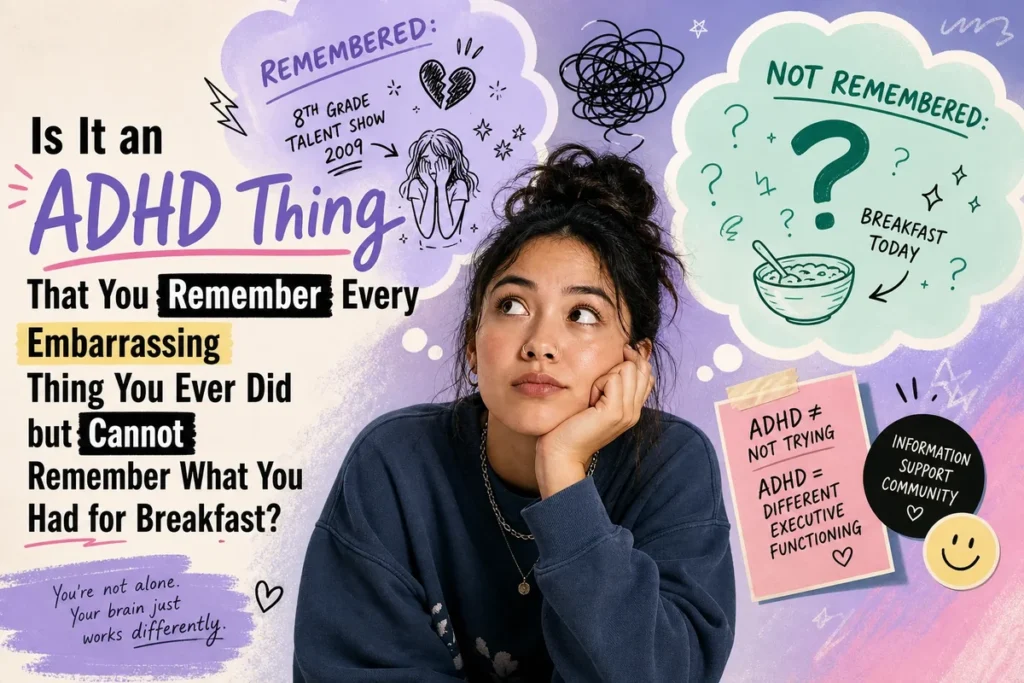
You are lying in bed at 2 AM, trying to sleep, when your brain decides now is the perfect time to replay that thing you said at a party in 2011. The exact words. The exact facial expression of the person you said it to. The temperature of the room. You can feel the shame as if it happened thirty seconds ago, not thirteen years ago. Meanwhile, you genuinely cannot remember what you had for breakfast this morning. Was it toast? Cereal? Did you even eat breakfast? You have no idea. You remember a random Strongbad video from 2003 with crystal clarity, but your own meal from six hours ago is simply gone.
Yes, this is an ADHD thing. It is called differential emotional memory encoding, and it explains why your brain treats embarrassing moments like permanent archives while letting neutral information evaporate. Your ADHD emotional memory system works differently from your working memory, and understanding this paradox changes how you relate to both.
The ADHD Memory Paradox Nobody Talks About
People assume memory is one thing. Either you have a good memory or you do not. But memory is actually several different systems, and ADHD affects them unevenly. Your working memory, which handles recent neutral information like what you ate or where you put your keys, is genuinely impaired. Research consistently shows that people with ADHD have working memory deficits across both verbal and visuospatial domains, struggling to hold and manipulate information in the moment.1
But your emotional memory? That system is not impaired. In fact, it may be hyperactive. The same brain that cannot hold onto "I put my phone on the kitchen counter" for more than thirty seconds will encode "I mispronounced that word in front of my crush in 2008" with the fidelity of a 4K video recording. This is not a contradiction. It is two different memory systems being affected in opposite ways by the same underlying neurology.
The problem is that most people, including many clinicians, do not understand this paradox. They see you recall vivid details from years ago and assume your memory is fine. They do not realise you are not choosing what to remember. Your brain is making those choices for you, based on emotional intensity rather than practical relevance.
Why ADHD Emotional Memory Burns So Bright
The amygdala is your brain's emotional tagging system. When something happens that triggers strong emotion, particularly negative emotion like shame, fear, or embarrassment, your amygdala essentially stamps that memory with a red flag that says "IMPORTANT: SAVE FOREVER." This is an ancient survival mechanism. Our ancestors needed to remember where the predator attacked, not what berries they ate on a random Tuesday.
In neurotypical brains, this system has some calibration. The prefrontal cortex, the part of the brain responsible for executive function, helps regulate emotional responses and provides context. It might tell the amygdala, "Yes, that was embarrassing, but it was also minor and nobody actually cared."
In ADHD brains, this regulation is weaker. The prefrontal cortex is already working overtime just to manage attention and impulse control. It has fewer resources to spare for dampening emotional intensity. So the amygdala tags memories with the same urgency it would use for a genuine threat. That mildly awkward thing you said at a networking event gets encoded with the same emotional weight as a near-death experience.
Your brain does not distinguish between social embarrassment and physical danger when it comes to memory storage. Both get the red-flag treatment.
This is why you can recall the exact wording of a text message you sent in 2015 that you worried might have sounded rude. The emotional charge at the moment of encoding was high enough to bypass your impaired working memory and go straight into long-term storage.
Why Breakfast Disappears Into the Void
Now contrast that with breakfast. You sat at your kitchen table. You ate something. It was probably fine. There was no emotional intensity. No shame. No fear. No excitement. Just neutral sensory information: the taste of food, the texture, the time on the clock.
This neutral information relies entirely on your working memory to be encoded. And your working memory is the exact system that ADHD impairs most severely. Without an emotional tag to flag it as important, the breakfast data gets processed like spam email: briefly acknowledged, then deleted before it can reach long-term storage.
It is not that you were not paying attention during breakfast. You may have been fully present, enjoying your food, completely engaged in the moment. But engagement is not enough for encoding when your working memory has a hole in the bottom of the bucket. The experience flows through, and nothing sticks.
Working Memory vs Emotional Memory: Working memory handles neutral, recent information and is impaired in ADHD. Emotional memory handles intense experiences and is often hyperactive in ADHD. They are separate systems with opposite problems.
This explains the maddening inconsistency that makes people doubt your ADHD. How can you remember a random video from twenty years ago but not where you parked your car an hour ago? Because the video was funny. It made you laugh. Your amygdala flagged it. The parking spot was neutral. Your working memory dropped it immediately.
The Late-Night Embarrassment Replay Loop
There is a specific cruelty to how ADHD emotional memory works at night. During the day, your brain is busy. It has tasks, distractions, inputs. The embarrassing memories are still there, but they are competing with other stimuli. At night, when external input drops to near zero, there is nothing to compete with. Your brain, seeking stimulation in the dark, goes digging through its archives. And guess what it finds first? The files with the biggest red flags. The embarrassments. The regrets. The things you said wrong.
This is not rumination in the clinical sense, though it can overlap with anxiety and depression. It is your dopamine-seeking brain, deprived of external stimulation, turning inward and grabbing whatever is most emotionally charged. The memories that hurt are also the memories that generate the strongest neurological response. Your brain is essentially doomscrolling through your own past.
For people with late discovery ADHD, this often includes a lifetime of accumulated embarrassments that they never had context for. Every time they were "too much" or "too sensitive" or "too weird," their amygdala was dutifully encoding the moment for future retrieval. Now they have a mental library of shameful moments, all filed under "proof that something is wrong with you," and their brain pulls these files automatically when there is nothing else to do.
Why Standard Memory Advice Fails for ADHD
Typical memory advice assumes a balanced system. "Pay more attention." "Write things down." "Create a memory palace." These strategies assume your working memory is functional enough to participate in the encoding process. For ADHD brains, this assumption is flawed.
Telling someone with ADHD to "pay more attention" to remember breakfast is like telling someone with a broken bucket to "hold water more carefully." The problem is not effort. The problem is the container. No amount of attention will fix a working memory deficit in the moment.
You cannot attention your way out of a neurological impairment. External systems are not crutches. They are accommodations for a real disability.
Similarly, strategies for reducing rumination often focus on cognitive reframing: telling yourself the embarrassing moment was not that bad, that nobody remembers it, that you are being too hard on yourself. These strategies work for neurotypical brains where the prefrontal cortex can successfully downregulate emotional intensity. For ADHD brains, the emotional tag is already burned into the memory. Trying to talk yourself out of the feeling is like trying to un-highlight a page after the highlighter has dried.
This does not mean nothing helps. It means the things that help are different from what most advice suggests.
What Actually Helps With ADHD Emotional Memory
The first shift is understanding. Knowing why your brain does this removes the self-blame. You are not dwelling on embarrassing moments because you are dramatic or narcissistic. Your amygdala is doing exactly what it was designed to do: flag emotionally intense experiences for long-term storage. The problem is miscalibration, not character flaw.
For working memory, external systems are essential. You do not need to remember what you had for breakfast. You need your phone to remember. Photos of meals. Notes in a daily log. Calendar entries. These are not workarounds for laziness. They are legitimate accommodations for a neurological difference. People who need glasses do not apologise for wearing them. People with ADHD working memory deficits should not apologise for using external memory systems.
External Memory Systems: Photos, notes, and logs are not crutches. They are the glasses for your working memory impairment. Use them without shame.
For ADHD emotional memory, particularly the late-night embarrassment loops, interruption is more effective than reframing. When an old memory surfaces, naming what is happening can break the automatic emotional response. "This is my amygdala pulling up a flagged file. This is a memory, not a current event. I am safe right now." This does not erase the memory. It creates a thin layer of distance between you and the emotional intensity.
Physical interruption also works. Getting out of bed, turning on a light, drinking cold water, doing fifteen jumping jacks. These actions force your brain to process new sensory information, giving it something else to attend to. You are essentially giving your stimulation-seeking brain something other than old embarrassments to chew on.
Some people find it helpful to "complete" old embarrassments by imagining a different ending, forgiving their past self explicitly, or even writing the memory down and then throwing the paper away. These rituals do not change the memory itself. They add a new layer to it: a memory of processing the memory. Over time, this can reduce the automatic emotional charge when the original memory surfaces.
The Upside of ADHD Emotional Memory
This system is not all downside. The same mechanism that burns embarrassments into your brain also preserves intensely positive moments. The first time someone you loved said they loved you back. The moment you finished something you worked hard on. The time you laughed so hard you could not breathe. These memories are also flagged and preserved with unusual clarity.
Your brain does not only store negative emotional experiences. It stores intense emotional experiences. The negative ones just tend to surface more often because of the negativity bias built into human survival instincts. But deliberately recalling positive emotional memories, or creating new ones by adding emotional weight to moments you want to remember, can shift the balance over time.
This is not toxic positivity or gratitude journaling. It is strategic use of a neurological quirk. If your amygdala is going to flag and preserve emotionally intense moments, you can sometimes influence which moments get flagged by being more emotionally present during positive experiences. Notice when something good is happening. Let yourself feel it fully. Give your brain something other than shame to archive.
Living With Two Memory Systems
The ADHD memory paradox is real, it is neurological, and it is not your fault. You are not broken for remembering a random video from 2003 while forgetting your own breakfast. You are living with a brain that has one impaired memory system and one hyperactive memory system, and nobody taught you how to work with both.
External systems handle the working memory gaps. Interruption and naming handle the emotional memory loops. Understanding handles the shame of being inconsistent. None of this is about fixing yourself. It is about accommodating a brain that processes memory differently from what mainstream advice assumes.
The next time your brain decides to replay that awkward moment from a decade ago, you can recognise what is happening: your amygdala doing its job, a little too well, with a little too much enthusiasm. And the next time you forget what you ate for breakfast, you can recognise that too: your working memory doing its job, a little too poorly, because the bucket has holes. Both are true. Both are ADHD. Neither is a character flaw.
Rate this article
Was this a useful hit?