Is It an ADHD Thing That You Interrupt People Even Though You Are Genuinely Trying Not To?

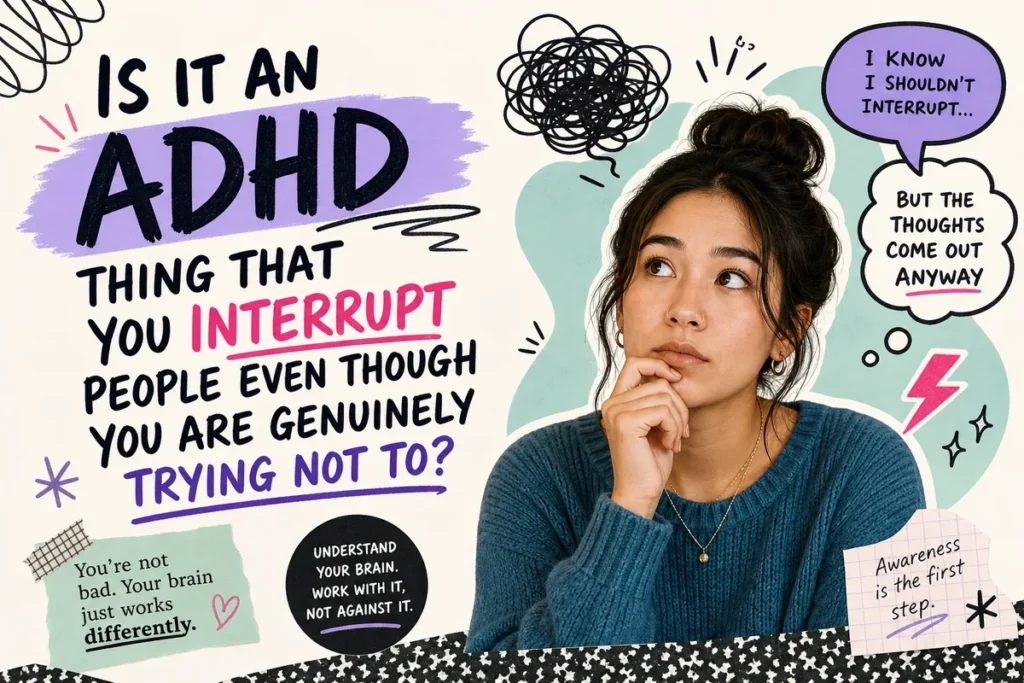
You're in a conversation, fully engaged, genuinely interested in what the other person is saying. You're nodding, you're tracking, you're being a good listener. And then a thought appears in your head. Maybe it's a connection to what they just said. Maybe it's a question you want to ask. Maybe it's something completely tangential that your brain decided was urgent. You feel the thought starting to escape. You try to hold it. You're actively telling yourself to wait. But the words are already leaving your mouth, cutting across their sentence, and now you're watching their face shift into that familiar expression: somewhere between surprise and irritation. Again.
Yes, this is absolutely an ADHD thing. What you're experiencing is called impulsive verbal intrusion, and it happens because of two overlapping deficits: impulse control and working memory. Your brain registers the thought as perishable, something that will vanish in seconds if not spoken. At the same time, the part of your brain responsible for behavioural inhibition simply cannot respond fast enough to stop the words. The intention to wait is completely real. The capacity to execute that intention in the moment is not available.
Why ADHD Interrupting Conversations Feels Physically Impossible to Stop
Here's what neurotypical people don't understand: for them, holding a thought while someone else speaks is effortless. They can tuck the idea into a mental queue, wait for a natural pause, and retrieve it later. The thought doesn't feel like it's actively dissolving. The waiting doesn't feel like holding water in a sieve.
For ADHD brains, working memory operates differently. The "queue" where thoughts are supposed to wait is smaller, more volatile, and constantly being overwritten by incoming information. When a thought enters your mind during conversation, it immediately feels urgent because your brain knows, from experience, that it will not be there in ten seconds. Possibly not in five.
This is why ADHD interrupting conversations isn't about disrespect or selfishness. It's about a genuine neurological limitation that creates impossible choices: speak now and appear rude, or wait politely and lose the thought entirely. The research on ADHD and language production consistently shows that people with ADHD have "overall organizational problems" with speech timing, including difficulties with knowing when to initiate conversations and when to hold back.
The rapid-fire speech of an individual with ADHD leaves little room for others who might want to participate in the conversation.
That quote from CHADD captures something essential: this isn't just about individual interruptions. It's about a fundamentally different conversational rhythm that ADHD brains create, often without conscious awareness.
The Thought Feels Like It Will Die If You Don't Say It
Non-ADHD people sometimes ask: "Can't you just write it down and wait?" The answer is theoretically yes, but practically, the time it takes to find paper, pen, and write down the thought is longer than the thought's shelf life in working memory. By the time you've written two words, you've forgotten what you were writing.
More importantly, the internal pressure to speak isn't rational. It's not a considered decision. It's a reflex driven by your brain's panic response to anticipated loss. The thought doesn't feel like "I should say this at some point." It feels like "this thought is leaving my brain right now and I must speak it before it vanishes forever."
This is why trying harder doesn't work. The advice to "just wait" assumes that waiting is a matter of willpower. But you can't willpower your way into a larger working memory capacity. You can't decide to have better impulse control through sheer determination. What you can do is build external systems and physical strategies that buy your brain the extra seconds it needs.
The four-second threshold: Research shows silence becomes "awkward" for humans around the four-second mark. For ADHD brains, that four seconds can feel like an eternity. Practice extending your tolerance for conversational silence in small increments.
Why You Do It More With People You're Comfortable With
Here's something that might resonate: you probably interrupt strangers or authority figures less than you interrupt close friends and family. This isn't because you care about strangers more. It's because social anxiety around unfamiliar people activates your inhibitory systems in ways that genuine comfort does not.
When you're anxious, your brain is on high alert. That heightened state temporarily strengthens your ability to suppress impulses because your threat-detection system is actively monitoring for social danger. When you're relaxed with someone you love, that monitoring system stands down. And with it goes some of your inhibitory capacity.
This creates a painful irony: you interrupt most often around the people whose opinion matters most to you. The people you least want to hurt by interrupting are the people you interrupt most. And those people, reasonably, feel hurt. They might say things like "You don't listen to me" or "You only care about what you have to say." And you know, viscerally, that this isn't true. But you can't prove it, because the behaviour keeps happening.
The Shame Spiral After Interrupting
For many people with ADHD, the interruption itself is only half the problem. The other half is what happens immediately after.
You interrupt. You see their face. You realise what you've done. And then your brain floods with shame, self-criticism, and desperate over-explanation. "Sorry, I didn't mean to, I just thought of something, sorry, please continue, I'm listening now, I promise." Except now you're talking even more, which is technically more interrupting, and you can feel yourself making it worse with every word, and now you're not even sure what they were saying before you interrupted, and the whole conversation has derailed.
This shame response is particularly pronounced in people with ADHD who were late to their discovery. If you spent years being criticised for interrupting without understanding why you couldn't stop, that criticism became internalised. Every interruption now triggers not just present-moment embarrassment but echoes of every time someone called you rude, self-centred, or inconsiderate.
ADHD behaviours are often misperceived as disrespectful, lazy, careless, self-absorbed, or rude.
You are none of those things. Your brain processes conversation differently. That's the full explanation. It's not an excuse, because you're still responsible for working on it. But it is a reason, and the reason matters.
Why Standard Advice About ADHD Impulsivity Talking Fails
The advice most commonly given for ADHD impulsivity talking is some variation of: "Take a breath before you speak." This advice is well-intentioned but fundamentally misunderstands the problem.
By the time you could take a breath, the words are already out. The impulse to speak doesn't announce itself, politely wait for you to consider it, and then proceed. It just fires. The conscious awareness that you're about to interrupt often arrives after the first three words have left your mouth, not before.
Other common advice includes: "Focus on listening instead of on what you want to say next." This would be excellent advice if ADHD were a motivation problem. It's not. You are focusing on listening. You're doing everything you're supposed to do. The thought that interrupts is not something you're "focusing on." It's something that appears, unbidden, and demands expression.
The problem with most advice about ADHD social communication is that it assumes the ADHD person is doing something wrong that they could simply choose to do right. The actual situation is that the ADHD brain is executing a different operating system, one that processes conversation through different hardware with different limitations.
What Actually Helps With ADHD Blurting Out
The first thing that helps is explaining to the people closest to you what's actually happening. Not as an excuse, but as context. Something like: "When I interrupt you, it's not because I don't care what you're saying. It's because my brain registers thoughts as urgent and perishable in a way that makes waiting feel physically difficult. I'm working on it, and I need you to know it's not about you."
This won't make the interrupting stop. But it can change how the other person interprets it, which can change the dynamic between you.
Physical strategies can also help. Some people find that pressing their tongue to the roof of their mouth creates enough of a physical barrier to buy an extra second or two of delay. Others hold a pen and write a single keyword to preserve the thought, which reduces the panic-driven urgency to speak. Still others develop a hand signal with close conversation partners: a small gesture that means "I have something to say and I'm holding it."
The keyword anchor: When a thought appears, write one word. Just one. This takes less than two seconds and gives your brain permission to release the "urgent" flag on the thought. The thought is preserved. You can wait.
Medication, if you're someone who takes it, often helps with impulse control across the board, including verbal impulses. Many people report that stimulant medication creates a brief buffer between impulse and action, enough time to choose whether to speak. If you're not on medication or haven't discussed this symptom with your prescriber, it's worth mentioning.
The Mastering Awkward Silence Approach
Therapists often use a technique called "awkward silence" to create space for clients to think and speak without being led. The same technique can work in reverse for people with ADHD: deliberately practising longer silences in conversation to build tolerance for the discomfort.
Start small. During a low-stakes conversation, when you feel the urge to speak, count silently to four before allowing yourself to respond. Four seconds will feel like thirty. That's fine. The goal is to prove to your brain that thought don't actually evaporate as fast as it claims they do. Sometimes they do. But sometimes, if you wait four seconds, the thought is still there. And sometimes, if you wait four seconds, you realise the thought wasn't worth saying anyway.
This practice needs to happen in safe environments first. Don't try it in a high-pressure work meeting or during an argument with your partner. Try it with a friend who knows what you're working on, or during casual conversations where the stakes are genuinely low.
Interrupting Doesn't Mean You're Not Listening
One final thing worth understanding: interrupting is not evidence of not listening. In fact, many ADHD interruptions happen precisely because you were listening so intently that your brain made a connection it had to express. The interruption is proof of engagement, not absence.
The problem is that the other person doesn't experience it that way. From their perspective, they were speaking and you cut them off. Their experience is valid. Your experience is also valid. Both things can be true at once.
Working on ADHD interrupting conversations isn't about becoming a different person or pretending you don't have the thoughts that demand expression. It's about building enough of a buffer to choose when and how to express them. Some thoughts can wait. Some can be written down. Some genuinely do need to be said immediately. The skill is in developing enough space between impulse and action to make that judgment call, instead of your brain making it for you.
The next time you interrupt someone, try this: instead of spiralling into apology, simply say "Sorry, please continue." Then redirect your full attention back to them. The shorter your recovery time, the less disruption to the conversation. This isn't about being perfect. It's about getting back on track faster when the imperfect inevitably happens.
Rate this article
Was this a useful hit?