Is It an ADHD Thing That You Finally Got Into Flow at 11:47 PM and Now You Physically Cannot Stop?

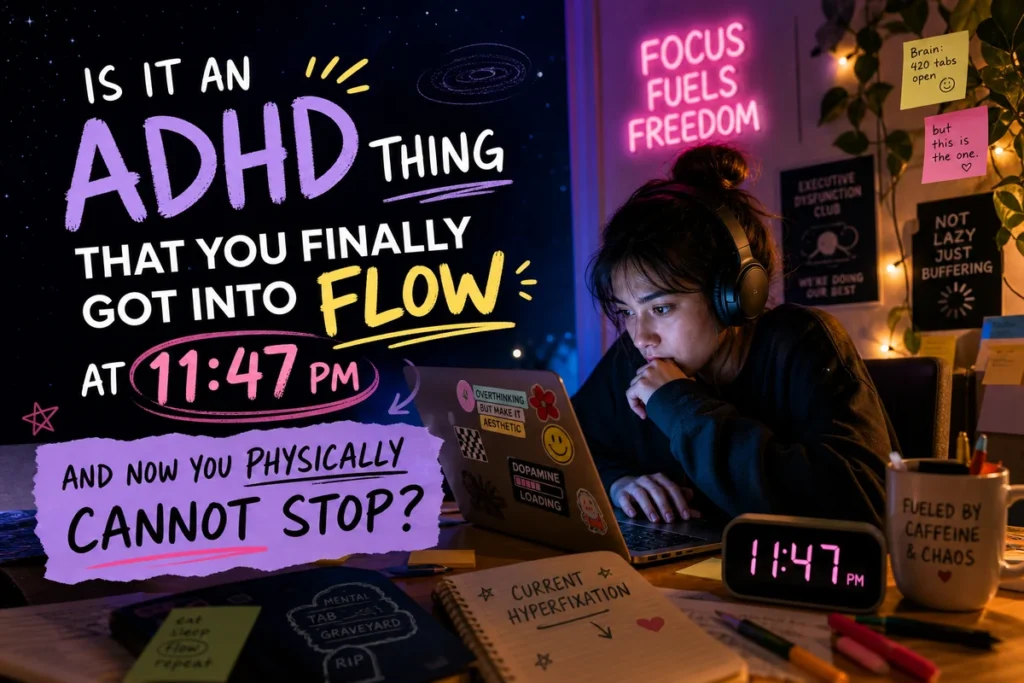
It's 11:47 PM and something has finally clicked. The document you stared at for six hours is suddenly writing itself. Your hands are moving faster than your thoughts. The code is flowing. The design is taking shape. The words are coming. You look up and it's 1:30 AM. You look up again and it's 3:15 AM. Your eyes are dry. Your back aches. You haven't eaten since noon. And yet the idea of stopping right now, when you're finally in it, feels physically impossible. Like asking you to hold your breath underwater. Like asking you to walk away from the only good thing that happened today.
Yes, this is an ADHD thing. You're experiencing a collision between hyperfocus and time blindness: two core features of the ADHD brain that combine at night to create a state where stopping isn't just difficult, it feels structurally impossible. There's a reason this happens after 11 PM and not at 2 PM, and it has nothing to do with discipline.
Why ADHD Hyperfocus at Night Feels Different
Hyperfocus is not a superpower you can summon. It's a state your brain falls into when the dopamine conditions are exactly right: the task is novel enough, the stakes feel immediate enough, and the world has finally stopped interrupting. At night, all three conditions converge. The emails stop coming. The notifications slow. The ambient pressure of "you should be doing something productive" lifts because technically the workday is over. Paradoxically, this is when your brain decides it's safe to engage.
ADHD hyperfocus at night also benefits from something researchers call "chronotype misalignment." Studies on ADHD and circadian rhythms show a strong correlation between ADHD and delayed sleep phase: your internal clock runs later than neurotypical clocks. Your cortisol peaks later. Your alertness peaks later. What the world calls "late" is what your biology calls "prime time."
When the house is quiet and the day's expectations have officially ended, the ADHD brain finally has permission to dive. And once it dives, it loses the ability to come up for air.
This is not poor self-regulation. This is dopamine doing exactly what dopamine does: locking onto a reward and refusing to let go until the reward is depleted or the body physically gives out.
The Time Blindness Problem
Here's the part that makes nighttime hyperfocus dangerous: once you're in it, time stops being a thing you can perceive. ADHD time blindness isn't metaphorical. Research from Russell Barkley and others shows that ADHD fundamentally impairs time perception at the neurological level. The prefrontal cortex, which handles time estimation, is underactive. The result is that you literally cannot feel time passing when you're engaged in something.
During the day, external cues interrupt this: meetings start, people knock, hunger becomes impossible to ignore because you're surrounded by reminders to eat. At night, those cues vanish. The only thing left is you and the task. And because ADHD time blindness flow state erases the normal feedback loop of "it's been two hours," you genuinely do not experience the passage of time. You think it's been forty minutes. It's been four hours.
Why clocks don't help: Even if there's a clock visible, the ADHD brain in hyperfocus deprioritises external information. You might glance at the time and immediately forget what you saw. The number doesn't carry weight because your brain is fully allocated to the task.
This is why you can look at your phone, see it says 2:34 AM, and feel nothing. The information enters your eyes but does not reach the part of your brain that makes decisions. You're in a tunnel, and time is happening outside the tunnel.
The Revenge Bedtime Connection
There's another layer to why this happens at night, and it's emotional. ADHD revenge bedtime procrastination isn't just a meme. It's a documented phenomenon where people who feel they had no control over their day reclaim time at night by staying up. The logic isn't conscious. It's more like: the day was not mine, but the night can be.
After spending all day fighting your brain to do things that didn't feel engaging, finally being in flow feels like justice. Your brain interprets stopping as losing the only real productivity you achieved. Why would you stop now, when you spent eight hours failing to start? The sunk cost fallacy merges with genuine dopamine reward. You keep going not because you're unaware it's late, but because stopping feels like wasting the only good part.
This is why telling yourself "I'll stop in ten more minutes" doesn't work. Your brain does not believe tomorrow will be as good as right now. And based on your lived experience, that belief is probably accurate. Tomorrow you might stare at this same document for six hours again and get nothing. Tonight, you're getting something. Your brain is not going to voluntarily exit that state.
The Missing Internal Stop Signal
Neurotypical brains have an internal stop signal. It's a function of executive control: the ability to interrupt your own behaviour, zoom out, and make a meta-decision about whether to continue. ADHD brains have a weakened version of this signal. When hyperfocus is active, the signal is essentially muted.
Think of it like a car with a faulty fuel gauge. You're driving and the needle says full. It keeps saying full even as the tank empties. Eventually you just run out and stop suddenly, not because you chose to stop, but because the resource depleted. That's what happens at 3 AM when your body finally forces the issue: your eyes physically cannot stay open, or you feel nauseous from exhaustion, or the sun starts coming up and the shock of daylight breaks the trance.
The ADHD brain doesn't stop tasks. Tasks stop the ADHD brain. The difference matters because it explains why willpower alone is not a solution.
You're not choosing to stay up until 3 AM. You're experiencing the absence of a neurological mechanism that would allow you to choose otherwise. The shame you feel the next day is misplaced. You weren't being irresponsible. You were being trapped in a dopamine loop without an exit.
Why Standard Sleep Advice Fails Completely
Every sleep article will tell you to stop screens an hour before bed. Put your phone outside the bedroom. Establish a wind-down routine. These suggestions assume you have a predictable relationship with when flow will hit. They assume you can schedule your productivity.
ADHD productivity at night is not scheduled. It arrives without warning, often in the final hours of what was supposed to be a wasted day. By the time you realise you're in flow, you've already missed the window to "not start something engaging after 9 PM." You didn't start it. It started you.
The advice to "just stop" also ignores the genuine cost of stopping. If you've been trying to make progress on something for days and finally cracked it at 11:30 PM, stopping means gambling that you'll be able to access that state again tomorrow. For ADHD brains, that gamble often loses. The flow state is rare. You don't waste it.
The real issue: Sleep advice is designed for people whose brains cooperate with intentions. ADHD brains don't work that way. External systems have to do the work that internal regulation cannot.
What Actually Helps
You need external interrupts that are strong enough to break hyperfocus. Internal reminders won't work. Alarms you can dismiss won't work. You need systems that force a physical change in your environment.
Set an alarm that is genuinely annoying and place the phone across the room. Not on vibrate. Loud. Embarrassingly loud. The goal is to make the alarm more disruptive than continuing the task is rewarding. When it goes off, you have to physically move, and that movement is sometimes enough to break the trance.
Create a "state save" ritual. Part of why stopping feels impossible is the fear that you'll lose your place. Before bed, even if it feels pointless, write down exactly where you were and what you were about to do next. One sentence. "Was about to add the third section about pricing." This gives your brain evidence that tomorrow-you will be able to pick up the thread. It lowers the stakes of stopping.
Use body-based cues instead of time-based cues. Set a hydration alarm that forces you to get up and refill water. The biological need to urinate will eventually become strong enough to interrupt. Build in physical stops because cognitive stops don't work.
If you know you're prone to ADHD hyperfocus at night, front-load the wind-down. Start your "before bed" routine at 9 PM, not 11 PM. Not because you'll be asleep by 10, but because it builds in buffer for the inevitable two hours you'll lose if flow hits.
The Permission Shift
Here is the reframe that actually matters: the problem is not that you have good creative hours at night. The problem is that you have no system for exiting those hours. Stop trying to fix the timing. Fix the off-ramp.
You are not broken for coming alive at midnight. Millions of years of evolution produced night-owl neurotypes because they were useful: someone needed to guard the camp while others slept. Your biology is not a disorder. The mismatch between your biology and a 9-to-5 world is the disorder.
What you need is not to stop being productive at night. What you need is a reliable way to preserve your work and exit the flow state before it costs you tomorrow. The goal is not perfect sleep hygiene. The goal is sustainable midnight sessions that don't wreck you.
Work with the brain you have. Build exits. Protect the flow, but give it a container so it doesn't flood everything else.
Tonight, before you start whatever you're about to start, set one alarm that you cannot ignore. Label it something that will actually register: "Tomorrow depends on this" or "Last call, for real." When it fires, save your place in one sentence. Then walk away. Not because the flow wasn't real, but because you've done this before, and you know what 4 AM costs you. ADHD hyperfocus at night is a feature. Burning out by dawn is the bug. Fix the bug. Keep the feature.
Rate this article
Was this a useful hit?