Is It an ADHD Thing That a Small Inconvenience Sends You Completely Over the Edge?

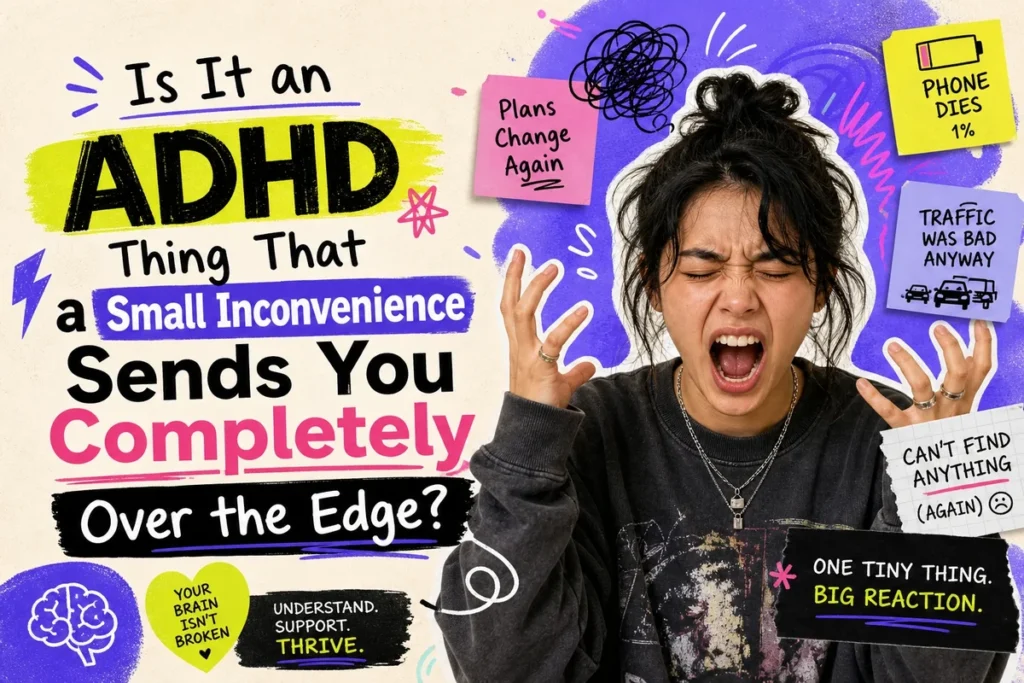
The WiFi drops for three seconds and you're suddenly gripping the edge of your desk, jaw clenched, heart pounding like someone just insulted your entire family. The pen you needed isn't in the drawer where you always keep it, and within moments you're yanking open every drawer in the house, slamming them shut, muttering things you'd never say out loud in public. Your partner makes an offhand comment about the dishes, something minor, neutral even, and you feel your chest tighten with a fury that makes no logical sense. Later, when the storm passes, you're left confused and exhausted. Why did that small thing feel so enormous? Why couldn't you just shrug it off like everyone else seems to?
Yes, this is an ADHD thing. It's called emotional dysregulation, and it's one of the most underrecognised core features of ADHD. The same executive function networks that help neurotypical brains regulate and modulate emotional responses are the exact networks that function differently in ADHD brains. Your reaction isn't irrational: it's proportional to your internal experience, even when it looks disproportionate to the external trigger.
ADHD Emotional Dysregulation Is a Core Feature, Not a Side Effect
For decades, the diagnostic criteria for ADHD focused almost exclusively on attention and hyperactivity. Emotional symptoms were treated as secondary, something that might tag along but wasn't central to the condition. This was a fundamental misunderstanding of how ADHD actually works in the brain.
Research has now established that emotional dysregulation is intrinsic to ADHD, not a comorbid condition or a personality quirk. The prefrontal cortex, which acts as your brain's executive control center, is responsible for both attention regulation and emotional modulation. When this region develops and functions atypically, as it does in ADHD, both capacities are affected. You can't separate the two.
The executive function system includes the ability to inhibit responses, to pause before reacting, to evaluate whether your emotional response matches the situation. In ADHD, this inhibitory function is impaired. Emotions arrive at full intensity with no buffer, no dimmer switch, no time to decide whether the response is warranted. The feeling hits you before you can think about it.
The inability to regulate emotional responses in ADHD isn't about weakness or immaturity. It's about neurobiology. The braking system that other people use automatically simply works differently in your brain.
Why Minor Frustrations Trigger Major Reactions
Here's what's actually happening when the WiFi drops and you feel like throwing your laptop across the room. Your brain is processing that minor inconvenience through a system that doesn't automatically downgrade its significance. Neurotypical brains perform a rapid, unconscious calculation: this is small, this doesn't threaten anything important, this doesn't require a strong response. That calculation happens in milliseconds, before the emotional response fully forms.
In ADHD, that calculation either doesn't happen, happens too slowly, or gets overridden by the raw emotional signal. The frustration arrives at the same intensity it would if something genuinely serious had occurred. Your nervous system responds to the dropped WiFi as if it were a genuine threat. Heart rate increases. Cortisol spikes. Muscles tense. You're in fight-or-flight over a three-second internet glitch.
This is compounded by something called frustration intolerance, which is particularly pronounced in ADHD. The research describes this as reacting to even minor frustrations with physical aggression or intense emotional responses. It's not that you have less patience than other people as a character trait. It's that your nervous system is wired to experience frustration more intensely and to struggle with the inhibitory processes that would normally soften that experience.
The Proportionality Paradox: Your emotional response IS proportional to what you're experiencing internally. The problem is that what you're experiencing internally is vastly more intense than the external trigger warrants. To observers, your reaction looks excessive. To you, it matches exactly what you're feeling.
The Accumulation Effect: Why It's Often Not Just About That One Thing
When you finally snap over something minor, it's rarely just about that one thing. ADHD brains are often running at a higher baseline level of stress due to the constant effort required to function in a world not designed for them. You've been compensating all day. Managing attention takes more effort. Remembering things takes more effort. Filtering out distractions takes more effort. Regulating your emotions in small ways throughout the day takes more effort.
By the time you get home and the pen isn't where it should be, your regulatory capacity is depleted. That pen becomes the final straw on a pile of straws that's been accumulating since you woke up. The explosion isn't really about the pen. It's about the fact that you've been doing invisible emotional labour for hours and you have nothing left in the tank.
This is why people with ADHD often notice their emotional reactions are worse when they're tired, hungry, overstimulated, or already stressed about something else. The regulatory system was already working at capacity. One more demand, even a tiny one, overloads it completely.
ADHD Emotional Sensitivity Makes Everything Hit Harder
Beyond the regulatory difficulties, there's evidence that people with ADHD may actually experience emotions more intensely in the first place. This is sometimes called emotional hyperreactivity. The feeling itself is bigger before any regulation even begins.
Think of it like a volume dial. If a neurotypical person experiences a minor frustration at volume 3, you might be experiencing it at volume 7 or 8. Even if you had identical regulatory capacity, you'd have more to regulate. But you don't have identical capacity. You have impaired regulation trying to manage amplified feelings. The math doesn't work in your favour.
This heightened emotional sensitivity isn't all negative. It's likely part of why many people with ADHD experience joy intensely, love deeply, and feel moved by art and music in ways that seem excessive to others. The dial goes both directions. But when the emotion is frustration, anger, or disappointment, that same sensitivity becomes a liability.
People with ADHD often describe feeling emotions physically: rage in the chest, disappointment like a weight, frustration like electricity under the skin. This isn't metaphor. The emotional experience is so intense it registers as bodily sensation.
Why Standard Advice About Emotional Regulation Fails
Most emotional regulation advice assumes you have time between the trigger and the response. Count to ten. Take a deep breath. Think about whether this will matter in five years. Walk away and cool down.
This advice doesn't account for what happens when the emotion arrives already at full intensity, when there is no gap between trigger and response, when the counting and breathing would have to happen in a fraction of a second to be useful. By the time you remember you're supposed to count to ten, you're already at eight on the anger scale.
The advice also often carries an implicit judgment: that you should be able to control this, that it's a choice, that you're simply not trying hard enough. This adds shame to the already overwhelming emotional experience. Now you're furious about the WiFi AND ashamed of being furious about the WiFi. Neither feeling is getting regulated.
Standard approaches also ignore the physiological reality of ADHD. This isn't a thinking problem you can think your way out of. Your nervous system is activated. Your stress hormones are elevated. Your prefrontal cortex is already offline, overwhelmed by the limbic system's alarm signals. Telling yourself to calm down is like telling yourself not to sneeze: the conscious mind has very little control over what's happening.
What Actually Helps With ADHD Emotional Dysregulation
Because the regulatory system works differently in ADHD, effective strategies need to work differently too. They need to either prevent the emotional surge from getting so large in the first place, or they need to intervene at the physical level since the cognitive level is already compromised.
Managing baseline stress is one of the most effective approaches. If you're already running at 60% capacity when you wake up, you have very little margin for the frustrations that will inevitably occur. Sleep, exercise, nutrition, medication if it's part of your treatment plan: these all affect your baseline. They don't eliminate emotional dysregulation, but they give you more buffer before you hit the threshold.
Physical interventions work when cognitive ones can't. Cold water on your face or hands, intense physical movement like jumping jacks or a short sprint, holding ice cubes: these interrupt the physiological cascade. They give your nervous system something else to respond to, which can break the escalation cycle. This isn't about suppressing the emotion. It's about giving your system a reset point.
Recognising the pattern helps over time, even if it can't help in the moment. After the emotion passes, looking back at what happened with curiosity rather than shame builds self-knowledge. What was your state before the trigger? Were you tired, hungry, already stressed? What made this particular trigger hit so hard? This information helps you anticipate and prepare, even if it can't prevent every episode.
Separate the Trigger from the Response: When you notice a disproportionate reaction, try naming them as distinct events: "The trigger was the pen. The response is this rage. They're not the same size." This doesn't make the rage disappear, but it starts to create the separation your brain doesn't automatically provide.
The Social Cost of Emotional Dysregulation
One of the hardest aspects of ADHD emotional dysregulation is how it affects relationships. Partners, family members, coworkers: they see the reaction, not the internal experience driving it. They see you exploding over a pen and conclude you're unreasonable, dramatic, or have anger issues. They can't see that you experienced the missing pen as genuinely enraging, that your reaction matched your internal reality even if it didn't match the external one.
This leads to a painful pattern. You react intensely. Others judge the reaction as excessive. You feel ashamed and misunderstood. That shame adds to your baseline stress. Your regulatory capacity decreases. The next reaction is even harder to manage. The cycle reinforces itself.
Explaining ADHD emotional dysregulation to people in your life isn't about excusing behaviour or avoiding accountability. It's about providing context. You're still responsible for the impact of your reactions on others. But understanding the neurological basis changes the conversation from "why can't you just control yourself" to "how can we work with how your brain actually functions."
Some people with ADHD find it helpful to have a signal they can use with trusted people when they feel the surge coming. A word or gesture that means "I'm about to lose my capacity to regulate and I need to step away." This isn't running from conflict. It's recognising that trying to resolve anything in that state will only make things worse.
Living With Intensity
ADHD emotional dysregulation isn't something you cure or completely overcome. It's something you learn to recognise, anticipate, and work with. Some days will be better than others. Some triggers will always hit harder than they should. The goal isn't perfect regulation: it's reducing the frequency and intensity of the most disruptive episodes, and recovering faster when they happen.
Understanding that this is neurological rather than a character flaw changes how you relate to yourself after a disproportionate reaction. You can still wish you had responded differently without concluding that you're fundamentally broken. The reaction wasn't a choice. What you do with the understanding afterward can be.
The intensity that makes small frustrations overwhelming is the same intensity that makes you passionate, creative, and deeply engaged with things that matter to you. You don't get to keep one and eliminate the other. But you can learn to recognise when the intensity is working against you and develop strategies that help you ride out the wave without causing damage. That's not weakness. That's working intelligently with the brain you actually have.
Rate this article
Was this a useful hit?