Is It an ADHD Thing That It Is 3 AM and You Are Still Scrolling Even Though You Are Exhausted?

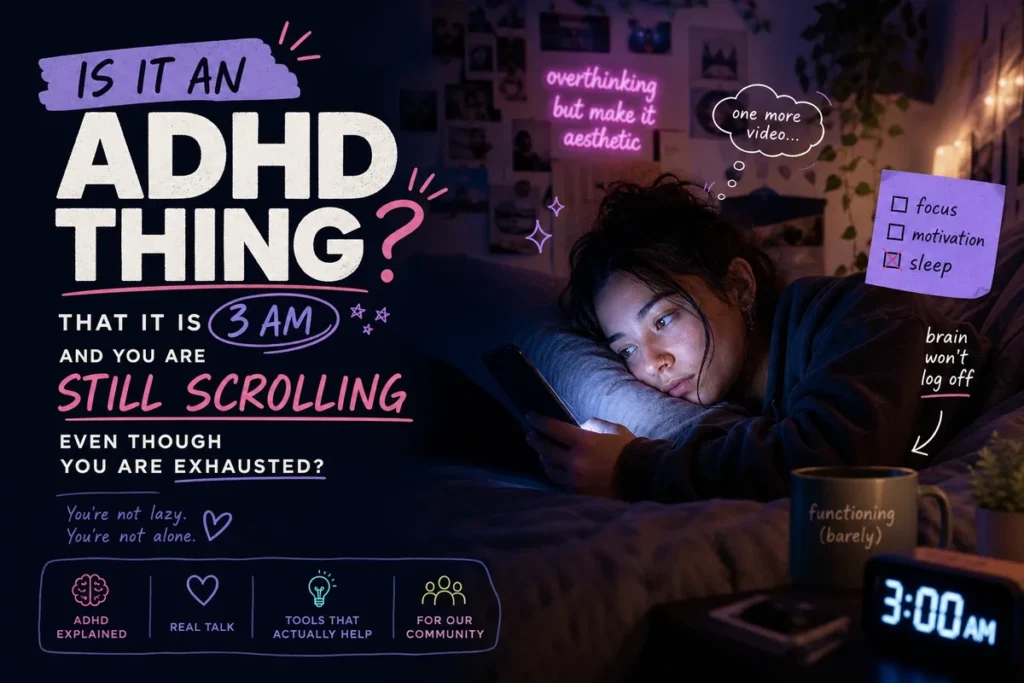
It is 3 AM. Your eyes burn. Your body is heavy in a way that feels almost painful. You have work in five hours, or class, or something that requires you to function like a person. You know you need to sleep. You have known for hours. And yet your thumb keeps moving. Another video. Another scroll. Another article you will not remember reading. You are exhausted in a way that should make sleep inevitable, but instead you are watching your seventeenth YouTube video about a topic you did not care about at 11 PM and somehow still do not care about now. You are not even enjoying this. You just cannot stop.
Yes, this is an ADHD thing. It is called revenge bedtime procrastination combined with dopamine-seeking behavior, and it happens because your ADHD brain has not received a stop signal. Exhaustion alone is not enough to override the nervous system's demand for stimulation.
Why ADHD Doomscrolling at Night Feels Impossible to Stop
Here is what neurotypical advice assumes: that tiredness is a signal your brain will act on. That when your body says "enough," your brain will comply. That fatigue creates an automatic pathway to sleep. For the ADHD brain, this assumption is wrong.
The ADHD brain has a dysregulated dopamine system. Dopamine is not just the "reward" chemical. It is the chemical that allows you to shift between activities, to feel satisfied with stopping, to register that you have had enough of something. When dopamine signaling is impaired, your brain cannot generate the internal cue that says "this scroll session is complete."
So you keep scrolling. Not because you want to. Not because the content is compelling. Because your brain has not received the neurochemical signal that says "done."
This is why ADHD doomscrolling at night feels qualitatively different from simply staying up late because you are having fun. You are not having fun. You know you are not having fun. You are watching something you do not care about while your body screams for rest, and you cannot make yourself stop.
The Revenge Bedtime Procrastination Component
There is another layer to this. It is called revenge bedtime procrastination, and it is particularly common in people with ADHD.
Revenge bedtime procrastination is the phenomenon of delaying sleep to reclaim a sense of control over your own time. If your entire day has been spent meeting external demands, doing things you had to do rather than things you wanted to do, and managing the constant friction of an ADHD brain in a neurotypical world, then nighttime becomes the only window that feels like yours.
The logic is not conscious. It is not "I am going to sacrifice sleep to rebel against my schedule." It is more like a deep resistance to ending the day, because ending the day means starting tomorrow, and tomorrow is just another day of the same exhausting struggle.
Going to bed late even when you are exhausted, then being mad at yourself the next morning. This cycle is not a character flaw. It is the collision of dopamine dysregulation and a nervous system that has not had enough input that feels self-directed.
The revenge is not against sleep itself. It is against the relentless forward march of time that keeps pulling you into obligations you did not choose. Scrolling at 3 AM is a form of standing still. It is refusing, just for a few more hours, to surrender today.
Why Exhaustion Does Not Create a Stop Signal
In a neurotypical brain, physical tiredness creates what researchers call a homeostatic sleep drive. The longer you are awake, the stronger the pressure to sleep becomes, until it overwhelms everything else. This system works in the ADHD brain too. The problem is that it is competing with something else.
The ADHD brain is chronically understimulated. Not under-entertained. Understimulated at a neurochemical level. The baseline dopamine activity is lower, which means the brain is constantly scanning for sources of stimulation to bring it up to normal operating levels.
Your phone is an extremely efficient dopamine delivery device. The variable reward schedule of social media (will this scroll reveal something interesting? maybe this video will be the one), the novelty of constantly changing content, the low-effort high-variety nature of scrolling: all of it is precisely calibrated to what the ADHD brain craves.
So you have two competing drives: the homeostatic sleep pressure saying "you need rest" and the dopamine-seeking drive saying "you need stimulation." In a neurotypical brain, sleep pressure wins. In the ADHD brain, dopamine-seeking often overrides it, because the understimulated brain experiences the absence of stimulation as a kind of pain.
The stuck feeling: This is why you can lie there, phone in hand, eyes burning, genuinely not wanting to keep scrolling, and still not stop. It is not that you lack willpower. It is that your brain is receiving conflicting signals and the one that usually loses (tiredness) keeps losing.
The ADHD Sleep Problems Phone Connection
ADHD sleep problems are well-documented in research. People with ADHD are significantly more likely to have delayed sleep phase syndrome (a shifted circadian rhythm that makes falling asleep at conventional times difficult), to take longer to fall asleep once in bed, and to have lower sleep quality overall.
What research is now exploring is how the phone specifically interacts with these existing vulnerabilities. The blue light suppressing melatonin is real but probably not the main issue. The main issue is that the phone provides exactly the kind of stimulation the ADHD brain cannot generate internally.
When you put the phone down, you are left alone with your thoughts. For an ADHD brain, especially one that is also tired, "alone with your thoughts" often means a carousel of random anxieties, unfinished tasks, awkward moments from years ago, and an inability to control what the brain decides to surface. The phone is a buffer against that. Scrolling is not relaxing, but it is better than the alternative.
Hours go by before you even realize it. It is like being stuck in place. You are not doing anything anymore. You are not creating, not enjoying the things you used to love. You have tried to break out of it. You really have.
This is the cycle: you scroll because putting the phone down feels worse than keeping it. You know you need to sleep. You keep scrolling. Hours pass. You finally crash from sheer exhaustion, sleep poorly, wake up tired, drag through the day, and by night your brain is so desperate for something that feels like self-directed time that the cycle starts again.
Why Standard Sleep Advice Fails for ADHD
Standard sleep hygiene advice was not designed for brains that cannot generate internal stop signals. "Put your phone away an hour before bed" assumes that putting the phone away is a simple action. For the ADHD brain, it is not. There is no internal mechanism that makes "enough scrolling" feel satisfying. You either scroll until you physically cannot anymore, or you use external structure to intervene.
"Wind down with a relaxing activity" assumes that your brain will accept a lower-stimulation activity as a substitute. But reading a book, taking a bath, or doing gentle stretching does not deliver the dopamine hits that scrolling does. The ADHD brain often experiences these activities as boring, which creates its own kind of restlessness that makes sleep harder, not easier.
"Just go to bed when you are tired" assumes that tiredness creates action. In ADHD, tiredness creates the desire for action but not the ability to execute it. You can be exhausted and completely unable to initiate the sequence of behaviors that results in being asleep.
This is why people with ADHD often describe the experience of scrolling at 3 AM as being "trapped" rather than choosing. You are not choosing to stay up. You are stuck in a loop that your brain cannot exit without external help.
What Actually Helps with ADHD Doomscrolling at Night
The goal is not to eliminate the brain's need for stimulation. That need is real and it is not going away. The goal is to work with the brain's requirements while still moving toward sleep.
External stop signals work better than willpower. Setting a timer or alarm that goes off at a specific time creates an external event that can interrupt the scroll loop. The alarm is not asking you to decide to stop. It is creating a break in the pattern that gives you a chance to choose differently. Some people find it helpful to put the phone in another room when the alarm rings, because the physical act of getting up can disrupt the stuck feeling.
Switching to audio content can help. If your brain needs input to calm down, a podcast or audiobook lets you close your eyes while still receiving stimulation. The content is linear (no choices about what to scroll to next), which reduces the dopamine-seeking behavior, and having your eyes closed removes one of the arousal signals that keeps you awake.
Name the avoidance: Sometimes the most powerful intervention is simply saying out loud what you are actually avoiding. Not "I should go to sleep" but "I do not want tomorrow to start" or "I do not want to be alone with my thoughts." Naming the real resistance can create just enough self-awareness to shift the pattern.
Addressing the revenge component matters too. If nighttime scrolling is partly about reclaiming time that feels like yours, the solution is not to eliminate that time but to protect it earlier. Even fifteen minutes during the day that is genuinely self-directed, not obligated, not productive, can reduce the pressure to steal hours from sleep.
Medication timing can be relevant. Some people find that stimulant medication taken too late in the day makes sleep harder. Others find that the regulation provided by medication actually helps them transition to sleep more easily. This is worth discussing with a prescriber, because the relationship between ADHD medication and sleep is individual.
The Reframe: This Is a Signal, Not a Failure
Lying in bed at 3 AM, exhausted and still scrolling, is not evidence that you lack discipline or do not want to take care of yourself. It is evidence that your brain is struggling to generate stop signals and is searching for stimulation it cannot produce internally.
The shame spiral makes it worse. Telling yourself you are "so stupid" for staying up late, being "mad at yourself the next morning," treating this as a personal failing: none of that gives your brain the regulation it needs. It just adds emotional dysregulation on top of sleep deprivation.
What helps is understanding the mechanism and then building external supports around it. Not because you are broken, but because your brain has specific requirements that differ from the default assumptions about how humans transition to sleep.
The 3 AM scroll is a symptom of an understimulated brain trying to meet its own needs in the only way it knows how. When you stop fighting that need and start working with it, redirecting it toward lower-activation inputs, creating external interrupts, protecting self-directed time earlier in the day, the pattern can shift. Not through willpower. Through structure that respects how your particular brain actually works.
Rate this article
Was this a useful hit?