Is It an ADHD Thing That You Will Do Anything to Avoid Making a Phone Call?

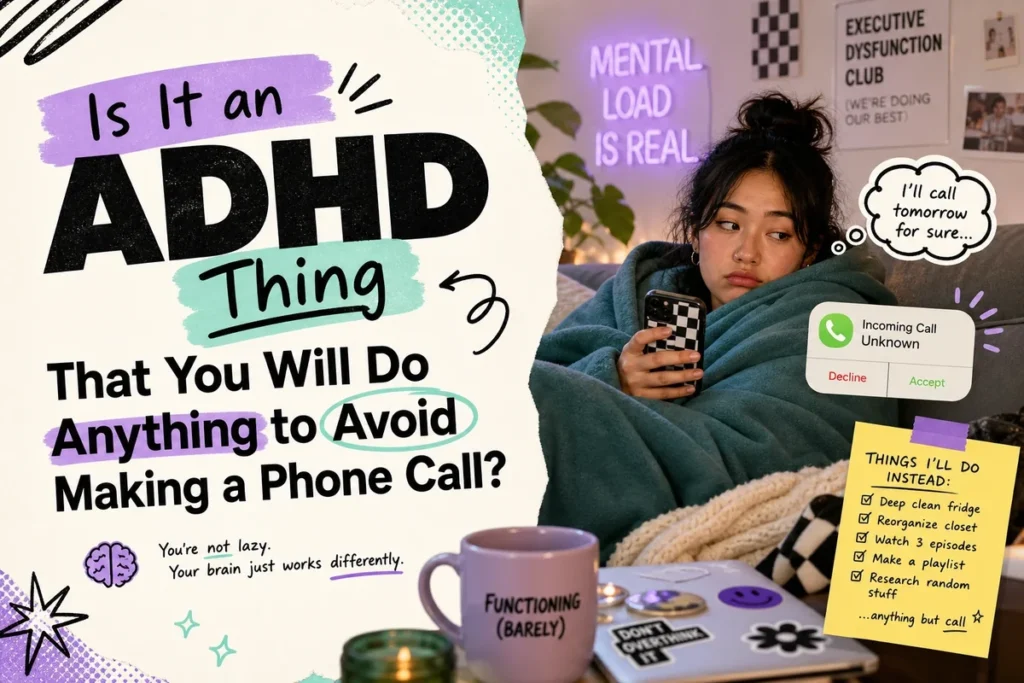
The prescription is ready. You got the text three days ago. You need to call the pharmacy to confirm your insurance information before they can release it. The pharmacy's phone number is right there in the text. You have opened that text eleven times. You have typed the number into your keypad twice. You have not pressed call.
Instead, you have reorganised your entire kitchen, responded to 47 text messages, researched the history of your prescription medication, and convinced yourself that maybe you don't really need that medication anyway. You'll text your doctor. You'll use the app. You'll walk into the pharmacy in person and wait in line for twenty minutes because somehow that feels easier than a ninety-second phone call.
Yes, this is absolutely an ADHD thing. It's called task initiation deficit combined with real-time processing demands, and it creates a perfect storm that turns phone calls into one of the most cognitively expensive tasks in your day.
Why ADHD Phone Call Anxiety Feels Different From Social Anxiety
Here's what people get wrong: they assume you're scared of talking to people. They tell you to "just relax" or remind you that the person on the other end doesn't care about your awkward pauses. That advice misses the point entirely.
You're not scared of the person. You're overwhelmed by the format.
Phone calls are unscripted, unpredictable, and happen in real time with zero visual feedback. For a brain that already struggles with executive function, that's not a minor inconvenience. That's a cognitive triathlon with no training.
Social anxiety says: "They'll judge me." ADHD phone avoidance says: "I can't predict what they'll say, I won't be able to think fast enough, I'll forget why I called, and I can't even picture their face while we talk." These are completely different experiences, and they require completely different solutions.
The issue isn't that you're afraid of human interaction. It's that phone calls strip away every accommodation your brain relies on to function in conversations.
The Real-Time Processing Problem
In a text conversation, you can read a message, get distracted, make a cup of tea, come back, re-read the message, think about your response, type it, delete it, retype it, and send it when you're ready. The other person has no idea that your response took nine minutes because you remembered you needed to check if you'd paid your electricity bill.
Phone calls don't work that way.
Someone speaks. You have approximately 1.5 seconds to process what they said, formulate a coherent response, and deliver it out loud. If your working memory glitches (which it does, constantly, because ADHD), you're left with dead air. You can't scroll up to see what they just said. You can't re-read the context. The moment is gone.
Research on attention and real-time communication shows that ADHD brains often struggle with what researchers call "multicommunicating": managing overlapping synchronous conversations that require immediate responses. Phone calls are the purest form of this. You have to listen, process, remember, formulate, and speak simultaneously. For a brain with attention regulation challenges, that's not a conversation. That's juggling while someone throws more balls at you.
ADHD Phone Avoidance and the Missing Visual Cues
Here's something neurotypical people take for granted: when you talk to someone face-to-face, you can see them thinking. You can see them pause. You can see confusion flicker across their face before they ask a clarifying question. You can see them nodding, which tells you to keep talking, or shifting their weight, which tells you to wrap it up.
ADHD brains are often hypervigilant about social cues because we've learned we miss things. We compensate by watching carefully. We read rooms. We adjust in real time based on what we observe.
Take away visual cues, and we're flying blind.
On a phone call, you can't tell if the silence means they're thinking or they're confused or you've accidentally offended them or the call dropped. You can't tell if they're nodding along or checking their email. You can't tell if you're talking too fast or too slow or too much. Every conversation becomes a guessing game, and your brain has to work twice as hard to fill in information that would be automatic in person.
The ADHD paradox: You might actually prefer a 45-minute in-person meeting over a 5-minute phone call. It's not about time. It's about cognitive load.
Why the Call Itself Isn't the Hard Part
If someone handed you a phone mid-call and said "here, talk to this person about your insurance," you'd probably manage it. Awkwardly, maybe. With some verbal stumbling. But you'd get through it.
The problem isn't the call. The problem is starting the call.
Task initiation deficit means your brain struggles to shift from "not doing the thing" to "doing the thing." Phone calls are uniquely terrible for this because they require multiple sub-tasks before you even dial: finding the number, knowing what you'll say, anticipating questions, having relevant information ready, choosing a quiet space, ensuring you have enough time.
Each sub-task is a micro-decision. Each micro-decision is an opportunity for your brain to glitch, distract, or simply refuse. By the time you've figured out where you put the account number they'll probably ask for, you've lost the momentum to actually dial.
This is why you'll let a prescription sit at the pharmacy for a week but respond to texts within seconds. Texts have no initiation cost. Phone calls have dozens.
ADHD Task Initiation and Phone Calls: The Dopamine Calculation
Your brain runs on a dopamine economy. It constantly calculates: how much effort will this take versus how much reward will it produce? For neurotypical brains, "making a quick phone call" scores as low effort, moderate reward. They just do it.
For ADHD brains, that calculation is broken.
The effort feels enormous because of everything we've discussed: real-time processing, no visual cues, task initiation friction, unpredictability. The reward feels tiny because the outcome is abstract and delayed. You don't get your medication until you go to the pharmacy. The dopamine hit is multiple steps removed from the action.
Compare this to responding to a text: minimal effort, immediate completion, conversation archived and done. The dopamine equation is completely different.
Studies on ADHD and problematic phone use have found that individuals with attention regulation challenges often show different patterns of media engagement, preferring formats that offer immediate feedback and controllable pacing over synchronous communication that demands instant responses. You're not lazy. Your brain is doing math, and phone calls keep coming up as a bad investment.
You will spend two hours researching the best way to phrase a thirty-second voicemail, then decide to call back later. This is not avoidance. This is your brain trying to reduce uncertainty to a manageable level.
Why "Just Do It" Makes Things Worse
The standard productivity advice for phone avoidance is to "eat the frog": do the hard thing first, get it over with, and enjoy the relief. This advice assumes the hard thing will feel easier once you've started.
For ADHD brains, that's often not true.
The relief of finishing a dreaded phone call is real, but it doesn't generate momentum for the next one. Each call is its own separate executive function challenge. You don't build phone call muscles. You don't desensitise. You just deplete your cognitive resources and have less available for the rest of the day.
What's worse, forcing yourself through calls by sheer willpower often backfires. You forget what you wanted to say. You get flustered. You hang up without the information you needed. This creates a negative association that makes the next call even harder to initiate. The frog multiplies.
Worth knowing: Phone call anxiety in ADHD often increases after late discovery. Once you understand why calls are hard, you become more aware of the cognitive load, which can temporarily make it feel worse. This is normal. Awareness is the first step toward building better systems.
What Actually Helps With ADHD Telephobia
The goal isn't to become someone who loves phone calls. The goal is to reduce the cognitive cost enough that your brain stops treating calls as threats.
Script the first sentence. Not the whole call. Just the opening line. "Hi, I'm calling about my prescription, my date of birth is..." That's it. Having one scripted sentence gives your brain a foothold. You know exactly how to start, which removes the biggest initiation barrier.
Use body doubling. Make the call while someone else is in the room, even if they're doing something completely unrelated. Their presence creates a subtle accountability structure that can push you past the initiation threshold. This works even if they don't know you're struggling.
Batch calls with something rewarding. Call the pharmacy while walking to get coffee. Call your insurance while waiting for a friend. Pairing the call with movement or a secondary reward changes the dopamine equation.
Give yourself permission to be awkward. Say "let me find that information" and actually take time to find it. Say "sorry, could you repeat that?" as many times as you need. The other person doesn't care. They've heard worse. Removing the pressure to perform perfectly reduces the cognitive load of the call.
Consider alternatives, but be honest about them. If the pharmacy has an app, use it. If you can schedule a callback instead of calling, do that. But if avoidance strategies mean you never get your prescription, they're not helping you. The goal is function, not comfort.
The Phone Call Isn't the Problem
ADHD phone call anxiety is one of those experiences that makes perfect sense once you understand it, but sounds completely irrational when you try to explain it to someone without ADHD. "You can text for hours but you can't make a two-minute call?" Yes. Those are fundamentally different tasks.
The phone call isn't the problem. The problem is a communication format that requires real-time processing, instant verbal responses, sustained attention without visual cues, and task initiation with no external trigger. For ADHD brains, that's not a phone call. That's a final exam you didn't study for, administered randomly, with no chance to review your answers.
Your pharmacy prescription is still sitting there. Here's what's going to get it done: write down one sentence you'll say when they answer. "Hi, my name is [name], I'm calling about a prescription." Put your phone in your hand. Set a two-minute timer. Call before it ends. The constraint creates urgency your brain can actually work with. After the call, the relief will be real, even if the next call will be just as hard. That's not a failure. That's just how this works.
Rate this article
Was this a useful hit?