Is It an ADHD Thing That Certain Background Noise Helps You Focus While Other Sounds Make You Want to Scream?

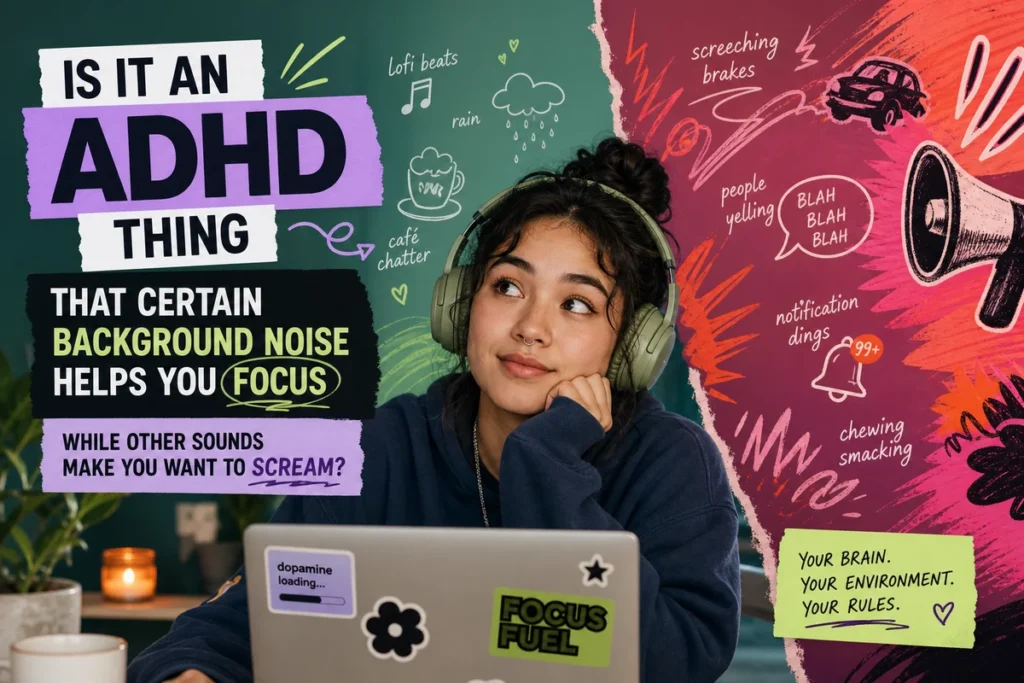
You're sitting in a coffee shop, and the ambient noise of espresso machines, distant chatter, and clinking cups creates a cocoon around your brain. You're finally writing. Words are flowing. For once, your thoughts aren't scattering in twelve directions. Then you get home, where it's quiet, and you can't string two sentences together. The silence is somehow louder than the coffee shop ever was.
Or the reverse happens. You're trying to work at home, and your partner starts watching a show in the other room. Not loudly. Just audible enough that you can almost make out the dialogue. And suddenly you want to crawl out of your own skin. You put in headphones. You play rain sounds. The relief is immediate, like your nervous system finally unclenched. Meanwhile, your neurotypical coworker works happily with the office TV on in the background, and you wonder why you're like this.
Yes, this is an ADHD thing. It's called stochastic resonance combined with semantic filtering deficits, and it explains the maddening paradox of ADHD background noise focus: certain sounds help you concentrate while others make you want to scream, and the difference has nothing to do with volume.
The ADHD Background Noise Focus Paradox Explained
Your brain has a problem that sounds counterintuitive: it's under-stimulated. The ADHD prefrontal cortex, responsible for focus, impulse control, and filtering irrelevant input, runs on lower baseline dopamine than neurotypical brains. This creates a constant, low-grade restlessness. Your attention system is perpetually scanning for something, anything, to engage with.
Enter background noise. The right kind of noise occupies your distraction-seeking circuitry just enough to stop it from hijacking your focus. Researchers call this stochastic resonance: the phenomenon where a small amount of random noise actually improves signal detection in a system.1 For ADHD brains, consistent background sound acts like a placeholder. It satisfies the part of your brain that needs stimulation without demanding cognitive resources.
But not all noise works. The ADHD auditory system has a specific vulnerability: it struggles to filter semantic content. Speech, recognizable words, narrative audio, these all activate language processing regions that compete directly with whatever task you're trying to do. Your brain can't help but try to decode meaning. This is why you can work in a crowded café where the conversations blur into indistinct murmur, but you cannot function when someone's playing a podcast two rooms away.
Why the Coffee Shop Works But Your Living Room Doesn't
Coffee shop noise has three qualities that make it ADHD-compatible. First, it's consistent: the general hum stays at a relatively stable level without sudden spikes. Second, it's non-semantic: individual conversations blend into acoustic texture rather than discernible words. Third, it's predictable in its unpredictability. The variation exists, but it follows a pattern your brain can anticipate and ignore.
Your living room, by contrast, is a minefield. A ticking clock. The refrigerator humming and stopping. A car passing outside. Your upstairs neighbor's footsteps. Each sound is discrete, unpredictable, and separated by silence. Your attention system can't settle because it's constantly being pinged by novel input. The silence itself becomes a texture your brain keeps monitoring, waiting for the next interruption.
This is why "just work somewhere quiet" fails as advice. Quiet environments require your ADHD brain to generate its own stimulation, which usually means thoughts wandering to more interesting places than your spreadsheet. The absence of external input doesn't create focus. It creates a vacuum that your attention happily fills with internal distraction.
The Specific Sounds That Hijack ADHD Attention
Understanding ADHD auditory sensitivity means understanding what makes a sound cognitively intrusive versus cognitively supportive. Three factors determine whether a noise helps or harms your focus.
Semantic content: Can your brain extract meaning from the sound? Speech is the worst offender, especially in a language you understand. Song lyrics activate the same problem, which is why instrumental music works for many ADHDers while vocal tracks destroy concentration. Your language processing system doesn't have an off switch. If words are present, your brain will try to decode them.
Predictability: Does the sound follow a pattern? Repetitive, consistent noise becomes invisible to your attention system. Unpredictable noise demands constant reorientation. This is why chewing, keyboard clicking, or pen tapping drives you to fury while a running fan or steady rain is soothing. The irregular timing of human-generated sounds keeps triggering your novelty detection system.
Emotional salience: Does the sound carry emotional weight? A baby crying, a siren, angry voices, these sounds evolved to demand attention. Your ADHD brain, already bad at filtering, has zero chance of ignoring stimuli tagged as emotionally significant. This extends to sounds that have acquired personal meaning: your specific notification tone, a song associated with a memory, your own name spoken across a room.
The ADHD auditory experience isn't about being picky or difficult. It's about having an attention filter that operates on different rules, letting through sounds that neurotypical filters block automatically.
ADHD White Noise and Brown Noise: Why They Work
White noise, brown noise, pink noise: these terms describe different frequencies of consistent background sound. White noise contains all frequencies at equal intensity. Brown noise emphasizes lower frequencies. Pink noise falls between them. For ADHD, the specific color matters less than the consistency.
These sounds work because they're maximally predictable and minimally semantic. There's no meaning to extract, no pattern to track, no variation to anticipate. They occupy your auditory processing channel with static that requires zero cognitive engagement, freeing your prefrontal cortex to actually do its job.
Research supports this. A 2007 study found that white noise improved cognitive performance in children with attention deficits while slightly impairing neurotypical children.2 The interpretation: ADHD brains need more stimulation to reach optimal arousal, and white noise provides exactly that without demanding attention.
Lo-fi beats, ambient music, and nature sounds work through similar mechanisms. They provide consistent, predictable audio texture with minimal semantic content. The slight variations in instrumental music or birdsong add enough interest to prevent habituation without demanding active processing.
Finding your frequency: Not all consistent noise works equally for everyone. Some ADHDers focus best with brown noise. Others need rain sounds or café ambiance. The common thread is predictability and lack of speech. Experiment to find your specific audio environment, then protect it fiercely.
ADHD Sensory Processing Noise: When Sounds Become Unbearable
The flip side of needing background noise is being tortured by the wrong sounds. ADHD sensory processing differences mean certain noises become overwhelming in a way that feels disproportionate to the actual volume or significance. This isn't being dramatic. It's your nervous system responding to input it cannot filter.
Misophonia, the intense emotional reaction to specific trigger sounds like chewing or breathing, overlaps significantly with ADHD.3 The sounds that trigger misophonic responses are typically repetitive, human-generated, and unpredictable in their specific timing. They share exactly the features that ADHD filtering systems struggle with most.
The emotional intensity of these reactions often surprises ADHDers themselves. You know, rationally, that your coworker's keyboard clicking is not a personal attack. You know the sound isn't actually that loud. And yet your entire body tenses, your thoughts derail, and you feel a rage that seems unhinged given the stimulus. This is your attention system in overwhelm, not a character flaw.
ADHD auditory sensitivity extends beyond misophonia triggers to general sound environments. Open offices, restaurants, family gatherings: any space where multiple sound sources compete becomes exhausting because your brain can't select which input to prioritize. You're processing everything at once, at equal intensity, with no automatic filtering to reduce the load.
Why Standard Noise Advice Fails for ADHD
Neurotypical advice about noise and focus assumes an attention system that operates on different principles. "Just tune it out" presumes filtering capacity you don't have. "Work in silence" ignores your need for baseline stimulation. "Wear earplugs" removes all sound, leaving you alone with an understimulated brain that will manufacture its own distractions.
Even well-meaning accommodations miss the point. Noise-canceling headphones alone don't solve the problem. They remove intrusive sound, but they create silence, which ADHD brains experience as its own form of distraction. The solution isn't removing noise. It's replacing uncontrolled noise with controlled noise that occupies your auditory channel without hijacking your attention.
The other failure is treating this as a preference rather than a neurological requirement. Asking for a specific audio environment isn't being high-maintenance. It's recognizing that your brain has different input requirements than neurotypical brains. A quiet library might be perfect for someone whose attention system self-regulates. For you, that same silence might be torture.
ADHD background noise focus isn't about finding the perfect environment. It's about understanding that you require active sound management, and building systems that provide the auditory input your brain needs to function.
Building Your Sound Environment: What Actually Helps
Start by auditing your problem sounds. What specific noises derail you? Write them down. You'll likely notice patterns: unpredictable timing, semantic content, emotional salience. Understanding your triggers helps you anticipate and manage them before they destroy your focus.
Create a portable audio environment. Headphones plus a consistent background sound, whether brown noise, lo-fi beats, or ambient soundscapes, gives you control regardless of physical location. This is armor against unpredictable noise. Build a playlist or find apps that generate exactly the sound profile your brain needs.
Layer your defenses. In environments where intrusive sound is unavoidable, noise-canceling headphones plus controlled background audio plus physical distance creates multiple barriers. You're not eliminating external noise entirely. You're drowning it in noise you control.
Communicate your needs specifically. "I need quiet to work" invites misunderstanding. "I need to control my audio environment because unpredictable sounds hijack my attention" explains the actual requirement. People are more accommodating when they understand the mechanism rather than perceiving arbitrary demands.
The silence trap: If you find yourself unable to focus in complete silence, you're not failing at concentration. You're experiencing exactly what happens when an ADHD brain has insufficient external input. Add consistent background sound before assuming the problem is willpower.
The Deeper Pattern: ADHD Brains Need Managed Input
The ADHD background noise focus paradox points to a broader truth about ADHD neurology. Your brain doesn't self-regulate its arousal and attention automatically. It needs external input, but it can't filter that input effectively. The result is constant negotiation between understimulation and overwhelm.
Sound is just one domain where this plays out. Light, temperature, physical sensation: ADHD sensory processing affects multiple input channels. The same principles apply. You need enough stimulation to prevent distraction-seeking, but not so much that your filtering systems become overwhelmed. You require control over your environment that neurotypical people can take for granted.
This isn't about being sensitive or difficult. It's about having a nervous system that operates on different parameters. The coffee shop helps because it provides stimulation without demanding attention. The ticking clock hurts because it demands attention without providing useful stimulation. Your job is learning which inputs fall into which category for your specific brain.
The practical takeaway: stop trying to force yourself into environments that work against your neurology. The right background noise isn't a luxury or a quirky preference. For ADHD, controlled audio input is a genuine tool for cognitive function. Build your sound environment deliberately, protect it fiercely, and stop apologizing for needing what your brain needs to work.
Rate this article
Was this a useful hit?