Is It an ADHD Thing That Something Someone Said in 2019 Hits You Like a Truck at 2 AM?

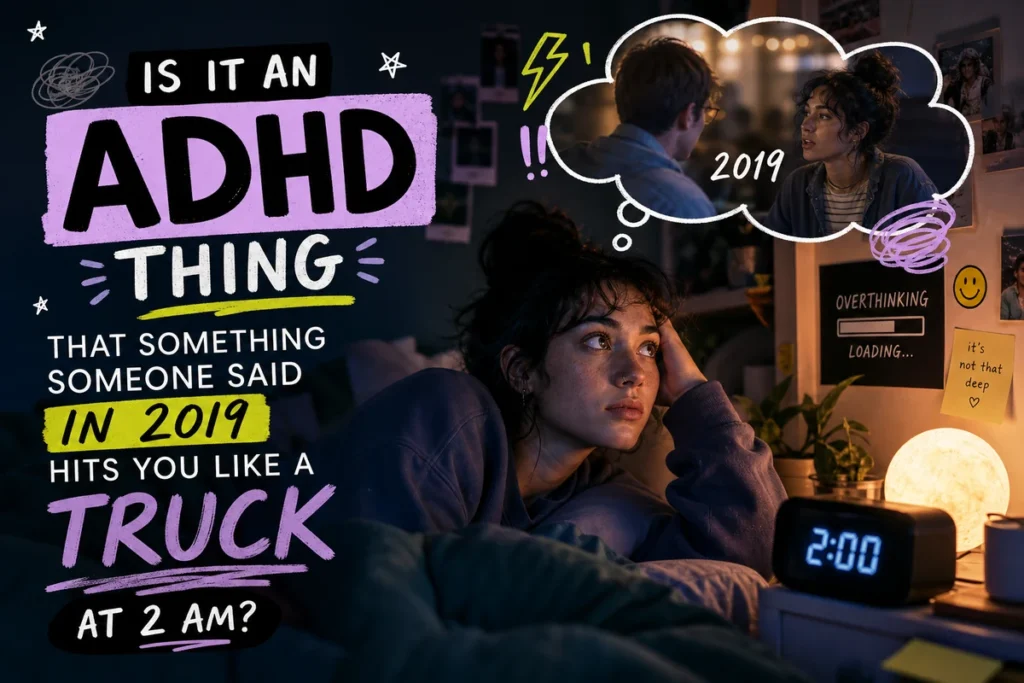
You're lying in bed. The room is dark. You're tired, but sleep isn't coming. And then, out of nowhere, your coworker's face from three jobs ago appears in your mind. You hear her voice, clear as if she's standing next to you: "Oh, I didn't realise you were invited to this meeting." She said it casually. She probably forgot it five minutes later. That was 2019. It is now 2 AM and your chest is tight, your face is hot, and you're composing the perfect comeback you'll never deliver. Or maybe it's your aunt at Christmas dinner in 2017, the way she said "interesting choice" about your career. Or your friend who paused just a beat too long before saying your haircut looked "different." The comment itself was nothing. A throwaway line. But right now, in the dark, it feels like evidence of something terrible about you that everyone can see.
Yes, this is an ADHD thing. What you're experiencing is ADHD rejection sensitive dysphoria meeting delayed emotional processing, compounded by your brain's tendency to treat emotional memories as if they're happening right now.
Understanding ADHD Rejection Sensitive Dysphoria
ADHD rejection sensitive dysphoria, often abbreviated as RSD, describes the intense emotional pain that occurs in response to perceived rejection, criticism, or failure. The key word is "perceived." The rejection doesn't need to be real. It doesn't need to be intended. Your nervous system responds to the possibility of rejection with the same intensity as confirmed, deliberate cruelty.
Dr. William Dodson, who coined the term, estimates that rejection sensitive dysphoria affects the majority of people with ADHD. The emotional response is neurological, not psychological. This isn't about being "too sensitive" or needing thicker skin. Your brain processes social and emotional information differently, and it does so with an intensity that neurotypical brains don't experience.
The "dysphoria" part matters. This isn't sadness or disappointment. Dysphoria is a physical state of unease, a full-body discomfort that feels unbearable. When RSD activates, your chest might tighten. Your stomach might drop. You might feel a sudden urge to escape, to hide, to disappear. Some people describe it as feeling like they've been punched. Others say it's closer to a sudden grief, like something died.
ADHD rejection sensitive dysphoria doesn't respond to logic. You can know the comment meant nothing and still feel devastated by it.
Why Old Comments Surface at 2 AM
During the day, your ADHD brain is busy. It's processing the meeting that just happened, the email you need to send, the conversation across the office, the notification on your phone, the hunger you haven't addressed, the song stuck in your head. Your working memory is full. There's no room for a random comment from 2019.
But at 2 AM, the input stops. The room is dark. The phone is silent. Your brain, which has been running on external stimulation all day, suddenly has nothing to process. So it starts pulling files from storage. And because ADHD brains struggle with time perception and emotional regulation, those old files don't feel old. They feel current.
Research on ADHD and emotional memory suggests that the prefrontal cortex, which normally helps regulate emotional responses and provide context (like "this was years ago and doesn't matter"), is underactive in ADHD. Meanwhile, the amygdala, which processes emotional significance and threat, remains highly responsive. The result is emotional memory without temporal context. Your brain doesn't experience the 2019 comment as a memory. It experiences it as information that needs processing right now.
The Timestamp Problem: Your ADHD brain stores emotional pain without clear timestamps. A comment from 2019 can feel as fresh as something said yesterday because your nervous system filed it under "unresolved threat" rather than "past event."
The ADHD Rumination Loop
ADHD rumination works differently than typical rumination. In neurotypical rumination, people often think through problems in a somewhat logical way, even if they're stuck. ADHD rumination tends to be more emotionally driven and less linear. You're not thinking through the situation. You're reliving it. Your brain is running the scene on repeat, each time with the same emotional intensity, searching for something it can never find: a way to make the rejection un-happen.
The 2 AM timing makes this worse. Your executive functions, already compromised by ADHD, are even weaker when you're tired. The part of your brain that could normally step in and say "this doesn't matter, go to sleep" is offline. What remains is raw emotional processing with no regulation.
You might find yourself composing the perfect response, the thing you wish you had said. You might analyse the other person's tone, facial expression, word choice, trying to determine their true intent. You might review your own behaviour leading up to the comment, looking for what you did wrong. This feels productive. It feels like you're solving something. But you're not. You're just feeding the loop.
Why Standard Advice Fails
"Just let it go." "Don't take things so personally." "That was years ago, why are you still thinking about it?" These responses assume you have a choice. They assume that emotional regulation is simply a matter of deciding to feel differently. For ADHD brains dealing with rejection sensitive dysphoria, this is like telling someone with a broken leg to just walk normally.
Standard sleep advice also misses the mark. "Clear your mind." "Think peaceful thoughts." "Focus on your breathing." These techniques work when the problem is general restlessness. They don't work when your brain has decided that a 2019 comment is an emergency that requires immediate attention. You can't clear your mind when your amygdala is sounding alarms.
Even therapy approaches that work well for other forms of rumination, like cognitive restructuring, hit a wall with RSD. You can cognitively understand that the comment didn't mean anything. You can list evidence that the person likes you. You can recognise that your interpretation is probably wrong. And your body will still feel like you've been betrayed.
RSD late at night isn't about willpower or perspective. It's about a nervous system that processes rejection as physical threat.
The ADHD Emotional Memory Archive
People with ADHD often describe having an extensive mental archive of every social mistake, awkward moment, and perceived rejection they've ever experienced. This isn't melodrama. ADHD emotional memory tends to be sticky in specific ways: negative emotional experiences are stored with high fidelity and can be recalled in vivid detail, while the context that would soften them (like knowing the other person was having a bad day, or that the relationship remained fine afterward) doesn't get stored with the same strength.
This means your brain has perfect recall of the comment, the tone, the facial expression. But it has fuzzy recall of the fact that this coworker later invited you to her wedding, or that your aunt called the next week to say she was proud of you. The negative moment is preserved in high definition. The resolution is compressed into nothing.
At 2 AM, your brain accesses these high-definition files. And because it doesn't have the context files to go with them, it interprets the emotion as current and valid. The pain is real. The conclusion your brain draws from the pain (that this comment reveals something true and terrible about your worth) is what's distorted.
What Actually Helps With ADHD Rejection Sensitive Dysphoria
First, recognise what's happening. Name it: "This is RSD. This is a 2019 memory that feels current because my brain doesn't timestamp emotional pain properly." This naming activates your prefrontal cortex and creates a small amount of distance between you and the experience. You're not making the pain go away. You're creating a sliver of space where your observing mind can exist alongside the experiencing mind.
Second, change your physical state. RSD at 2 AM is partly a body experience. Your nervous system is in a threat state. Lying in the dark, horizontal, gives your brain the message that it's safe to process old pain. Interrupting the physical pattern can interrupt the mental one. Turn on a light. Sit up. Put your feet on the floor. Get a glass of water. You're not solving the emotional problem. You're telling your body that this is not actually an emergency.
Third, give your brain the closure it's looking for. ADHD rumination often continues because the brain is searching for resolution that never happened. Write down the comment. Write what you wish you had said. Write what you know now that you didn't know then. This isn't about crafting the perfect comeback. It's about giving your brain a sense of completion so it can stop replaying the scene.
The Morning Test: If something feels devastating at 2 AM, commit to revisiting it at 10 AM. Your prefrontal cortex will be back online, and the emotional intensity will likely be reduced by 80%. Most 2 AM emergencies are filing errors, not actual crises.
The Longer Game
RSD late at night ADHD patterns can be reduced, though rarely eliminated entirely. Some people find that medication helps, particularly alpha-agonists like guanfacine or clonidine, which can reduce the intensity of the emotional response. Others find that regular exercise, consistent sleep schedules, and reduced alcohol intake (which disrupts sleep architecture and emotional regulation) make nighttime rumination less frequent.
Building an explicit "context archive" can help over time. When something good happens in a relationship, write it down. When you receive positive feedback, save it somewhere accessible. This creates evidence files that your brain can access alongside the painful memories. It won't eliminate RSD, but it can provide counterweight.
Some people find it helpful to do a brief "emotional processing" session during the day, giving their brain dedicated time to review unprocessed social experiences. If your brain knows it will get time to analyse the day's interactions, it may be less likely to ambush you at 2 AM. This isn't guaranteed, but for some ADHD brains, scheduled worry time reduces unscheduled worry.
Living With the Archive
You will probably always have a brain that stores social pain vividly and retrieves it at inconvenient times. This is part of how your nervous system works. The goal isn't to become someone who doesn't feel rejection deeply, because that's not available to you. The goal is to recognise what's happening when it happens, to have strategies that interrupt the worst of the spirals, and to stop treating your 2 AM emotional responses as evidence about your worth.
That comment from 2019 is data about a moment. It is not data about who you are. Your brain's insistence on replaying it says something about ADHD emotional memory. It says nothing about whether you deserved the comment or what it meant. When you're lying in the dark and your nervous system serves up evidence from years ago that you're fundamentally flawed, remember that you're experiencing ADHD rejection sensitive dysphoria. Your brain is processing a file without a timestamp. The pain is real. The conclusion is a filing error.
Rate this article
Was this a useful hit?